
Oil at $200, Rates at 12%: The Saturday That Didn't Happen
Forecasts of oil hitting $200 and interest rates at 12% failed to materialize on a specific Saturday, leaving predictions unfulfilled.
English · Original discussion in Spanish · Published
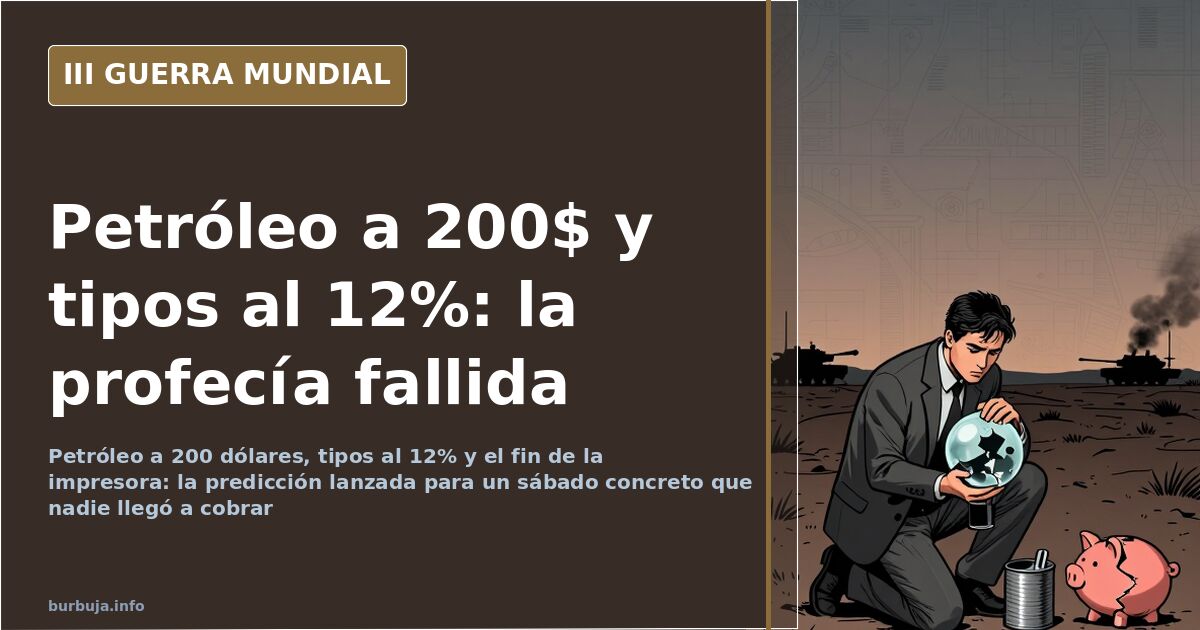
Oil at $200, Rates at 12%, and the Dollar in ICU
The script was textbook and fit in four lines: an attack between Israel and Iran, retaliation, crude oil skyrocketing to $200, and interest rates planted at 12% within six months. With that cocktail, the forecast decreed, the money printer would stop, and anyone who couldn't do something truly productive would suffer. The dollar, directly, would pass away.
What's striking isn't the prediction. What's striking is that its own author reformulated it at the first hint of reality. "The night is young," he dropped, and looked back at the calendar. A few replies down, the dominant response fit in two words: nothing happens.
What Was Announced for That Saturday
The starting point was an attack and its response between Israel and Iran, planned with markets closed so no one could react in time. From there came the full chain: oil at $200, rates at 12%, end of the money printer, and an economy where only those producing tangible goods survive. The second layer of the argument added an ingredient not measured in charts: the religious, the historical, the visceral.
And a tagline that would reappear later: the supposedly rational behavior of actors becomes more aggressive as, they argue, the dollar runs out of time. Opposing this, a diagnosis of the real economy from one participant: China deflates through overproduction and acquires cheap energy and raw materials, while the West only has the printing machine and a layer of intermediaries living off it.
"Nothing Will Happen": The Majority Bet
Facing the apocalyptic scenario, the dominant response was calm skepticism. That nothing happens and the index rises on Monday. That everything bets on it never happens. That the summary of what will occur is, literally, nothing. One of the most celebrated messages condensed it into an image: four bombs, two shouts, and everyone goes home.
The mockery wasn't just about the gravity of the issue, but about the scale of the attack: more than an offensive, according to this reading, it would be a small dog's bluff to avoid angering the neighbor too much. Another message placed the Israeli move on the trinc Friday, with calm ahead. There was even a 100% verifiable prophecy: that 24 hours would pass. It did. And the weekend close, when the hours had already passed, was the most predictable of all: nothing peine.
"It's All Arranged": The Theater Theory
A different current doesn't dispute the gravity, but the authorship. It argues that both sides actually respond to the same international financial interests and that the escalation is choreography. The circulating comparison is of two rival soft drinks fighting for the same market but sharing shareholders; in the financial version, those shareholders would be the Bank for International Settlements and large global fund managers.
The conclusion of this thesis is that the real objective isn't in the Middle East, but in the citizen's pocket: preparing the ground for central bank digital currencies, with the digital euro as the European format, and tightening control over money. None of these claims are accompanied by any proof in the conversation; they function as suspicion, not data. The most earthly version of the same argument is even simpler: prices and taxes will rise, and freedoms will be cut, just enough so no one protests too much.
Gold, Bitcoin, and a Trailer Full to Bursting
If fiat money wobbles, the recurring question was where to take cover. Answers split between metals and crypto. Some place gold above $5,000 per ounce and send cryptocurrencies to the moon. The inverse scenario also appears, formulated as a forecast by another participant: lockdown after summer, gold crash, crypto collapse, general correction, and then, rebound with rate cuts.
Among the most earthly anecdotes remained the tractor trailer story. A message asked if it should have been filled; the response raised the stakes: better fill the trailer with gold and silver until it bursts. No one cashed in the prediction, but the fuel joke lasted all weekend.
The F-35, Radars, and the Night That Was Supposed to Be Decisive
In the intermediate phase, the tone rose. It is claimed that an F-35 with a nuclear weapon in its hold was shot down and that a dawn attack would have eliminated early warning radars; from there, the warning that the next two nights were critical. These are statements that find no subsequent verification in the conversation itself, and thus should be read: as part of the narrative, not part of the balance sheet.
The result, in any case, was the same. The calendar kept moving without oil touching $200 or rates jumping to 12%. The prediction stood, waiting for another Saturday.
The weekend ended with the most domestic chronicle possible: rest, card games, family, and a last-minute oenological discovery — Toro wine turned out to be more than acceptable. Meanwhile, oil stayed where it was. And the dollar, too. How many more Saturdays can the same prediction withstand before it stops selling?
The script was textbook and fit in four lines: an attack between Israel and Iran, retaliation, crude oil skyrocketing to $200, and interest rates planted at 12% within six months. With that cocktail, the forecast decreed, the money printer would stop, and anyone who couldn't do something truly productive would suffer. The dollar, directly, would pass away.
What's striking isn't the prediction. What's striking is that its own author reformulated it at the first hint of reality. "The night is young," he dropped, and looked back at the calendar. A few replies down, the dominant response fit in two words: nothing happens.
What Was Announced for That Saturday
The starting point was an attack and its response between Israel and Iran, planned with markets closed so no one could react in time. From there came the full chain: oil at $200, rates at 12%, end of the money printer, and an economy where only those producing tangible goods survive. The second layer of the argument added an ingredient not measured in charts: the religious, the historical, the visceral.
And a tagline that would reappear later: the supposedly rational behavior of actors becomes more aggressive as, they argue, the dollar runs out of time. Opposing this, a diagnosis of the real economy from one participant: China deflates through overproduction and acquires cheap energy and raw materials, while the West only has the printing machine and a layer of intermediaries living off it.
"Nothing Will Happen": The Majority Bet
Facing the apocalyptic scenario, the dominant response was calm skepticism. That nothing happens and the index rises on Monday. That everything bets on it never happens. That the summary of what will occur is, literally, nothing. One of the most celebrated messages condensed it into an image: four bombs, two shouts, and everyone goes home.
The mockery wasn't just about the gravity of the issue, but about the scale of the attack: more than an offensive, according to this reading, it would be a small dog's bluff to avoid angering the neighbor too much. Another message placed the Israeli move on the trinc Friday, with calm ahead. There was even a 100% verifiable prophecy: that 24 hours would pass. It did. And the weekend close, when the hours had already passed, was the most predictable of all: nothing peine.
"It's All Arranged": The Theater Theory
A different current doesn't dispute the gravity, but the authorship. It argues that both sides actually respond to the same international financial interests and that the escalation is choreography. The circulating comparison is of two rival soft drinks fighting for the same market but sharing shareholders; in the financial version, those shareholders would be the Bank for International Settlements and large global fund managers.
The conclusion of this thesis is that the real objective isn't in the Middle East, but in the citizen's pocket: preparing the ground for central bank digital currencies, with the digital euro as the European format, and tightening control over money. None of these claims are accompanied by any proof in the conversation; they function as suspicion, not data. The most earthly version of the same argument is even simpler: prices and taxes will rise, and freedoms will be cut, just enough so no one protests too much.
Gold, Bitcoin, and a Trailer Full to Bursting
If fiat money wobbles, the recurring question was where to take cover. Answers split between metals and crypto. Some place gold above $5,000 per ounce and send cryptocurrencies to the moon. The inverse scenario also appears, formulated as a forecast by another participant: lockdown after summer, gold crash, crypto collapse, general correction, and then, rebound with rate cuts.
Among the most earthly anecdotes remained the tractor trailer story. A message asked if it should have been filled; the response raised the stakes: better fill the trailer with gold and silver until it bursts. No one cashed in the prediction, but the fuel joke lasted all weekend.
The F-35, Radars, and the Night That Was Supposed to Be Decisive
In the intermediate phase, the tone rose. It is claimed that an F-35 with a nuclear weapon in its hold was shot down and that a dawn attack would have eliminated early warning radars; from there, the warning that the next two nights were critical. These are statements that find no subsequent verification in the conversation itself, and thus should be read: as part of the narrative, not part of the balance sheet.
The result, in any case, was the same. The calendar kept moving without oil touching $200 or rates jumping to 12%. The prediction stood, waiting for another Saturday.
The weekend ended with the most domestic chronicle possible: rest, card games, family, and a last-minute oenological discovery — Toro wine turned out to be more than acceptable. Meanwhile, oil stayed where it was. And the dollar, too. How many more Saturdays can the same prediction withstand before it stops selling?
Also available in: Deutsch
Summary of a discussion on Burbuja.info - Foro de economía, actualidad y política., translated from Spanish and reviewed before publication. Read the full discussion (118 replies).
More summaries
-
Forum Summary: Digital ID and CBDCs Seen as Control System
Buenos Aires launches digital identity, Macron signs SGIN decree, and the ECB advances on the digital euro, fueling fears of a control system.
-
Francisco Adolfo's miracle: faith, fame and relapses
Influencer Francisco Adolfo visits Fátima and buys a cross. Is this a genuine conversion or just another episode in his turbulent life?
-
Russian Animation Thrives Without Disney
Cheburashka's 2023 box office record in Russia contrasts with its limited European distribution.
-
Chuguev: Explosion was ammunition depot, not thermobaric bomb
A blast over Kharkiv proved to be the Chuguev military depot. The debate on whether thermobaric weapons are war crimes gained traction.
-
Swastika Tattoo on Captured Soldier Reignites War Propaganda Debate
A captured soldier's swastika tattoo sparks renewed discussion on symbols, propaganda, and war narratives.
-
Ukraine counteroffensive: 100 km² gained, deemed a failure
Ukraine's counteroffensive has reclaimed just over 100 km² in weeks, with Western tanks destroyed and no air support, undermining success narratives.