
Oct 1: The Date That Divides Spain and Both Sides Claim
Oct 1 divides Spain again years later: electoral turnout, the d'Hondt law, bank bailouts, and Puigdemont mark the anniversary.
English · Original discussion in Spanish · Published
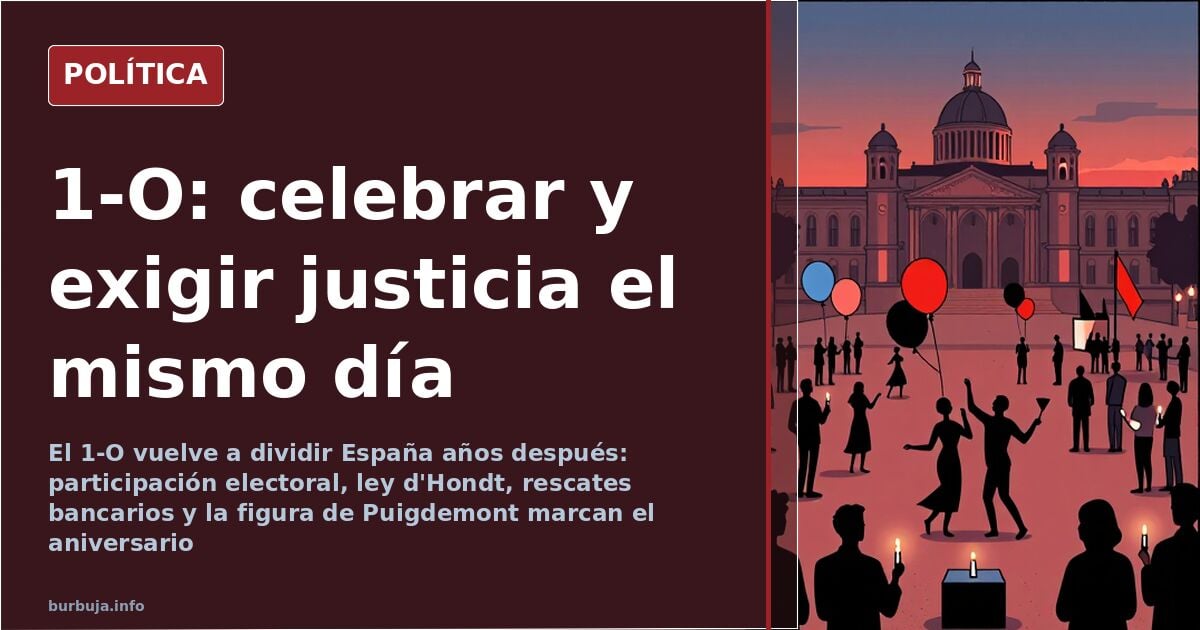
Oct 1: The same date is used to celebrate and demand justice
On October 1, 2017, Catalonia held a self-determination referendum that separatists commemorate as a foundational day and critics recall as a coup. That day saw police charges, and the debate includes both celebrations and reproaches. Years later, the anniversary continues to act as the switch that activates both national narratives simultaneously. The paradox bothers anyone seeking a single version: the same date is commemorated as a antiestéticat and as a grievance, almost simultaneously.
Was it a coup or a vote without guarantees?
It depends on who you ask, and that is the crux. Part of the separatist movement argues that they won: the phrase attributed to Puigdemont states that "despite wanting us defeated, we defeated them", and some go further, claiming that Oct 1 turned people into separatists who were not before. On the other side, the day is described as a coup, albeit with a hint of irony: some joke that it lasted only seconds and that nothing has been learned in eight years. Neither narrative admits nuances, which explains the temperature of each anniversary.
The turnout figures each side interprets
Electoral data serves both trenches. In the 2017 Catalan Parliament elections, with a 79.09% turnout, 4,393,099 voters went to the polls out of 5,557,901 registered. In 2021, turnout fell to 51.29%: 2,884,845 voters out of 5,624,067 registered. From this, a figure repeated on both sides is derived: whoever measures the separatist weight against the total census, not just voters, gets a much lower percentage than usually advertised. The full calculation, cross-referenced with the d'Hondt law and district distribution, yields results that disconcert both sides.
Why the d'Hondt law is debated in the Catalan conflict
Because it decides how many votes each seat costs, and in Catalonia, the province weighs more than the number. It is common to hear that the system overrepresents less populated areas and that a vote in a specific province is worth several in the Barcelona metropolitan area. The discussion turns toxic quickly: some recall that without this correction, majorities would be different; others reply that the same scale distributes seats across the rest of Spain and that rural votes also decide governments outside Catalonia.
The cost of bank bailouts no one has repaid
Here, money provides figures that debate participants cross as ammunition. According to the numbers they use, the Bankia bailout is estimated at around 45,000 million euros, compared to 12,000 million for Caixa Catalunya. The former CAM received about 26,000 million. The comparison serves as cross-ammunition: each side points to the bank managed by the rival community and recalls who was governing then. In the thread, it is argued that the bill was paid by all taxpayers and that what has been returned is zero.
Puigdemont in Belgium and the rise of VOX
The former president remains in Belgium, and his figure structures much of the conversation. For some, it is proof that justice does not reach those responsible; for others, a political exile. Meanwhile, VOX's electoral growth is cited in the thread as a thermometer of wear and tear. The debate also antiestéticatures amnesty, flatly rejected from some positions ("no forgetting, no pardon") and presented by others as a condition to normalize Catalan politics.
With these elements, one might expect the anniversary to lose steam. The opposite occurs. Every October 1, the same question returns—who won, who lost, who pays—and the two answers still do not touch. How many more anniversaries are needed for the date to stop dividing and simply start informing?
On October 1, 2017, Catalonia held a self-determination referendum that separatists commemorate as a foundational day and critics recall as a coup. That day saw police charges, and the debate includes both celebrations and reproaches. Years later, the anniversary continues to act as the switch that activates both national narratives simultaneously. The paradox bothers anyone seeking a single version: the same date is commemorated as a antiestéticat and as a grievance, almost simultaneously.
Was it a coup or a vote without guarantees?
It depends on who you ask, and that is the crux. Part of the separatist movement argues that they won: the phrase attributed to Puigdemont states that "despite wanting us defeated, we defeated them", and some go further, claiming that Oct 1 turned people into separatists who were not before. On the other side, the day is described as a coup, albeit with a hint of irony: some joke that it lasted only seconds and that nothing has been learned in eight years. Neither narrative admits nuances, which explains the temperature of each anniversary.
The turnout figures each side interprets
Electoral data serves both trenches. In the 2017 Catalan Parliament elections, with a 79.09% turnout, 4,393,099 voters went to the polls out of 5,557,901 registered. In 2021, turnout fell to 51.29%: 2,884,845 voters out of 5,624,067 registered. From this, a figure repeated on both sides is derived: whoever measures the separatist weight against the total census, not just voters, gets a much lower percentage than usually advertised. The full calculation, cross-referenced with the d'Hondt law and district distribution, yields results that disconcert both sides.
Why the d'Hondt law is debated in the Catalan conflict
Because it decides how many votes each seat costs, and in Catalonia, the province weighs more than the number. It is common to hear that the system overrepresents less populated areas and that a vote in a specific province is worth several in the Barcelona metropolitan area. The discussion turns toxic quickly: some recall that without this correction, majorities would be different; others reply that the same scale distributes seats across the rest of Spain and that rural votes also decide governments outside Catalonia.
The cost of bank bailouts no one has repaid
Here, money provides figures that debate participants cross as ammunition. According to the numbers they use, the Bankia bailout is estimated at around 45,000 million euros, compared to 12,000 million for Caixa Catalunya. The former CAM received about 26,000 million. The comparison serves as cross-ammunition: each side points to the bank managed by the rival community and recalls who was governing then. In the thread, it is argued that the bill was paid by all taxpayers and that what has been returned is zero.
Puigdemont in Belgium and the rise of VOX
The former president remains in Belgium, and his figure structures much of the conversation. For some, it is proof that justice does not reach those responsible; for others, a political exile. Meanwhile, VOX's electoral growth is cited in the thread as a thermometer of wear and tear. The debate also antiestéticatures amnesty, flatly rejected from some positions ("no forgetting, no pardon") and presented by others as a condition to normalize Catalan politics.
With these elements, one might expect the anniversary to lose steam. The opposite occurs. Every October 1, the same question returns—who won, who lost, who pays—and the two answers still do not touch. How many more anniversaries are needed for the date to stop dividing and simply start informing?
Summary of a discussion on Burbuja.info - Foro de economía, actualidad y política., translated from Spanish and reviewed before publication. Read the full discussion (268 replies).
More summaries
-
Puigdemont's wig: accident or political strategy?
Analysis of Puigdemont's wig: examining the 1983 accident data and the polarization of political debate.
-
Living in Catalonia Without Feeling Catalan: The Identity Clash
Debate divides residents: Is living in Catalonia enough to be Catalan, or does identity require language and sentiment?
-
Tweet Places Pablo Fernández in Luxury Housing Development
A tweet places Pablo Fernández living in a luxury development from the Mahou-Calderón operation, the same one Podemos tried to halt.
-
Thomas Aquinas and 13th-Century Spain’s Fatwa Against Muhammad
A 13th-century Spanish theologian accused Muhammad of pandering to carnal desires, shaping a foundational Christian critique of Islam.
-
Franco 40 Years On: Spain's Most Divisive Legacy
Four decades after his death, Francisco Franco remains polarizing: defenders cite low unemployment, while critics highlight repression and open graves.
-
Cuba: US embargo doesn't block food exports to the island
The US is Cuba's top food exporter despite the blockade. The embargo excludes food and medicine, contradicting the regime's claims of scarcity.