
Cuba: US embargo doesn't block food exports to the island
The US is Cuba's top food exporter despite the blockade. The embargo excludes food and medicine, contradicting the regime's claims of scarcity.
English · Original discussion in Spanish · Published
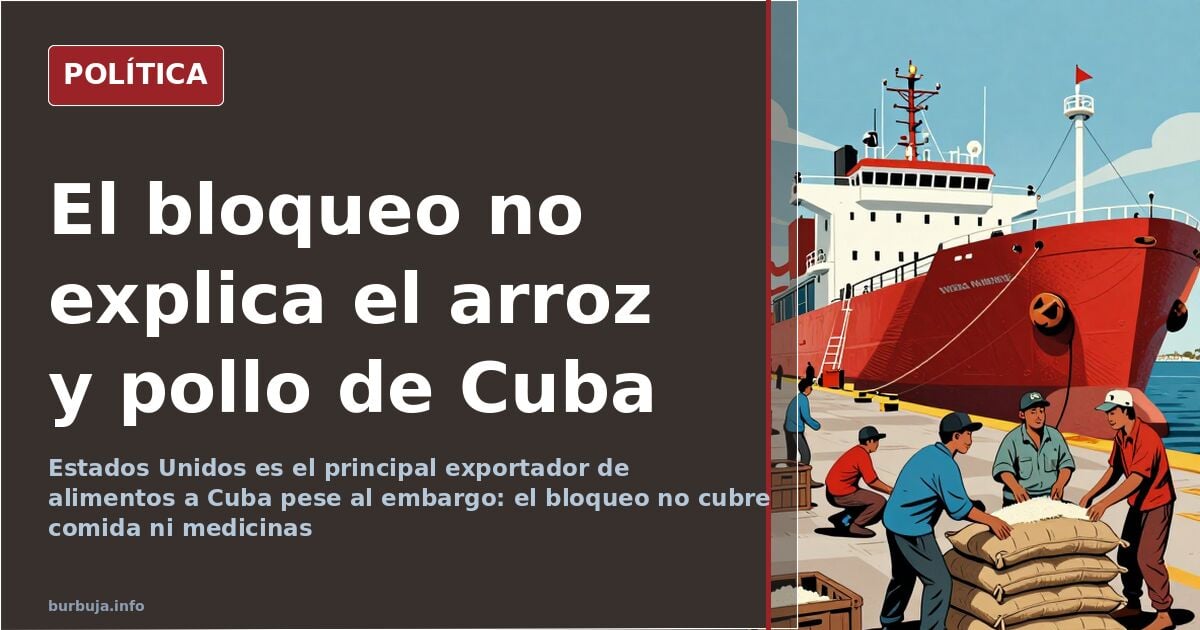
Cuba: US embargo doesn't block food exports to the island
The most repeated excuse for Cuban shortages collapses under its own logic. The United States, the official blocker, is the main food exporter to the island: frozen chicken and powdered milk served in tourist hotels ship from US ports. The embargo covers neither food nor medicine. Yet the regime blames every blackout on a siege that, in the food aisle, is nowhere to be found.
Does the blockade explain Cuba's food shortage?
The cited argument claims the island cannot trade with 80% of global GDP. It has a temporal blind spot. The USSR fully funded an economy that was already unproductive, and the accounts from that era were never balanced. The Soviet bloc disappeared over thirty years ago. Cuba can trade with the vast majority of the planet and still produces little to sell. A country that generates no surplus has nothing to put on the table.
The striking aspect is the narrative mechanism. Every internal problem becomes the consequence of an external siege, a pattern maintained for six decades. The alibi works because no one asks about supply: how much sugar is produced, how much rice is planted, what peine to the hard currency earned in good years. These are annoying questions, with worse answers.
Cuba's income before the revolution
Before 1959, the island had per capita income higher than that of Italy and Spain. Today, it ranks among the poorest countries in the Americas. A nation that was a Caribbean benchmark for services has become a catalog of queues, blackouts, and rationing books.
The Spanish case serves as an uncomfortable mirror. Spain transitioned from an agrarian economy to the eighth largest economic power worldwide in a few decades, with all the caveats one might add. Regime supporters blame its ruin on an embargo that, precisely, does not block food. Critics counter: what model needs to import the chicken its own people eat?
Cuban protests and the role of mobile phones
The protests that have unfolded on the island have found in mobile internet their best amplifier. The spread of videos and testimonies via phone has overwhelmed the regime's information control. Under hashtags like SOSCubaLibre, arrests and disappearals reported by official press are denied. The streets record, publish, and await a response.
The pattern repeats in each protest cycle. Connectivity arrives drop by drop and at high prices, but a phone with data is enough to break the regime's monopoly on the narrative. It is the same technology the system cannot shut down without exposing its own isolation.
Two standards for dictators
The issue has a domestic derivative. "They are very brave when dealing with dead dictators, but very cowardly with living ones," summarized politician Inés Arrimadas. The phrase neatly frames the Spanish conversation: condemnations of Franco flow freely, while abuses denounced in the Caribbean island receive a fraction of that energy.
One strand of analysis attributes this to ideological coherence: those who militate on one side hardly point to their own field. Another attributes it to pure electoral calculation, more comfortable looking at one's own past than at others' present. In between lie the names of the detained.
The tourist who only finds rice and chicken
The best graphic does not come from a report, but from a hotel complaint. A Spanish traveler returning from Cuba recounted that at a luxury hotel, only rice and chicken were served, with rationed chicken. Breakfast milk was also scarce. Guests ended up on the street searching for something to eat. What the tourist did not know is that this chicken was frozen, purchased from the United States, and the milk arrived in powder form to be reconstituted on the island.
This testimony is not an exception. Visitors to Cuba return with the impression that no other Caribbean island serves so little and so poorly. Strikingly absent: not even fruit trees were planted in a territory with soil and climate abundant enough to grow them.
The copied Asian model, unacknowledged
An inescapable comparison arises with China. The Chinese Communist Party fulfills its five-year plans and has become an industrial power, while Cuba endures decades of deprivation. The difference, some argue, lies not in the label, but in management and partial market openness. Others call it by its name: state capitalism with a Leninist surname.
The Cuban regime presents itself as an alternative to capitalism and has spent half a century importing basic foods. If the embargo is not a unique explanation and the model yields no production, what sustains the discourse dedicated to it here?
The most repeated excuse for Cuban shortages collapses under its own logic. The United States, the official blocker, is the main food exporter to the island: frozen chicken and powdered milk served in tourist hotels ship from US ports. The embargo covers neither food nor medicine. Yet the regime blames every blackout on a siege that, in the food aisle, is nowhere to be found.
Does the blockade explain Cuba's food shortage?
The cited argument claims the island cannot trade with 80% of global GDP. It has a temporal blind spot. The USSR fully funded an economy that was already unproductive, and the accounts from that era were never balanced. The Soviet bloc disappeared over thirty years ago. Cuba can trade with the vast majority of the planet and still produces little to sell. A country that generates no surplus has nothing to put on the table.
The striking aspect is the narrative mechanism. Every internal problem becomes the consequence of an external siege, a pattern maintained for six decades. The alibi works because no one asks about supply: how much sugar is produced, how much rice is planted, what peine to the hard currency earned in good years. These are annoying questions, with worse answers.
Cuba's income before the revolution
Before 1959, the island had per capita income higher than that of Italy and Spain. Today, it ranks among the poorest countries in the Americas. A nation that was a Caribbean benchmark for services has become a catalog of queues, blackouts, and rationing books.
The Spanish case serves as an uncomfortable mirror. Spain transitioned from an agrarian economy to the eighth largest economic power worldwide in a few decades, with all the caveats one might add. Regime supporters blame its ruin on an embargo that, precisely, does not block food. Critics counter: what model needs to import the chicken its own people eat?
Cuban protests and the role of mobile phones
The protests that have unfolded on the island have found in mobile internet their best amplifier. The spread of videos and testimonies via phone has overwhelmed the regime's information control. Under hashtags like SOSCubaLibre, arrests and disappearals reported by official press are denied. The streets record, publish, and await a response.
The pattern repeats in each protest cycle. Connectivity arrives drop by drop and at high prices, but a phone with data is enough to break the regime's monopoly on the narrative. It is the same technology the system cannot shut down without exposing its own isolation.
Two standards for dictators
The issue has a domestic derivative. "They are very brave when dealing with dead dictators, but very cowardly with living ones," summarized politician Inés Arrimadas. The phrase neatly frames the Spanish conversation: condemnations of Franco flow freely, while abuses denounced in the Caribbean island receive a fraction of that energy.
One strand of analysis attributes this to ideological coherence: those who militate on one side hardly point to their own field. Another attributes it to pure electoral calculation, more comfortable looking at one's own past than at others' present. In between lie the names of the detained.
The tourist who only finds rice and chicken
The best graphic does not come from a report, but from a hotel complaint. A Spanish traveler returning from Cuba recounted that at a luxury hotel, only rice and chicken were served, with rationed chicken. Breakfast milk was also scarce. Guests ended up on the street searching for something to eat. What the tourist did not know is that this chicken was frozen, purchased from the United States, and the milk arrived in powder form to be reconstituted on the island.
This testimony is not an exception. Visitors to Cuba return with the impression that no other Caribbean island serves so little and so poorly. Strikingly absent: not even fruit trees were planted in a territory with soil and climate abundant enough to grow them.
The copied Asian model, unacknowledged
An inescapable comparison arises with China. The Chinese Communist Party fulfills its five-year plans and has become an industrial power, while Cuba endures decades of deprivation. The difference, some argue, lies not in the label, but in management and partial market openness. Others call it by its name: state capitalism with a Leninist surname.
The Cuban regime presents itself as an alternative to capitalism and has spent half a century importing basic foods. If the embargo is not a unique explanation and the model yields no production, what sustains the discourse dedicated to it here?
Summary of a discussion on Burbuja.info - Foro de economía, actualidad y política., translated from Spanish and reviewed before publication. Read the full discussion (266 replies).
More summaries
-
Spain should become the 51st US state, some argue
The idea of Spain becoming the 51st US state arises from perceived political and economic instability, seeking external protection against internal divisions.
-
Charlie Kirk Assassination Sparks Fears of US Collapse
The September 10, 2025 assassination of Charlie Kirk reignites debate on US political collapse and the dollar's role.
-
In 1960, 13% of Spain's university students were women; in the US, 38%
In 1960, 13% of Spain's university students were women, compared with 38% in the US. The figure reopens the debate about women under Franco.
-
Puigdemont's wig: accident or political strategy?
Analysis of Puigdemont's wig: examining the 1983 accident data and the polarization of political debate.
-
Franco 40 Years On: Spain's Most Divisive Legacy
Four decades after his death, Francisco Franco remains polarizing: defenders cite low unemployment, while critics highlight repression and open graves.
-
Andalusia election results: vote fragmentation and national political impact
Analysis of Andalusian election results shows vote fragmentation, coalition strategies, and the impact on national politics following complex electoral arithmetic.