
Living in Catalonia Without Feeling Catalan: The Identity Clash
Debate divides residents: Is living in Catalonia enough to be Catalan, or does identity require language and sentiment?
English · Original discussion in Spanish · Published
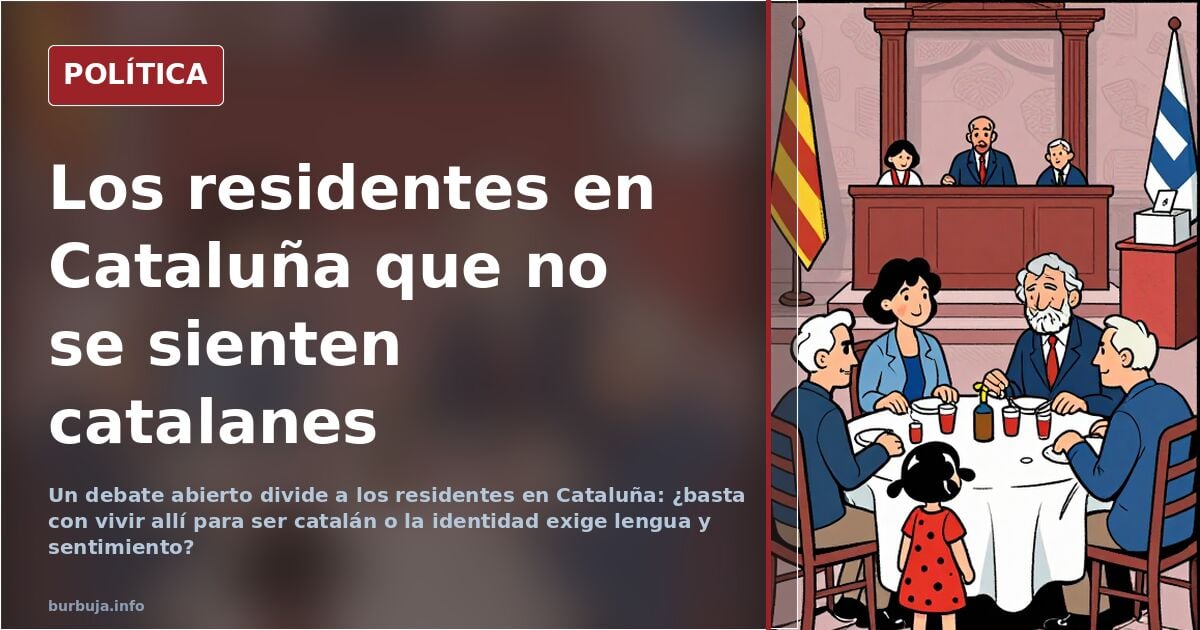
Living in Catalonia Without Feeling Catalan: The Identity Clash
‘There are people in Catalonia who do not want to be Catalan.’ This statement, attributed to Santiago Espot, acted as the spark. A heated debate has erupted over this idea, asking a central question that remains unanswered: how many residents live there without feeling Catalan? The issue has become a thermometer of identity wear after the procés, challenging the old mantra that ‘we are all Catalan.’ If everyone were, no one would need to ask.
Testimonies accumulate with an uncomfortable pattern. It is not just outsiders. There are also native Catalans with Catalan surnames and childhoods entirely Catalan who do not recognize themselves in the official narrative. Others argue that being Catalan is compatible with feeling Spanish and that no one should be forced to choose.
Who has the right to call themselves Catalan?
The most uncomfortable case does not involve a newcomer. It is someone who claims to have seven Catalan surnames, made castells and calçotades, spent summers at an esplai, yet stopped feeling Catalan upon entering university and interacting with people from other regions. This story appears in various versions. Another resident in Girona province notes they have lived in Catalonia for less than one-sixth of their life. A third spends only six months a year in the community.
Some argue that identity is not inherited or imposed, but chosen and felt. Conversely, another school of thought argues that Catalan identity has specific markers—language, national sentiment, political project—and those who do not share them are excluded, regardless of how long they have lived there. The clash between these two readings is the true axis of the issue.
Catalan in Schools: Mandatory Since 1977
One of the most detailed accounts points to the education system. A participant born and raised in Barcelona, 35 years in the city, places the key in the 1977-1978 academic year, when, according to their testimony, Catalan became mandatory in their school with one hour daily. The anecdote has an edge: while English classes remained basic, Catalan classes used five textbooks simultaneously, including grammar, history, and literature. This imbalance in demands is, for this testimony, another piece of the identity puzzle.
Girona or Gerona: The Name Also Discussed
The conversation drops to details. When one person writes the toponym in its Catalan form, another corrects them, reproaching the usage and insisting that in Spanish it is written Gerona. The response is swift: it is recalled that the official form is Girona, as shown on all signs. Toponymy thus becomes a miniature battlefield, where a letter serves to measure who is in and who is out of the imagined community.
The Fracture of the Procés in Families and Neighborhoods
The turning point highlighted by several testimonies is the procés. A participant born in Barcelona, who identifies as both Catalan and Spanish, states that the fracture reached the school gates, with looks and comments when picking up children. ‘The procés did great harm to Catalan society,’ she summarizes, adding that before that, there were no problems between those who wanted independence and those who did not. Daily coexistence became, according to several testimonies, a mined terrain.
Fiscal Grievance as Fuel
The discussion does not stay with identity. The old wound of money appears: some argue that Catalonia supports all of Spain, while another replies that this grievance narrative serves as an alibi. The reference to a worker from Soria who ‘works like a dog’ appears as a counterexample. It is the latest version of a clash mixing sentiment and accounting, with neither side fully aligning with the other.
Those Who Left, Those Who Stayed, and Those Who Do Not Fit
Three profiles emerge from the collection. The one who left and tells the story without nostalgia. The one who stays due to ties—work, family, mortgage—though they say they do not feel Catalan. And the one, born there, who describes themselves as a stranger in their own land, labeled ‘the Catalan’ by outsiders. This third profile summarizes the paradox: identity assigned from outside, identity denied from within.
With the testimonies on the table, the initial question still does not fit. No one has put a number to the issue, and the stories themselves contradict each other. Catalan identity is discussed today less in offices than in school stairwells.
‘There are people in Catalonia who do not want to be Catalan.’ This statement, attributed to Santiago Espot, acted as the spark. A heated debate has erupted over this idea, asking a central question that remains unanswered: how many residents live there without feeling Catalan? The issue has become a thermometer of identity wear after the procés, challenging the old mantra that ‘we are all Catalan.’ If everyone were, no one would need to ask.
Testimonies accumulate with an uncomfortable pattern. It is not just outsiders. There are also native Catalans with Catalan surnames and childhoods entirely Catalan who do not recognize themselves in the official narrative. Others argue that being Catalan is compatible with feeling Spanish and that no one should be forced to choose.
Who has the right to call themselves Catalan?
The most uncomfortable case does not involve a newcomer. It is someone who claims to have seven Catalan surnames, made castells and calçotades, spent summers at an esplai, yet stopped feeling Catalan upon entering university and interacting with people from other regions. This story appears in various versions. Another resident in Girona province notes they have lived in Catalonia for less than one-sixth of their life. A third spends only six months a year in the community.
Some argue that identity is not inherited or imposed, but chosen and felt. Conversely, another school of thought argues that Catalan identity has specific markers—language, national sentiment, political project—and those who do not share them are excluded, regardless of how long they have lived there. The clash between these two readings is the true axis of the issue.
Catalan in Schools: Mandatory Since 1977
One of the most detailed accounts points to the education system. A participant born and raised in Barcelona, 35 years in the city, places the key in the 1977-1978 academic year, when, according to their testimony, Catalan became mandatory in their school with one hour daily. The anecdote has an edge: while English classes remained basic, Catalan classes used five textbooks simultaneously, including grammar, history, and literature. This imbalance in demands is, for this testimony, another piece of the identity puzzle.
Girona or Gerona: The Name Also Discussed
The conversation drops to details. When one person writes the toponym in its Catalan form, another corrects them, reproaching the usage and insisting that in Spanish it is written Gerona. The response is swift: it is recalled that the official form is Girona, as shown on all signs. Toponymy thus becomes a miniature battlefield, where a letter serves to measure who is in and who is out of the imagined community.
The Fracture of the Procés in Families and Neighborhoods
The turning point highlighted by several testimonies is the procés. A participant born in Barcelona, who identifies as both Catalan and Spanish, states that the fracture reached the school gates, with looks and comments when picking up children. ‘The procés did great harm to Catalan society,’ she summarizes, adding that before that, there were no problems between those who wanted independence and those who did not. Daily coexistence became, according to several testimonies, a mined terrain.
Fiscal Grievance as Fuel
The discussion does not stay with identity. The old wound of money appears: some argue that Catalonia supports all of Spain, while another replies that this grievance narrative serves as an alibi. The reference to a worker from Soria who ‘works like a dog’ appears as a counterexample. It is the latest version of a clash mixing sentiment and accounting, with neither side fully aligning with the other.
Those Who Left, Those Who Stayed, and Those Who Do Not Fit
Three profiles emerge from the collection. The one who left and tells the story without nostalgia. The one who stays due to ties—work, family, mortgage—though they say they do not feel Catalan. And the one, born there, who describes themselves as a stranger in their own land, labeled ‘the Catalan’ by outsiders. This third profile summarizes the paradox: identity assigned from outside, identity denied from within.
With the testimonies on the table, the initial question still does not fit. No one has put a number to the issue, and the stories themselves contradict each other. Catalan identity is discussed today less in offices than in school stairwells.
Summary of a discussion on Burbuja.info - Foro de economía, actualidad y política., translated from Spanish and reviewed before publication. Read the full discussion (432 replies).
More summaries
-
Orriols calls for identifying the attackers of Aliança Catalana
An Aliança Catalana stall in Barcelona ends with a party member injured and a four-second video that splits accounts between assault and accident
-
Puigdemont's wig: accident or political strategy?
Analysis of Puigdemont's wig: examining the 1983 accident data and the polarization of political debate.
-
Franco 40 Years On: Spain's Most Divisive Legacy
Four decades after his death, Francisco Franco remains polarizing: defenders cite low unemployment, while critics highlight repression and open graves.
-
Cuba: US embargo doesn't block food exports to the island
The US is Cuba's top food exporter despite the blockade. The embargo excludes food and medicine, contradicting the regime's claims of scarcity.
-
Andalusia election results: vote fragmentation and national political impact
Analysis of Andalusian election results shows vote fragmentation, coalition strategies, and the impact on national politics following complex electoral arithmetic.
-
Pope Calls Migrant Rejection a Grave Sin as Vatican Fortifies Borders
Pope Francis labels rejecting migrants a grave sin while the Vatican maintains strict immigration laws and high walls.