
Novo Nordisk: GLP-1 Thesis Holds Despite Guidance Drop
Novo Nordisk shares fell nearly 20% after guiding for 7-8% growth in 2026. The obesity market grows 15% annually, dominated by two players.
English · Original discussion in Spanish · Published
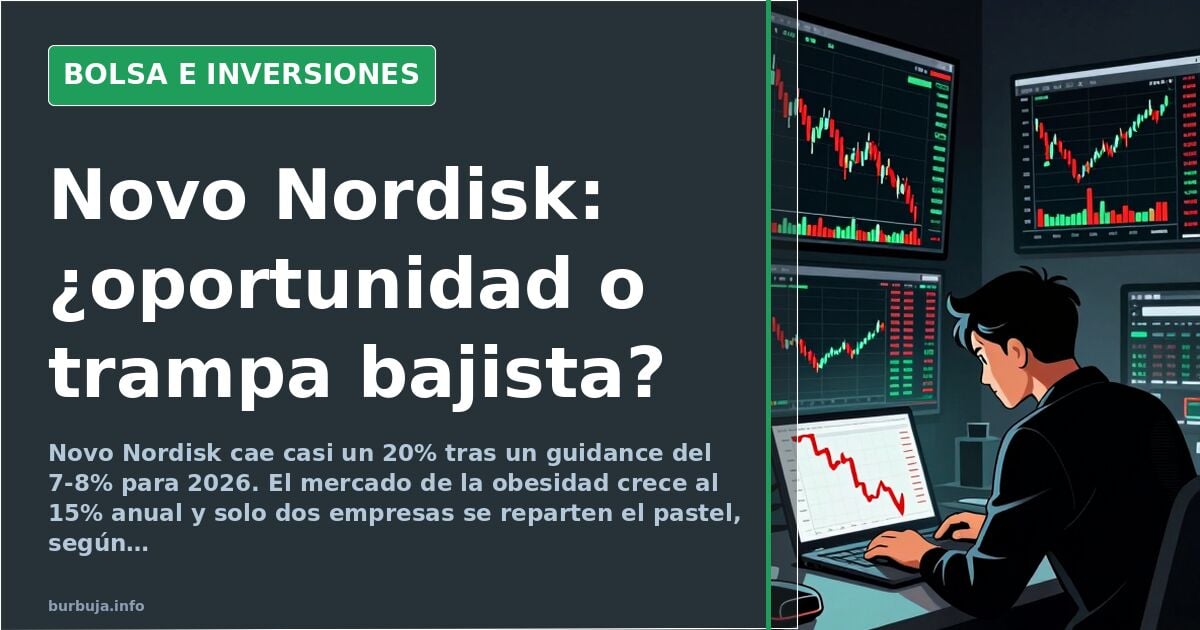
Novo Nordisk: The thesis that withstands panic and guidance cuts
The obesity and diabetes market is growing at 15% annually, with only two companies splitting the pie. This is the core argument supporting investment in Novo Nordisk, even as its stock plunges nearly 20% in a single session trinc guidance forecasting 7-8% growth for 2026, far below the 20% previously recorded. The question pervading this issue isn't whether the product works, but whether the market priced in exponential growth that was never going to happen.
Novo Nordisk is no ordinary company. It manufactures Ozempic and Wegovy, drugs that have turned obesity into a multi-billion dollar business. However, rival Eli Lilly has eaten into its market share, doing so in a specific context: Novo couldn't sell more because production was maxed out. That isn't fair competition; it's a supply constraint. The Danish firm invests at rates of €60 billion annually, a figure that AI giants would envy. OpenAI doesn't invest at that pace.
Why does Novo Nordisk fall if the business is growing?
The stock punishment reflects broken expectations. When a company habituates the market to 20% growth and suddenly guides for 7-8%, the adjustment is immediate. It doesn't matter that it continues to grow; what matters is that it grows less than models projected. This is capitalism in its cruelest form: you are penalized for delivering, but for delivering less than others dreamed up in a spreadsheet.
To this adds noise. The FDA's resolution on generics, competition from oral versions like pill-form Wegovy or Lilly's Orforglipron, and even geopolitical conflicts regarding Greenland. For much of the analysis, this last factor is pure noise: it doesn't affect the fundamentals of a pharma giant dominating diabetes and obesity treatments. But the market reacts to headlines, not balance sheets.
Some argue the real problem is that the market discounted infinite growth. Obesity doesn't behave like a tech market: it requires willingness, adherence, and often chronic treatment. Stopping the drug causes rebound weight gain, sometimes exceeding previous levels. This means the business isn't one-off doses, but lifelong consumption. A market growing 75% over four years, split between two main actors, according to circulating calculations.
Production as a competitive weapon
Lack of production capacity was Novo's Achilles' heel. While demand skyrocketed, the company couldn't manufacture enough, opening the door to cheaper generics and allowing Lilly to gain ground. Massive investment in capacity and production flexibility aims to close this gap. If Novo produces 50 million doses, it sells 50; if it produces 70, it sells 70. The limit isn't demand; it's the factory.
The other pillar is legal. Simply banning generic sales could boost the stock by 20%, according to forum users. This isn't an outlandish hypothesis in a sector where patents are the primary barrier to entry. If production recovers and illegal competition is halted, market share losses should reverse.
Optimists calculate simply: if the market doubles in four years and there are only two relevant players, both will grow. If Novo doesn't lose, Lilly multiplies. If Novo recovers, the stock has 50% upside potential. In any case, this isn't a short-term bet. Downward momentum is strong, and a rebound may take time.
Is Novo Nordisk an investment opportunity?
It depends on the time horizon. With a P/E ratio of 11 and 25% sales growth, some consider the stock undervalued. Others warn that growth is slowing and that Chinese and Lilly competition is unstoppable. The uncomfortable truth is that no one knows when the recovery will begin. The market may take months to recognize what the numbers already say.
The thesis rests on three pillars: a double-digit growing market, a dominant position in a duopoly, and production capacity being expanded rapidly. Risks are equally clear: competition, regulatory pressure, and a market that has learned to punish any sign of weakness. Novo isn't a safe bet, but it isn't the disaster suggested by the price.
Next week will be decisive: Q3 results, FDA resolution, and the possible acquisition of Metsera. Any of these events could move the stock violently. Those outside might find a cheaper entry point. Those inside will have to endure the noise. The prediction, with reservations, is that the market will eventually recognize the value, once production numbers and pill sales speak louder than headlines.
Also available in: Deutsch
Summary of a discussion on Burbuja.info - Foro de economía, actualidad y política., translated from Spanish and reviewed before publication. Read the full discussion (106 replies).
More summaries
-
Novo Nordisk and UnitedHealth: Two Plunges, Two Opposing Theses
Novo Nordisk drops sharply and UnitedHealth faces legal proceedings. Two plunges and the fiscal impact of the Danish dividend.
-
Novo Nordisk Plummets After Falling Short of Eli Lilly
CagriSema achieves 23% weight loss versus Eli Lilly's tirzepatide at 25.5%, causing Novo Nordisk stock to plunge to €35. Gross margin drops from 82.7% to 78.2%.
-
Pablo Gil trader reviews: respect and bearish bias
Two years warning of a stock market crash that hasn't come: opinions on Pablo Gil, the YouTube trader, split between respect and bias.
-
Iberdrola hits record highs: the safe haven now yielding more than a salary
Iberdrola is trading at all-time highs and is close to becoming the world's largest utility by market cap. Long-time shareholders aren't selling: dividends alone are already paying off.
-
PayPal splits the market: temporary re-rating or value trap?
The market is debating whether PayPal's fall is a temporary re-rating, a buying opportunity or a value trap.
-
Spain's PSOE and stocks: what to do with the Ibex if it wins the election
The Ibex doesn't vote: banks, construction firms and energy companies get paid by Brussels whoever wins. An analysis of which stocks can weather a new socialist term.