
Fake CNMV Call Demands Two-Hour Video Interview About Your Stocks
A caller impersonating Spain's market regulator requests a two-hour video call about your portfolio, already knowing your specific holdings.
English · Original discussion in Spanish · Published
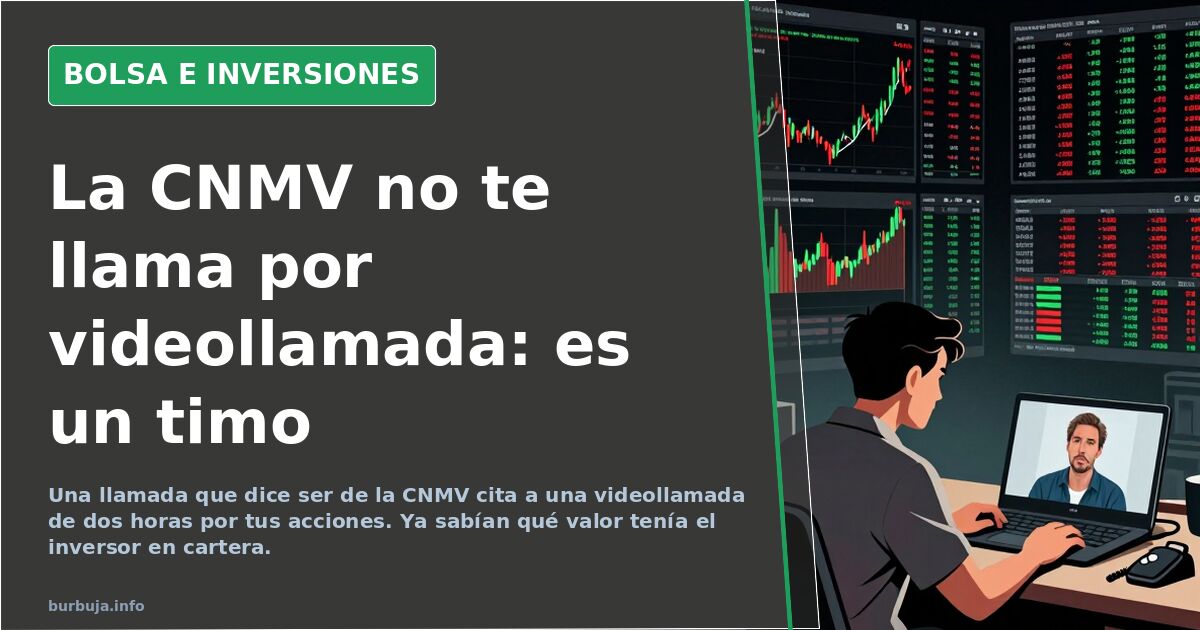
CNMV Impersonators Demand Two-Hour Video Calls: It’s a Scam
What would you do if someone claiming to be from the Comisión Nacional del Mercado de Valores (Spain's stock market regulator) invited you to a two-hour video conference to discuss stocks you just bought? The prudent response is to hang up. The detail that breaks the narrative isn't the request itself, but the prior knowledge: the caller already knows which asset you hold in your portfolio and when you purchased it. In a stock transaction, not everyone has access to that information.
The Call That Already Knew Which Shares You Bought
The script repeats. The phone rings, a voice on the other end identifies themselves as CNMV staff, asks for an email address to send documentation, and shortly after proposes a one or two-hour video call framed as a survey or interview about your investments. The bait has a grain of truth that makes it dangerous: in the case brought to light, the caller knew the exact name of the security, MONDO TV, and even dropped the full name of the supposed employee.
There are two possible interpretations. The first is that the matter is genuine and a public body wants to inquire about a specific transaction. The second—supported by the evidence—is that the data leaked through a breach: either from the broker used or from the impersonated institution itself. Plausibility or leak; in either scenario, this contact is no longer innocent. And if the interlocutor knows your transaction, the question isn't whether to distrust them, but when your privacy ceased to exist.
There is a colorful detail. For many, the company name sounds like a third-tier animation production studio, with series from the late nineties that some remember with more embarrassment than affection. Little for an investor, but another hint that the chosen name wasn't random.
Why a Video Call Is the Most Dangerous Part
Here lies the core of the issue. A phone call can be hung up; a video call cannot. If the goal is to capture image and voice, two hours of conversation provide enough fragments to mount identity theft. With cloning tools, those clips serve later to send distress messages to the victim's contacts. Therefore, the recommendation is strict: never show your ID, neither via video nor email.
The other vector is the link. If the conversation leads to installing software or confirming data on a website, the trap shifts from telephone to digital. The rule is simple: a link provided during a call is not a valid source, and poor video quality or audio-only reduces damage if someone insists on seeing your face.
Authorities Do Not Summon by Phone
An official requirement is notified in writing, with acknowledgment and guarantees. When the channel is a phone call, there is no way to verify who is on the other end, no matter what name they drop. And the number given to you during that same conversation proves nothing: you must go to the official CNMV website and look for the contact phone number there, rather than trusting the one given on the fly.
It is useful to know how a real requirement is presented: in writing, with identification of the file and the signing authority. If that doesn't arrive, there is no requirement. There is an exception scammers exploit to their advantage: official statistics. The INE (National Statistics Institute) does conduct mandatory-response surveys, with a prior letter and password, and at one time compensated participants with a €60 card upon completion. That an institution asks questions is not rare. That it does so blindly by phone, yes.
Time Also Has a Cost
One line of argument holds that if they truly want testimony, they should pay for it. For market research, figures of €60 or €70 per participant are common; here, they ask for an entire morning in exchange for nothing. Others would demand equivalent compensation in kind—two smartphones, a 40-inch TV, an air fryer—and continue with their lives.
Careful, however, with the easy excuse of dodging responsibility. Where there is a legal obligation to respond, avoiding the appointment may prolong the problem instead of resolving it.
What to Do: Verify, Change Passwords, and Report
The protocol is short. Call the CNMV yourself using the number on their website and ask if that person exists; if they know them and connect you, the contact gains credibility; if they don't know who it is, immediate block. Then, change the broker password and all passwords shared with other services. And report the call: someone impersonated a public body and handled private transaction data.
With this material, the mystery isn't that someone suspects. The mystery is that there are still people who hand over their email at the first call and, when trouble arrives, look for a culprit other than the handset.
What would you do if someone claiming to be from the Comisión Nacional del Mercado de Valores (Spain's stock market regulator) invited you to a two-hour video conference to discuss stocks you just bought? The prudent response is to hang up. The detail that breaks the narrative isn't the request itself, but the prior knowledge: the caller already knows which asset you hold in your portfolio and when you purchased it. In a stock transaction, not everyone has access to that information.
The Call That Already Knew Which Shares You Bought
The script repeats. The phone rings, a voice on the other end identifies themselves as CNMV staff, asks for an email address to send documentation, and shortly after proposes a one or two-hour video call framed as a survey or interview about your investments. The bait has a grain of truth that makes it dangerous: in the case brought to light, the caller knew the exact name of the security, MONDO TV, and even dropped the full name of the supposed employee.
There are two possible interpretations. The first is that the matter is genuine and a public body wants to inquire about a specific transaction. The second—supported by the evidence—is that the data leaked through a breach: either from the broker used or from the impersonated institution itself. Plausibility or leak; in either scenario, this contact is no longer innocent. And if the interlocutor knows your transaction, the question isn't whether to distrust them, but when your privacy ceased to exist.
There is a colorful detail. For many, the company name sounds like a third-tier animation production studio, with series from the late nineties that some remember with more embarrassment than affection. Little for an investor, but another hint that the chosen name wasn't random.
Why a Video Call Is the Most Dangerous Part
Here lies the core of the issue. A phone call can be hung up; a video call cannot. If the goal is to capture image and voice, two hours of conversation provide enough fragments to mount identity theft. With cloning tools, those clips serve later to send distress messages to the victim's contacts. Therefore, the recommendation is strict: never show your ID, neither via video nor email.
The other vector is the link. If the conversation leads to installing software or confirming data on a website, the trap shifts from telephone to digital. The rule is simple: a link provided during a call is not a valid source, and poor video quality or audio-only reduces damage if someone insists on seeing your face.
Authorities Do Not Summon by Phone
An official requirement is notified in writing, with acknowledgment and guarantees. When the channel is a phone call, there is no way to verify who is on the other end, no matter what name they drop. And the number given to you during that same conversation proves nothing: you must go to the official CNMV website and look for the contact phone number there, rather than trusting the one given on the fly.
It is useful to know how a real requirement is presented: in writing, with identification of the file and the signing authority. If that doesn't arrive, there is no requirement. There is an exception scammers exploit to their advantage: official statistics. The INE (National Statistics Institute) does conduct mandatory-response surveys, with a prior letter and password, and at one time compensated participants with a €60 card upon completion. That an institution asks questions is not rare. That it does so blindly by phone, yes.
Time Also Has a Cost
One line of argument holds that if they truly want testimony, they should pay for it. For market research, figures of €60 or €70 per participant are common; here, they ask for an entire morning in exchange for nothing. Others would demand equivalent compensation in kind—two smartphones, a 40-inch TV, an air fryer—and continue with their lives.
Careful, however, with the easy excuse of dodging responsibility. Where there is a legal obligation to respond, avoiding the appointment may prolong the problem instead of resolving it.
What to Do: Verify, Change Passwords, and Report
The protocol is short. Call the CNMV yourself using the number on their website and ask if that person exists; if they know them and connect you, the contact gains credibility; if they don't know who it is, immediate block. Then, change the broker password and all passwords shared with other services. And report the call: someone impersonated a public body and handled private transaction data.
With this material, the mystery isn't that someone suspects. The mystery is that there are still people who hand over their email at the first call and, when trouble arrives, look for a culprit other than the handset.
Also available in: Deutsch
Summary of a discussion on Burbuja.info - Foro de economía, actualidad y política., translated from Spanish and reviewed before publication. Read the full discussion (118 replies).
More summaries
-
Rafa Nadal fake ad scam steals €200,000 from Spanish pensioner
A 69-year-old man in Elizondo lost his life savings to Millenium One, an offshore broker using a fake Rafa Nadal endorsement.
-
Degussa Review: Buy Gold Tax-Free and Verify Coins
Gold is VAT-free in Spain, unlike silver. Degussa is generally pricey but offers the best deal for Mexican 50 Peso coins. Verifying coins is easier than bullion bars.
-
Spain: Conservative saver targets €25k interest via four deposits
A Spanish conservative investor splits savings into four €100k deposits, high-yield accounts and T-Bills to maximize fixed-income returns.
-
Spanish property yield drops from 7% to 4.4% despite price surge
A Spanish rental property bought for €120,000 and sold for €198,000 saw its gross yield fall from 7% to 4.4% due to capital appreciation.
-
500k Euros and a House: Enough to Quit Work?
With 500,000 euros and a Madrid home, some calculate 1,000 euros net monthly via 4% yields. Is it enough to stop working?
-
Bitcoin Breaks $100,000: Market Euphoria Meets Skepticism
Bitcoin surpasses $100,000, sparking investor euphoria. Bulls cite a US strategic reserve; bears warn of a Ponzi scheme.