
2021 Russian satire video mirrors Paris Olympics ceremony
A 2021 Russian satirical video depicting future games has resurfaced, sparking debate over the direction of the Olympic movement following the Paris opening ceremony.
English · Original discussion in Spanish · Published
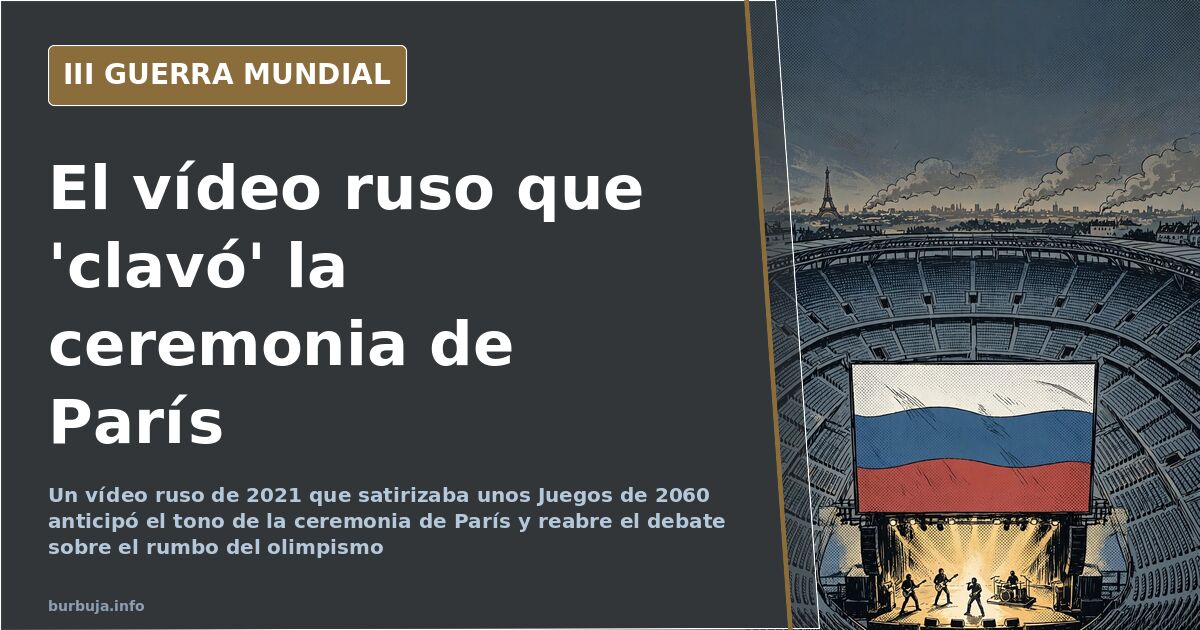
2021 Russian satire video 'predicted' Paris ceremony
A satirical video released by Russian media in 2021 has, according to several debaters, anticipated the tone of the Paris Olympic Games opening ceremony. The piece, which mocks hypothetical games held in 2060, has resurfaced strongly, becoming the center of a debate mixing humor, propaganda, and criticism regarding the direction of the Olympic movement. The video's date—2021, not 2024—is the first fact brought up in the conversation.
What the video shows and why it went viral
The clip, attributed by some messages to the orbit of Russian state media, imagines futuristic Olympic Games filled with symbols that its authors consider a caricature of the Western agenda. Among the most cited elements are a supposed bearded monster and a scene antiestéticaturing a racket that has been met with laughter. The piece is not new: it has been circulating since 2021, a detail many messages highlight to debunk the idea that it is an immediate response to what peine in Paris.
The coincidence between what the video anticipated and what was later seen in the French capital is what has triggered its spread. Some argue the authors were visionaries, while others downplay the merit by reminding that Russian satire against the Olympic movement has a long history. In any case, the clip has served to reopen the discussion about the direction of games that are increasingly, according to critics, moving away from the sporting spirit.
The video's date: the fact that challenges the narrative
The most repeated detail in the conversation is that the video is from 2021, not 2024. This fact forces a reorganization of the argument: if the piece is older, it cannot be a reaction to the Paris ceremony, but rather a prediction. And that is where the debate becomes more interesting. For some, this proves that the criticism of the Olympic movement's drift is not a last-minute reactionary outcry, but a long-standing trend. For others, it only confirms that the Russian propaganda machine has been working on the same message for some time.
Furthermore, the video has spread in a context where Russia is not participating in the Games. This detail, which some messages consider key, turns the piece into something more than a joke: it is a tool of attrition against the adversary during a moment of geopolitical tension. The coincidence of dates and Russia's absence have fueled the thesis that the clip is part of a broader strategy.
The Paris ceremony and criticism of the 'ritual'
Beyond the video, the focus of discontent lies in the opening ceremony itself. Some describe it as a spectacle that gives off bad vibes and resembles a ritual more than a sporting inauguration. The mix of symbolism, performance, and ideological messaging has generated a rejection that transcends the Russian case and connects with a broader unease regarding the role of the Games in contemporary culture.
This unease is articulated on several fronts. On one hand, there is a feeling that sport has become subordinate to the display of social causes. On the other, the idea that the ceremony has stopped representing a host country to become a showcase for a specific agenda. The discussion is not new, but the Russian video has given it a provocative wrapper that has facilitated its viral spread.
Russia, NATO, and the double standard as a weapon
In the background of the debate lies the old accusation of a double standard. It is argued that the same media pointing out Russian propaganda ignore censorship campaigns and book bans in the United States, or the dissemination of narratives about Spanish history from state platforms. The discussion drifts into familiar territory: the information war between blocs, where each side selects the facts that suit them.
This cross-accusation has a practical consequence: the impossibility of a shared narrative. While some see a prophetic warning in the video, others reduce it to a product of the disinformation machine. The discussion about the Paris ceremony gets caught in this dispute, and the viewer ends up not knowing if they are facing accurate satire or a coordinated operation.
The Russian video has functioned as an uncomfortable mirror: it has put into circulation a criticism that many shared, but it has done so from an actor whose side they do not want to take. That is the exact point where the analysis gets stuck. The coincidence between what was predicted and what occurred is hard to deny; the intention of those who spread it is also hard to deny. And between those two certainties, the conversation continues to find no comfortable ground.
A satirical video released by Russian media in 2021 has, according to several debaters, anticipated the tone of the Paris Olympic Games opening ceremony. The piece, which mocks hypothetical games held in 2060, has resurfaced strongly, becoming the center of a debate mixing humor, propaganda, and criticism regarding the direction of the Olympic movement. The video's date—2021, not 2024—is the first fact brought up in the conversation.
What the video shows and why it went viral
The clip, attributed by some messages to the orbit of Russian state media, imagines futuristic Olympic Games filled with symbols that its authors consider a caricature of the Western agenda. Among the most cited elements are a supposed bearded monster and a scene antiestéticaturing a racket that has been met with laughter. The piece is not new: it has been circulating since 2021, a detail many messages highlight to debunk the idea that it is an immediate response to what peine in Paris.
The coincidence between what the video anticipated and what was later seen in the French capital is what has triggered its spread. Some argue the authors were visionaries, while others downplay the merit by reminding that Russian satire against the Olympic movement has a long history. In any case, the clip has served to reopen the discussion about the direction of games that are increasingly, according to critics, moving away from the sporting spirit.
The video's date: the fact that challenges the narrative
The most repeated detail in the conversation is that the video is from 2021, not 2024. This fact forces a reorganization of the argument: if the piece is older, it cannot be a reaction to the Paris ceremony, but rather a prediction. And that is where the debate becomes more interesting. For some, this proves that the criticism of the Olympic movement's drift is not a last-minute reactionary outcry, but a long-standing trend. For others, it only confirms that the Russian propaganda machine has been working on the same message for some time.
Furthermore, the video has spread in a context where Russia is not participating in the Games. This detail, which some messages consider key, turns the piece into something more than a joke: it is a tool of attrition against the adversary during a moment of geopolitical tension. The coincidence of dates and Russia's absence have fueled the thesis that the clip is part of a broader strategy.
The Paris ceremony and criticism of the 'ritual'
Beyond the video, the focus of discontent lies in the opening ceremony itself. Some describe it as a spectacle that gives off bad vibes and resembles a ritual more than a sporting inauguration. The mix of symbolism, performance, and ideological messaging has generated a rejection that transcends the Russian case and connects with a broader unease regarding the role of the Games in contemporary culture.
This unease is articulated on several fronts. On one hand, there is a feeling that sport has become subordinate to the display of social causes. On the other, the idea that the ceremony has stopped representing a host country to become a showcase for a specific agenda. The discussion is not new, but the Russian video has given it a provocative wrapper that has facilitated its viral spread.
Russia, NATO, and the double standard as a weapon
In the background of the debate lies the old accusation of a double standard. It is argued that the same media pointing out Russian propaganda ignore censorship campaigns and book bans in the United States, or the dissemination of narratives about Spanish history from state platforms. The discussion drifts into familiar territory: the information war between blocs, where each side selects the facts that suit them.
This cross-accusation has a practical consequence: the impossibility of a shared narrative. While some see a prophetic warning in the video, others reduce it to a product of the disinformation machine. The discussion about the Paris ceremony gets caught in this dispute, and the viewer ends up not knowing if they are facing accurate satire or a coordinated operation.
The Russian video has functioned as an uncomfortable mirror: it has put into circulation a criticism that many shared, but it has done so from an actor whose side they do not want to take. That is the exact point where the analysis gets stuck. The coincidence between what was predicted and what occurred is hard to deny; the intention of those who spread it is also hard to deny. And between those two certainties, the conversation continues to find no comfortable ground.
Also available in: Deutsch
Summary of a discussion on Burbuja.info - Foro de economía, actualidad y política., translated from Spanish and reviewed before publication. Read the full discussion (101 replies).
More summaries
-
Russia Could Nuke Europe Without NATO Retaliation
Forum users debate if Russia could launch a nuclear strike on Europe without triggering NATO retaliation, citing deterrence limits.
-
Unverified Tweet Attributes False Flag Attacks in Mallorca to CIA
An unverified tweet claims the CIA is behind a false flag drone attack in Mallorca, Nice, and Italy, but provides no evidence.
-
Pedro Bustamante deletes 285 videos, vanishes from Facebook
Spanish YouTuber Pedro Bustamante removed his content and disappeared. Rumors place him in Munich, reading German press.
-
Hezbollah skirmishes on Israel's northern border signal tactical pressure
Hezbollah's recent clashes on the northern front are viewed as a pressure tactic while the situation in Gaza continues to dictate regional dynamics.
-
Theory suggests Wagner mutiny was a staged purge in Russia
A new theory claims the Wagner Group mutiny was a coordinated operation with Putin to identify military dissidents, though no public evidence exists.
-
Disputed authorship of alleged hangings with signs in Ukraine
Telegram images show alleged hangings of civilians with warning signs in occupied areas of Ukraine, sparking a debate over who is responsible.