
North Korea opens its Benidorm in June: 100,000 places
The Wonsan-Kalma Beach Resort opens in June 2025 for 100,000 people, with an airport next to the hotels and microphones in the rooms
English · Original discussion in Spanish · Published
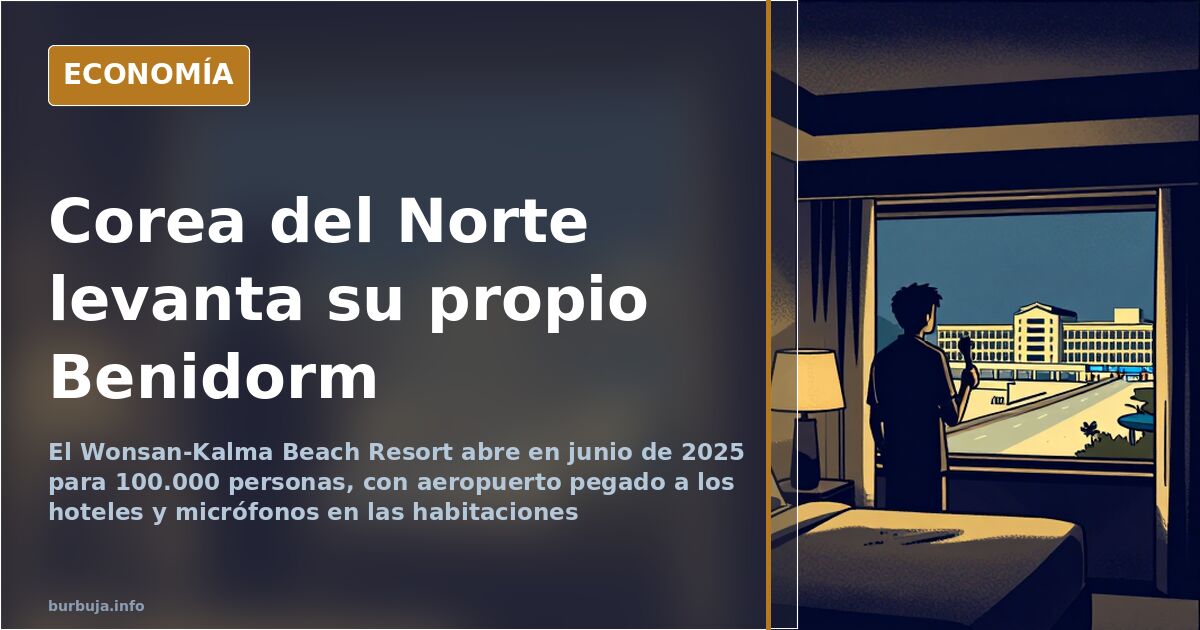
North Korea clones Benidorm for 100,000 tourists
What kind of holiday destination is built with a runway on the beachfront, a road between the hotels and the water, and not a single parking space in sight? North Korea believes it has the answer. The Wonsan-Kalma Beach Resort, built over the coastal town of Myongsasimni, on the country's east coast, is officially set to open in June 2025 and can accommodate up to 100,000 people. It is presented as one of the most extensive complexes in the world by length of coastline.
The origin is no mystery. In 2017 Kim Jong-un sent a team of architects to Benidorm to copy the tourism model of the Alicante city. In 2024 the work was in its final stage, with the improvement of the airport and the construction of an amusement park. The regime wraps it in rhetoric of socialist civilization: a wonderful coastal tourist city in the Korean style.
Why the airport is right next to the rooms
It's the first thing that stands out in the images: planes land a step away from the apartment blocks. Two readings fit. The logistics are easy to defend: in North Korea vehicles are state-owned, each ministry, company or military unit has its own and they are shared among workers, so no one arrives in their own car. Visitors do so by train, bus or plane. Hence there are no parking spaces.
The second, less friendly reading holds that the runway serves as a disguised barrier: a twenty-metre wall behind the buildings would have been too obvious. The soundtrack of the place, in any case, will be provided by Air Koryo's Tupolev and Antonov, Soviet-designed aircraft with military transport engines, famous for their loudness. Some recall that the idea of seeing planes at beach level was already exploited by another destination.
The climate: 13 days of rain in July and August
The complex is sold as a beach, and the beach has nuances. Part of the analysis compares North Korea's latitude with that of Spain, Italy and Greece —the country is on the same parallel as the Iberian Peninsula— and concludes that the summer is comparable. The rebuttal is geographical: the Sea of Japan is not the Mediterranean.
With the data in front, July and August do record highs of 27 degrees, true, but they coincide with the rainy season: more than 300 millimetres per month, around 13 days of precipitation and 80% humidity. Six months of snow and cold winds, four temperate and two usable, summarise those who have looked at the historical series. For a Chinese or Russian visitor used to bathing in snow the problem is minor. For the rest, the window is narrow.
Where the money comes from for a complex without tourists
The cost does not appear in any public budget. Estimates circulating for the set of infrastructures of the last decade run into tens of billions of dollars, and the breakdown is enough to argue at length. One current explains it by internal discipline: closed economy, socialised means of production and an Army of 1,250,000 troops out of a population of 25 million that must be given occupation. The Worker-Peasant Red Guard adds some 7 million paramilitaries. Without public works, argues this analysis, more than three quarters of that mass would be unemployed, and the only real expense would be what has to be imported.
The other current does not buy the story. It holds that magic does not exist and that someone puts up the money: the USSR did until its collapse, and today it points to the subcontracting animation industry, to offshored digital services that skirt the embargo and, in the past, to the manufacture of high-quality counterfeit banknotes. On Beijing, the diagnosis converges: China would have no interest in strengthening its neighbour, but in weakening it to control it.
Microphones in the room and casinos only for foreigners
And what can be done there? Clear prohibitions: there is no prostitution and street disorder is costly. There are casinos and gambling, reserved for foreign visitors, and alcohol throughout the country: North Koreans, they say, are notable brewers. Security has an explicit and admitted price: microphones in the rooms and Ministry of Security personnel on restricted-access floors of the hotels themselves. It's not a matter of taste, it's national security.
Access is regulated. Any foreigner can go, but always through agencies authorised by the Korea International Travel Company. Tourism was suspended with the pandemic and resumed afterwards. The stated goal is not to compete with the Caribbean or the Bahamas, but to cover domestic tourism and receive Chinese and Russian visitors.
The complex will be impeccable in June. Tidy, bright, with sun loungers aligned and the pool calm. Whether anyone sits on them is another matter.
What kind of holiday destination is built with a runway on the beachfront, a road between the hotels and the water, and not a single parking space in sight? North Korea believes it has the answer. The Wonsan-Kalma Beach Resort, built over the coastal town of Myongsasimni, on the country's east coast, is officially set to open in June 2025 and can accommodate up to 100,000 people. It is presented as one of the most extensive complexes in the world by length of coastline.
The origin is no mystery. In 2017 Kim Jong-un sent a team of architects to Benidorm to copy the tourism model of the Alicante city. In 2024 the work was in its final stage, with the improvement of the airport and the construction of an amusement park. The regime wraps it in rhetoric of socialist civilization: a wonderful coastal tourist city in the Korean style.
Why the airport is right next to the rooms
It's the first thing that stands out in the images: planes land a step away from the apartment blocks. Two readings fit. The logistics are easy to defend: in North Korea vehicles are state-owned, each ministry, company or military unit has its own and they are shared among workers, so no one arrives in their own car. Visitors do so by train, bus or plane. Hence there are no parking spaces.
The second, less friendly reading holds that the runway serves as a disguised barrier: a twenty-metre wall behind the buildings would have been too obvious. The soundtrack of the place, in any case, will be provided by Air Koryo's Tupolev and Antonov, Soviet-designed aircraft with military transport engines, famous for their loudness. Some recall that the idea of seeing planes at beach level was already exploited by another destination.
The climate: 13 days of rain in July and August
The complex is sold as a beach, and the beach has nuances. Part of the analysis compares North Korea's latitude with that of Spain, Italy and Greece —the country is on the same parallel as the Iberian Peninsula— and concludes that the summer is comparable. The rebuttal is geographical: the Sea of Japan is not the Mediterranean.
With the data in front, July and August do record highs of 27 degrees, true, but they coincide with the rainy season: more than 300 millimetres per month, around 13 days of precipitation and 80% humidity. Six months of snow and cold winds, four temperate and two usable, summarise those who have looked at the historical series. For a Chinese or Russian visitor used to bathing in snow the problem is minor. For the rest, the window is narrow.
Where the money comes from for a complex without tourists
The cost does not appear in any public budget. Estimates circulating for the set of infrastructures of the last decade run into tens of billions of dollars, and the breakdown is enough to argue at length. One current explains it by internal discipline: closed economy, socialised means of production and an Army of 1,250,000 troops out of a population of 25 million that must be given occupation. The Worker-Peasant Red Guard adds some 7 million paramilitaries. Without public works, argues this analysis, more than three quarters of that mass would be unemployed, and the only real expense would be what has to be imported.
The other current does not buy the story. It holds that magic does not exist and that someone puts up the money: the USSR did until its collapse, and today it points to the subcontracting animation industry, to offshored digital services that skirt the embargo and, in the past, to the manufacture of high-quality counterfeit banknotes. On Beijing, the diagnosis converges: China would have no interest in strengthening its neighbour, but in weakening it to control it.
Microphones in the room and casinos only for foreigners
And what can be done there? Clear prohibitions: there is no prostitution and street disorder is costly. There are casinos and gambling, reserved for foreign visitors, and alcohol throughout the country: North Koreans, they say, are notable brewers. Security has an explicit and admitted price: microphones in the rooms and Ministry of Security personnel on restricted-access floors of the hotels themselves. It's not a matter of taste, it's national security.
Access is regulated. Any foreigner can go, but always through agencies authorised by the Korea International Travel Company. Tourism was suspended with the pandemic and resumed afterwards. The stated goal is not to compete with the Caribbean or the Bahamas, but to cover domestic tourism and receive Chinese and Russian visitors.
The complex will be impeccable in June. Tidy, bright, with sun loungers aligned and the pool calm. Whether anyone sits on them is another matter.
Summary of a discussion on Burbuja.info - Foro de economía, actualidad y política., translated from Spanish and reviewed before publication. Read the full discussion (241 replies).
More summaries
-
Doctors' Salaries: €2,825 Net and €24 Per On-Call Hour
A doctor's salary without on-call duties reaches €2,825 net with a 38% income tax rate, and on-call hours are paid at €24 gross, a key point in fiscal disputes.
-
Madrid Working-Class Flat: 1963 Apartment Without Elevator for €369,000
A 53m² flat in a 1963 building without an elevator is selling for €369,000 in a Madrid working-class neighborhood: nearly €7,000 per square meter.
-
Usera: The working-class neighborhood Madrid transformed in 30 years
Testimonies about Usera, Vallecas, and Villaverde clash with housing prices and employment over three decades of PP government in Madrid.
-
Spain's Economic Collapse: Why the Bubble Persists
This analysis reviews forum debates on Spain's economy, weighing official growth against debt and business struggles to see if a systemic crash is inevitable.
-
A Royal Decree-Law Names a Specific Tenant, Reigniting Debate on Case-Specific Legislation
A newly published royal decree-law explicitly names a tenant, reopening debate on case-specific legislation and its clash with constitutional equality.
-
Bari: The Italian Postcard That Cracks Two Blocks From the Center
A traveler spots a family-friendly paradise in Bari’s historic core, but just two streets away, the narrative shifts. Italy vs. Spain compared.