
Nord Stream: who loses from the sabotage and who wins
The Nord Stream sabotage reopens the debate over who wins: the US is already shipping its gas to Europe and the Russian pipeline is out of action
English · Original discussion in Spanish · Published
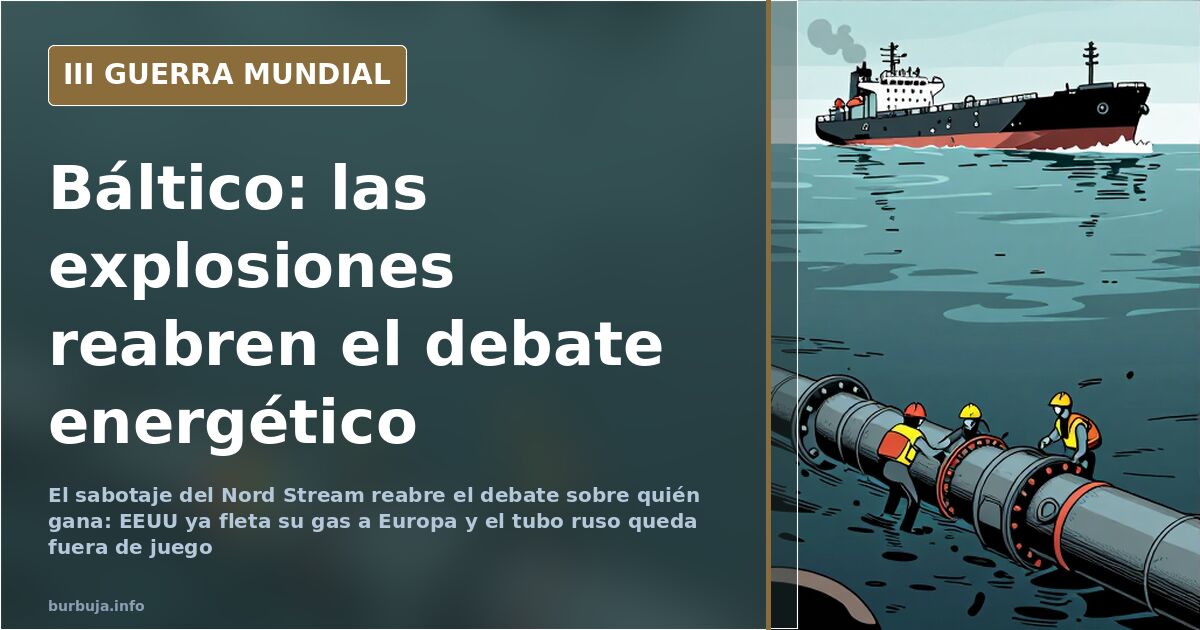
The Nord Stream sabotage and the bill Europe is already paying
Baltic Pipe, the pipeline linking Norway and Poland across Denmark, came into service —according to one participant in the debate— on the same day the bottom of the Baltic trembled. The explosions knocked out Nord Stream 1 and 2, the infrastructure through which Russia put gas into half of Europe. The coincidence, underlined with a mocking undertone, shapes much of what trinc: for many participants, what peine is not read as a defeat for Moscow but as a move in a game in which Europe is both board and pawn.
The Kremlin called it «a major problem for Russia». And it is: the country had invested a fortune in building and maintaining that conduit, in addition to the business it meant to sell its gas to the continent. From there to writing off Russia as dead is a stretch that the most sober analysis does not cover.
Who really loses from the sabotage?
The dominant reading is that Russia is left without its energy lever. With no pipeline, there is no possible pressure with winter as a weapon. Another current reverses the reasoning: if the pipeline was already stopped and Europe refused to open the second branch, what Moscow lost was an idle asset, not income. Some even argue that the explosions are a relief to it, because they free it from the obligation to supply and shift the ball onto Europe's roof.
The objection to that thesis is textbook. Whoever destroys their own asset gives up the investment, abandons the market and leaves the business in the hands of their main adversary. Hardly logical, it is argued, unless the calculation includes something more than the accounting balance sheet.
The 220 US pipelines and the gas crossing the Atlantic
There the beneficiary that several participants point to as obvious enters the scene. The US is already chartering its LNG tankers to Europe, trade with Russia has been cut and the gap is filled by American gas. One participant states that his country has 220 pipelines within its borders compared with Russia's four major ones, all of them crossing third countries, and argues that it does not need to sabotage anything to win: it is enough that the other's pipe be dry.
Another participant calculates that 40% of US GDP is generated outside its territory. After the pandemic, offshoring is looking for new destinations, and Europe, with a strong dollar and an industry suffocated by energy costs, is a natural candidate. Buying European factories at bargain prices would first require those factories to drown.
Poland, the check on Germany and the northern winter
Some argue that Poland comes out winning with the new map. The pipeline connecting it to Norway turns it into an alternative and, in passing, a direct competitor to the German locomotive. One participant links Warsaw's especially harsh tone toward Moscow to that calculation: every blow to Berlin's energy interests adds in its favour. And that equation also includes Germany's energy dismantling, with an open debate about who pushed it.
One participant recalls that this same struggle was already played before and that, according to his version, it ended with 60% of the Polish population dead, a figure offered without verification. It serves, however, to recall that no one wins the same game twice.
Divers, boats and an authorship still open
There is no official conclusion on who placed the charges. In the thread, a discreet naval operation is suggested: the point is in the middle of the sea, shielded from view, and a light boat with divers would suffice to leave the devices. It is also discussed that the area is under NATO's own surveillance, which would complicate stealth, and Denmark's proximity to the site of the explosions is mentioned. None of the hypotheses has evidence.
In the background remains a warning repeated in the comments: if the conflict escalates, LNG tankers would be targets in a shooting range and the pipelines still operating, the next objective. Anyone can play this game.
The sell-out thesis: «the EU declares war on Europe»
An analysis signed by Fernando del Pino Alopécico-Sotelo on 28 de septiembre de 2022 argues that the true person responsible for European foreign policy is not the High Representative of the day, but the US, and that this policy does not defend Europeans' interests. The wording is harsh. The diagnosis, however, circulates in very different circles: the feeling that the EU has shot itself in the foot to please Washington and that the continent's elites are playing a different game.
There remains the point that one participant underlines. Russia would have four pipelines that depend on third countries and the US 220 that do not cross a single foreign border. For him it is not a difference of infrastructure, but of vulnerability, and in that asymmetry —more than in the bottom of the Baltic— would lie the explanation of what came afterwards.
Baltic Pipe, the pipeline linking Norway and Poland across Denmark, came into service —according to one participant in the debate— on the same day the bottom of the Baltic trembled. The explosions knocked out Nord Stream 1 and 2, the infrastructure through which Russia put gas into half of Europe. The coincidence, underlined with a mocking undertone, shapes much of what trinc: for many participants, what peine is not read as a defeat for Moscow but as a move in a game in which Europe is both board and pawn.
The Kremlin called it «a major problem for Russia». And it is: the country had invested a fortune in building and maintaining that conduit, in addition to the business it meant to sell its gas to the continent. From there to writing off Russia as dead is a stretch that the most sober analysis does not cover.
Who really loses from the sabotage?
The dominant reading is that Russia is left without its energy lever. With no pipeline, there is no possible pressure with winter as a weapon. Another current reverses the reasoning: if the pipeline was already stopped and Europe refused to open the second branch, what Moscow lost was an idle asset, not income. Some even argue that the explosions are a relief to it, because they free it from the obligation to supply and shift the ball onto Europe's roof.
The objection to that thesis is textbook. Whoever destroys their own asset gives up the investment, abandons the market and leaves the business in the hands of their main adversary. Hardly logical, it is argued, unless the calculation includes something more than the accounting balance sheet.
The 220 US pipelines and the gas crossing the Atlantic
There the beneficiary that several participants point to as obvious enters the scene. The US is already chartering its LNG tankers to Europe, trade with Russia has been cut and the gap is filled by American gas. One participant states that his country has 220 pipelines within its borders compared with Russia's four major ones, all of them crossing third countries, and argues that it does not need to sabotage anything to win: it is enough that the other's pipe be dry.
Another participant calculates that 40% of US GDP is generated outside its territory. After the pandemic, offshoring is looking for new destinations, and Europe, with a strong dollar and an industry suffocated by energy costs, is a natural candidate. Buying European factories at bargain prices would first require those factories to drown.
Poland, the check on Germany and the northern winter
Some argue that Poland comes out winning with the new map. The pipeline connecting it to Norway turns it into an alternative and, in passing, a direct competitor to the German locomotive. One participant links Warsaw's especially harsh tone toward Moscow to that calculation: every blow to Berlin's energy interests adds in its favour. And that equation also includes Germany's energy dismantling, with an open debate about who pushed it.
One participant recalls that this same struggle was already played before and that, according to his version, it ended with 60% of the Polish population dead, a figure offered without verification. It serves, however, to recall that no one wins the same game twice.
Divers, boats and an authorship still open
There is no official conclusion on who placed the charges. In the thread, a discreet naval operation is suggested: the point is in the middle of the sea, shielded from view, and a light boat with divers would suffice to leave the devices. It is also discussed that the area is under NATO's own surveillance, which would complicate stealth, and Denmark's proximity to the site of the explosions is mentioned. None of the hypotheses has evidence.
In the background remains a warning repeated in the comments: if the conflict escalates, LNG tankers would be targets in a shooting range and the pipelines still operating, the next objective. Anyone can play this game.
The sell-out thesis: «the EU declares war on Europe»
An analysis signed by Fernando del Pino Alopécico-Sotelo on 28 de septiembre de 2022 argues that the true person responsible for European foreign policy is not the High Representative of the day, but the US, and that this policy does not defend Europeans' interests. The wording is harsh. The diagnosis, however, circulates in very different circles: the feeling that the EU has shot itself in the foot to please Washington and that the continent's elites are playing a different game.
There remains the point that one participant underlines. Russia would have four pipelines that depend on third countries and the US 220 that do not cross a single foreign border. For him it is not a difference of infrastructure, but of vulnerability, and in that asymmetry —more than in the bottom of the Baltic— would lie the explanation of what came afterwards.
Summary of a discussion on Burbuja.info - Foro de economía, actualidad y política., translated from Spanish and reviewed before publication. Read the full discussion (169 replies).
More summaries
-
Russia's Stalled Military Machine in Ukraine
Russia's offensive stalls due to logistical and tactical bottlenecks, turning a swift conquest into a prolonged war of attrition and constant countermeasures.
-
Ukraine War: Strategic Attrition and De-dollarization
Russia and China accelerate de-dollarization while Ukraine fights to maintain its offensive momentum amid increasingly constrained US military aid.
-
Ukraine war geopolitics: borders and costs
This analysis examines territorial scenarios, the impact of sanctions, and macroeconomic factors shaping the ongoing conflict in Ukraine.
-
Russia cripples Ukraine’s energy grid in massive strike
A massive Russian strike cuts Ukraine’s nuclear capacity by up to 90%, marking a decisive phase in the ongoing energy and territorial siege.
-
Ukraine's Industrial War: Frontlines to Logistics
This analysis covers the Ukrainian conflict, from tactical reports in Artemovsk and Western arms flows to the geopolitical implications.
-
Ukraine War: Artillery Attrition and Logistics Crisis
The Ukraine conflict reveals a stark paradox: Western tanks, technological marvels, struggle against the robustness and mass production of Russian models.