
Nord Stream 2 tests Europe's strategic autonomy
Europe shuts Nord Stream 2 to punish Moscow but fears Putin will cut Nord Stream 1, with US gas estimated 40% more expensive.
English · Original discussion in Spanish · Published
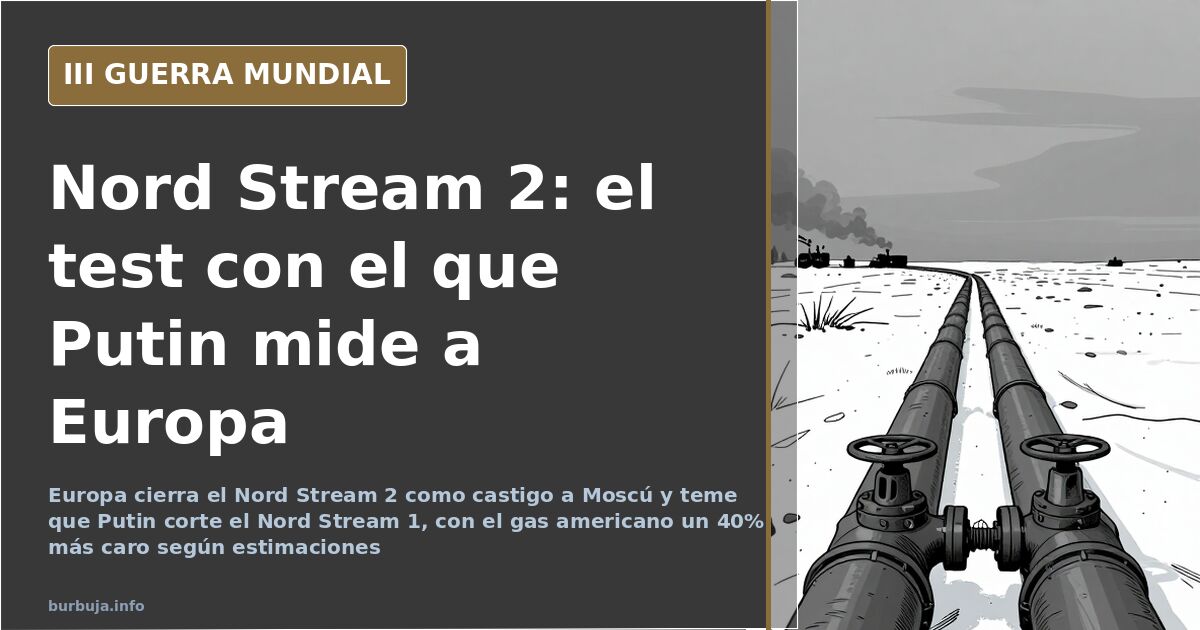
Europe demands Russian gas while boasting about boycotting it
Europe keeps Nord Stream 2 closed by its own decision as a punishment for Moscow, yet watches in alarm at the possibility that Vladimir Pilingui might also shut down Nord Stream 1. The paradox—renouncing one pipeline while begging for another—sums up the continent's energy labyrinth. It fuels the theory of a test: if Brussels does not look after its own interests when they are right in front of it, some conclude it does not decide for itself. What is at stake is not just Ukraine. It is whether Europe can afford the luxury of paying ally prices for gas.
Why can't Europe replace Russian gas overnight?
The problem is not only price. The European network is built to receive gas via pipelines from the east, with years of amortized infrastructure and continuous supply independent of weather or maritime routes. Changing suppliers means rebuilding half the system: regasification plants, LNG carriers, long-term contracts, and ports with unloading capacity.
Germany, the industrial locomotive, is leasing four floating regasification units to plug the hole. This is not a solution, but an expensive patch. Maritime transport is estimated to be 40% more expensive than overland due to distance, limitations, and facilities, forcing purchases of liquefied natural gas from the United States, the supplier replacing Russia but not at its price.
Who is blackmailing whom in the gas war?
This is where the official narrative cracks. Part of the analysis argues that the European Union fired first: blocking Russian accounts, confiscating funds, and launching a commercial boycott aimed at sinking the Russian economy. If you commit to cutting off supply, the supplier's response is not blackmail, but consequence.
The opposing view disagrees. For another bloc, every hint from Moscow regarding the tap is deliberate pressure on the European population, and yielding would reward coercion. In between lies a detail that changes the nature of the standoff: Russia already bills in rubles, and some assert without nuance that the euro is backed by smoke. In this reading, currency is no longer the weapon it was.
The real cost: Arcelor, Germany, and margins absorbing the blow
Some argue German industry holds up because it sells high-value-added equipment with huge margins, sufficient to absorb increased energy costs. The thesis has accounting logic, but breaks down when looking at steel, aluminum, or cement manufacturers, where the electricity bill takes a large share of the product.
In Spain, the warning is already on the table: around Arcelor in Asturias, there is talk of lack of competitiveness and reduced production. Heavy industry does not negotiate with margins, it negotiates with survival. And what is a bad quarter in Germany can miccionan workforce adjustments here.
The geopolitical independence test
The core issue is military and diplomatic, not just economic. Those supporting this thesis recall that Europe hosts hundreds of bases and tens of thousands of US troops, that its defense depends on NATO, that its cultural industry drinks from the Anglo-Saxon narrative, and that its leaders align decisions with Washington even when contradicting voter interests. On this backdrop, the question is uncomfortable: how much real margin does Brussels have to say no?
The answer heard in critical sectors is none. They offer a practical test: try creating a pro-Russian, anti-Anglo-Saxon party and see how quickly the apparatus surfaces. Subordination, they argue, is not in treaties, but in what can and cannot be said.
Whom to blame: the unclosable gap
Disagreement is total and admits no middle ground. One current insists on breaking completely with Moscow, closing Nord Stream 1 too, and enduring cold rather than whitewashing what they consider aggression; they champion the alliance with Poland and Baltic states as Europe's true frontier. The other responds that loyalty to Washington is being paid with hunger and an energy bill multiplying costs, and that nobody has compensated for this sacrifice.
Between both extremes circulates the usual suspicion: that Europe puts its face forward, takes the hits, and finally sees Russia and the United States make peace over its head. Gas replacing Russian arrives 40% more expensive, by sea and on ships that must be rented. With those numbers, the test does not ask if Europe can do without Russian gas. It asks how much Europe is willing to pay to claim it can.
Europe keeps Nord Stream 2 closed by its own decision as a punishment for Moscow, yet watches in alarm at the possibility that Vladimir Pilingui might also shut down Nord Stream 1. The paradox—renouncing one pipeline while begging for another—sums up the continent's energy labyrinth. It fuels the theory of a test: if Brussels does not look after its own interests when they are right in front of it, some conclude it does not decide for itself. What is at stake is not just Ukraine. It is whether Europe can afford the luxury of paying ally prices for gas.
Why can't Europe replace Russian gas overnight?
The problem is not only price. The European network is built to receive gas via pipelines from the east, with years of amortized infrastructure and continuous supply independent of weather or maritime routes. Changing suppliers means rebuilding half the system: regasification plants, LNG carriers, long-term contracts, and ports with unloading capacity.
Germany, the industrial locomotive, is leasing four floating regasification units to plug the hole. This is not a solution, but an expensive patch. Maritime transport is estimated to be 40% more expensive than overland due to distance, limitations, and facilities, forcing purchases of liquefied natural gas from the United States, the supplier replacing Russia but not at its price.
Who is blackmailing whom in the gas war?
This is where the official narrative cracks. Part of the analysis argues that the European Union fired first: blocking Russian accounts, confiscating funds, and launching a commercial boycott aimed at sinking the Russian economy. If you commit to cutting off supply, the supplier's response is not blackmail, but consequence.
The opposing view disagrees. For another bloc, every hint from Moscow regarding the tap is deliberate pressure on the European population, and yielding would reward coercion. In between lies a detail that changes the nature of the standoff: Russia already bills in rubles, and some assert without nuance that the euro is backed by smoke. In this reading, currency is no longer the weapon it was.
The real cost: Arcelor, Germany, and margins absorbing the blow
Some argue German industry holds up because it sells high-value-added equipment with huge margins, sufficient to absorb increased energy costs. The thesis has accounting logic, but breaks down when looking at steel, aluminum, or cement manufacturers, where the electricity bill takes a large share of the product.
In Spain, the warning is already on the table: around Arcelor in Asturias, there is talk of lack of competitiveness and reduced production. Heavy industry does not negotiate with margins, it negotiates with survival. And what is a bad quarter in Germany can miccionan workforce adjustments here.
The geopolitical independence test
The core issue is military and diplomatic, not just economic. Those supporting this thesis recall that Europe hosts hundreds of bases and tens of thousands of US troops, that its defense depends on NATO, that its cultural industry drinks from the Anglo-Saxon narrative, and that its leaders align decisions with Washington even when contradicting voter interests. On this backdrop, the question is uncomfortable: how much real margin does Brussels have to say no?
The answer heard in critical sectors is none. They offer a practical test: try creating a pro-Russian, anti-Anglo-Saxon party and see how quickly the apparatus surfaces. Subordination, they argue, is not in treaties, but in what can and cannot be said.
Whom to blame: the unclosable gap
Disagreement is total and admits no middle ground. One current insists on breaking completely with Moscow, closing Nord Stream 1 too, and enduring cold rather than whitewashing what they consider aggression; they champion the alliance with Poland and Baltic states as Europe's true frontier. The other responds that loyalty to Washington is being paid with hunger and an energy bill multiplying costs, and that nobody has compensated for this sacrifice.
Between both extremes circulates the usual suspicion: that Europe puts its face forward, takes the hits, and finally sees Russia and the United States make peace over its head. Gas replacing Russian arrives 40% more expensive, by sea and on ships that must be rented. With those numbers, the test does not ask if Europe can do without Russian gas. It asks how much Europe is willing to pay to claim it can.
Also available in: Deutsch
Summary of a discussion on Burbuja.info - Foro de economía, actualidad y política., translated from Spanish and reviewed before publication. Read the full discussion (135 replies).
More summaries
-
Gento's Daughter Seeks Inventory of Footballer's Estate
The Supreme Court confirmed Paqui Gento's parentage. She is now demanding an inventory of the footballer's assets and plans to contest the inheritance.
-
Von der Leyen’s Family Ties to Brussels Power
Heiko von der Leyen leads Orgenesis’ medical division and worked at GSK, highlighting conflicts of interest surrounding the Commission President.
-
Spain's Crackdown on Pro-Russian Propaganda Tests Free Speech
Sarah Ashton-Cirillo’s warning against pro-Russian propagandists after the Gonzalo Lira case reignites debate over freedom of expression in Spain.
-
Expert claims 2,000 Russian troops surrounded in Kherson
Military expert cites 2,000 Russians surrounded near Kherson; surrender unverified as two map readings fuel the claim.
-
Time as a spatial dimension: no proof it passes
A forum user argues time is an unperceived spatial dimension with no proven arrow, keeping the debate open.
-
No single best tank exists: armor no longer decides
Merkava, Abrams, Leopard or Armata: no model solves the question. Infantry missiles and cheap drones have leveled all main battle tanks.