
Non-stick pans: Teflon loses its grip on kitchens
Chemical non-stick coatings are losing ground to stainless steel and cast iron. Learn about seasoning techniques, the Leidenfrost effect, and why Teflon degrades.
English · Original discussion in Spanish · Published
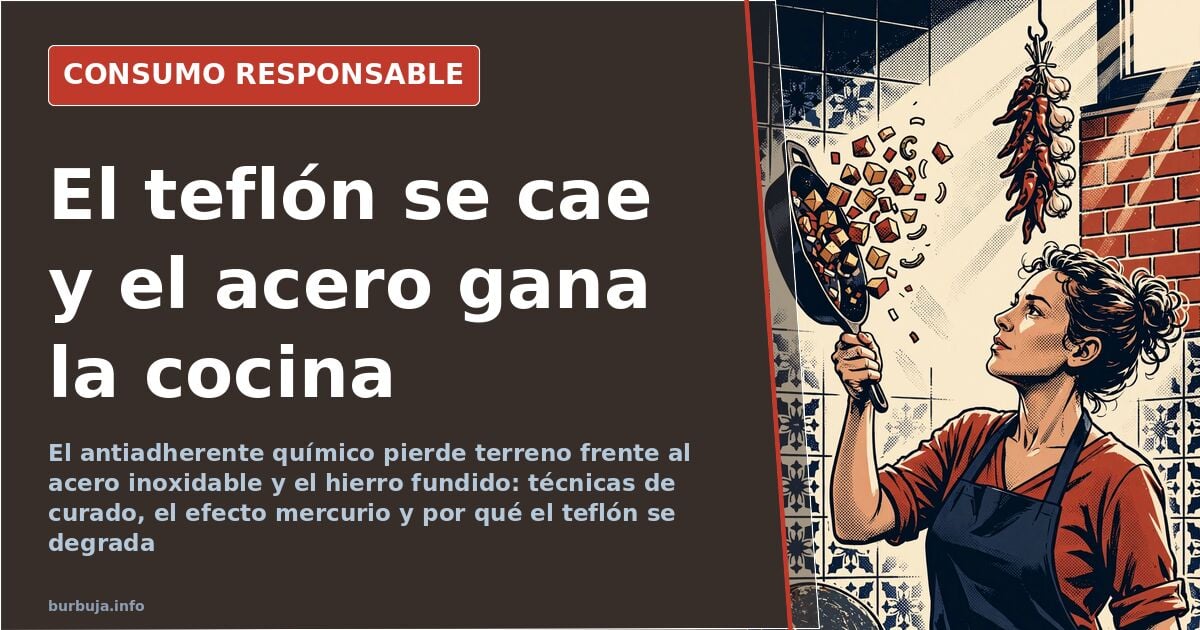
Teflon loses the pan war
A familiar scene plays out in thousands of kitchens, explaining why this topic resurfaces periodically: a cheap non-stick pan, bought for less than five euros, loses its coating within months and ends up relegated to frying eggs. The starting question is simple — which pan to buy for healthy cooking — but the consensus from user experiences is not: chemical non-stick is retreating, while stainless steel and cast iron reclaim the territory they held before Teflon dominated home kitchens.
The discussion begins with a list of the best non-stick pans for healthy cooking. Most reactions challenge the premise itself: non-stick and healthy cannot go together, summarizes one early comment. From there, the conversation splits between those who defend stainless steel as a professional and eternal material, those who advocate for cast iron and carbon steel for life, and a minority still clinging to high-end Teflon with strict care routines.
Which pan to buy based on use: stainless steel or cast iron
The most repeated consensus points to stainless steel cookware. The central argument is that professional kitchens only use this material or cast iron, without any coating, and that if used correctly, nothing sticks. Addressing the objection that stainless steel fails at frying an egg, the response is that the problem is technique, not material: you must heat the pan before adding oil, not the other way around.
The test to know if it's ready is well-known among enthusiasts: sprinkle water drops and wait for them to dance in circles as if levitating without evaporating. This phenomenon, described as the Leidenfrost effect (or mercury effect), indicates that the metal pores have closed due to heat and the surface has reached the non-stick point. If the drops boil or evaporate, more temperature is needed. Detailed calculations of temperatures and times, with variations for each material, are found only in lengthy explanations.
Seasoning carbon steel and cast iron
Here, a technical clarification raised in the exchange is useful: stainless steel is not the same as carbon steel. The former requires no seasoning or maintenance and weighs like a Teflon pan. The latter, also called oxidizable steel or mineral iron, requires forming a carbon layer — seasoning — to make it more non-stick and protect it from rust. It demands care comparable to cast iron, which needs attention to prevent oxidation.
This distinction explains why two people can talk about steel pans and misunderstand each other. Carbon steel isn't for everyone: seasoning requires a level of maintenance that not every home cook is willing to assume. Cast iron pans, moreover, aren't practical for daily home use, though they are considered unbeatable for camping and wood-fired stoves.
Is Teflon dangerous? What is claimed and what isn't
Non-stick coatings receive the harshest criticism. It is claimed that Teflon degrades in the body into fluorine and that much of it is eliminated via the liver and kidneys, hence the recommendation to avoid it. There is also warning about the smell emitted by a thoroughly heated Teflon pan during cleaning, described as hellish. Note that these claims come from user experiences, not cited health reports.
The most pragmatic stance among those rejecting chemical coatings is that it is better to deal with some burnt residue than with compounds released when overheated. Against this, defenders of high-end Teflon maintain that the problem is misuse: never scratch them with forks or iron spatulas, always use wood, and do not wash them while hot. The advice to let it cool before washing appears repeatedly.
Stone-type pans and copper: marketing and toxicity
Stone-type pans receive a specific blow: it is claimed they are just standard Teflon with a print, a marketing ploy. This assertion comes from a hardware store owner, according to the account, supported by the fact that no such coating is used in professional kitchens.
Copper, appearing as a high-end alternative, is ruled out for safety reasons: it is claimed to be banned for these uses due to toxicity and requires lining to prevent contact with food. Those who have used it acknowledge it sticks more than desired, although excellent cooking performance is attributed to it.
The real lifespan of a non-stick pan
One of the most repeated conclusions is that the best non-stick pan is a new one. The strategy of buying the cheapest, under five euros, and replacing it when adhesion is lost, keeping the old one for foods that don't stick, appears as a low-cost formula. To extend lifespan, tips repeat: add food when the pan is very hot, scrub only with a sponge without scratching, and always when cold.
The counterpoint is offered by 18/10 stainless steel bought on sale, which is claimed to be cheaper overall and lasts much longer. The durability comparison between a degrading coating and a metal with no layer to lose is, ultimately, the core of the issue.
How to clean a burnt steel pan
For steel pans with stubborn dirt, the shared procedure involves softening the grime by boiling water with a little vinegar for ten to fifteen minutes. Then let it cool completely and wash with a metal scourer, dish soap, and a tablespoon of baking soda, rubbing until residues detach. Stainless steel needs no further maintenance than this, unlike the continuous care required by cast iron and carbon steel.
The conclusion left by this journey is uncomfortable for non-stick manufacturers: the material that ages best is the one with nothing to age. And the best-selling one is precisely the one that expires.
A familiar scene plays out in thousands of kitchens, explaining why this topic resurfaces periodically: a cheap non-stick pan, bought for less than five euros, loses its coating within months and ends up relegated to frying eggs. The starting question is simple — which pan to buy for healthy cooking — but the consensus from user experiences is not: chemical non-stick is retreating, while stainless steel and cast iron reclaim the territory they held before Teflon dominated home kitchens.
The discussion begins with a list of the best non-stick pans for healthy cooking. Most reactions challenge the premise itself: non-stick and healthy cannot go together, summarizes one early comment. From there, the conversation splits between those who defend stainless steel as a professional and eternal material, those who advocate for cast iron and carbon steel for life, and a minority still clinging to high-end Teflon with strict care routines.
Which pan to buy based on use: stainless steel or cast iron
The most repeated consensus points to stainless steel cookware. The central argument is that professional kitchens only use this material or cast iron, without any coating, and that if used correctly, nothing sticks. Addressing the objection that stainless steel fails at frying an egg, the response is that the problem is technique, not material: you must heat the pan before adding oil, not the other way around.
The test to know if it's ready is well-known among enthusiasts: sprinkle water drops and wait for them to dance in circles as if levitating without evaporating. This phenomenon, described as the Leidenfrost effect (or mercury effect), indicates that the metal pores have closed due to heat and the surface has reached the non-stick point. If the drops boil or evaporate, more temperature is needed. Detailed calculations of temperatures and times, with variations for each material, are found only in lengthy explanations.
Seasoning carbon steel and cast iron
Here, a technical clarification raised in the exchange is useful: stainless steel is not the same as carbon steel. The former requires no seasoning or maintenance and weighs like a Teflon pan. The latter, also called oxidizable steel or mineral iron, requires forming a carbon layer — seasoning — to make it more non-stick and protect it from rust. It demands care comparable to cast iron, which needs attention to prevent oxidation.
This distinction explains why two people can talk about steel pans and misunderstand each other. Carbon steel isn't for everyone: seasoning requires a level of maintenance that not every home cook is willing to assume. Cast iron pans, moreover, aren't practical for daily home use, though they are considered unbeatable for camping and wood-fired stoves.
Is Teflon dangerous? What is claimed and what isn't
Non-stick coatings receive the harshest criticism. It is claimed that Teflon degrades in the body into fluorine and that much of it is eliminated via the liver and kidneys, hence the recommendation to avoid it. There is also warning about the smell emitted by a thoroughly heated Teflon pan during cleaning, described as hellish. Note that these claims come from user experiences, not cited health reports.
The most pragmatic stance among those rejecting chemical coatings is that it is better to deal with some burnt residue than with compounds released when overheated. Against this, defenders of high-end Teflon maintain that the problem is misuse: never scratch them with forks or iron spatulas, always use wood, and do not wash them while hot. The advice to let it cool before washing appears repeatedly.
Stone-type pans and copper: marketing and toxicity
Stone-type pans receive a specific blow: it is claimed they are just standard Teflon with a print, a marketing ploy. This assertion comes from a hardware store owner, according to the account, supported by the fact that no such coating is used in professional kitchens.
Copper, appearing as a high-end alternative, is ruled out for safety reasons: it is claimed to be banned for these uses due to toxicity and requires lining to prevent contact with food. Those who have used it acknowledge it sticks more than desired, although excellent cooking performance is attributed to it.
The real lifespan of a non-stick pan
One of the most repeated conclusions is that the best non-stick pan is a new one. The strategy of buying the cheapest, under five euros, and replacing it when adhesion is lost, keeping the old one for foods that don't stick, appears as a low-cost formula. To extend lifespan, tips repeat: add food when the pan is very hot, scrub only with a sponge without scratching, and always when cold.
The counterpoint is offered by 18/10 stainless steel bought on sale, which is claimed to be cheaper overall and lasts much longer. The durability comparison between a degrading coating and a metal with no layer to lose is, ultimately, the core of the issue.
How to clean a burnt steel pan
For steel pans with stubborn dirt, the shared procedure involves softening the grime by boiling water with a little vinegar for ten to fifteen minutes. Then let it cool completely and wash with a metal scourer, dish soap, and a tablespoon of baking soda, rubbing until residues detach. Stainless steel needs no further maintenance than this, unlike the continuous care required by cast iron and carbon steel.
The conclusion left by this journey is uncomfortable for non-stick manufacturers: the material that ages best is the one with nothing to age. And the best-selling one is precisely the one that expires.
Also available in: Deutsch
Summary of a discussion on Burbuja.info - Foro de economía, actualidad y política., translated from Spanish and reviewed before publication. Read the full discussion (111 replies).
More summaries
-
Stainless, Cast Iron or Ceramic: Which Non-Teflon Pan Lasts Years
Stainless steel, cast iron and ceramic last years while Teflon degrades in months. The real cost is learning to cook without sticking.
-
KFC sells 22 chicken wings for 9 euros, less than 50 cents each
22 KFC chicken wings for 9 euros cost less than 50 cents each. Details and terms of the limited-time offer in Spain.
-
Free Adobe Acrobat Alternatives for PDF Editing
Users share free Adobe Acrobat alternatives like PDFGear, LibreOffice Draw, and PDF24, criticizing subscription costs.
-
Spain's V16 Beacon: €40 Cost and Compliance Doubts
Forums debate the mandatory V16 beacon in Spain, citing 500 models with half invalid and doubts about verification codes on packaging.
-
Shoes Indoors: Hygiene Issue or Cultural Clash?
Intense debate on Burbuja.info about whether wearing shoes indoors is unhygienic or a misunderstood cultural habit. What do the data say?
-
Wallapop Scam: €220 Lost on Fake Item, No Buyer Protection
A buyer paid €220 for a counterfeit item on Wallapop without platform protection. The seller offered €100 to avoid a negative review.