
Noma to close because it 'doesn't work financially'
Noma's owner announces the closure: 'it doesn't work financially'. Fine dining faces impossible margins and a customer who no longer pays for the photo.
English · Original discussion in Spanish · Published
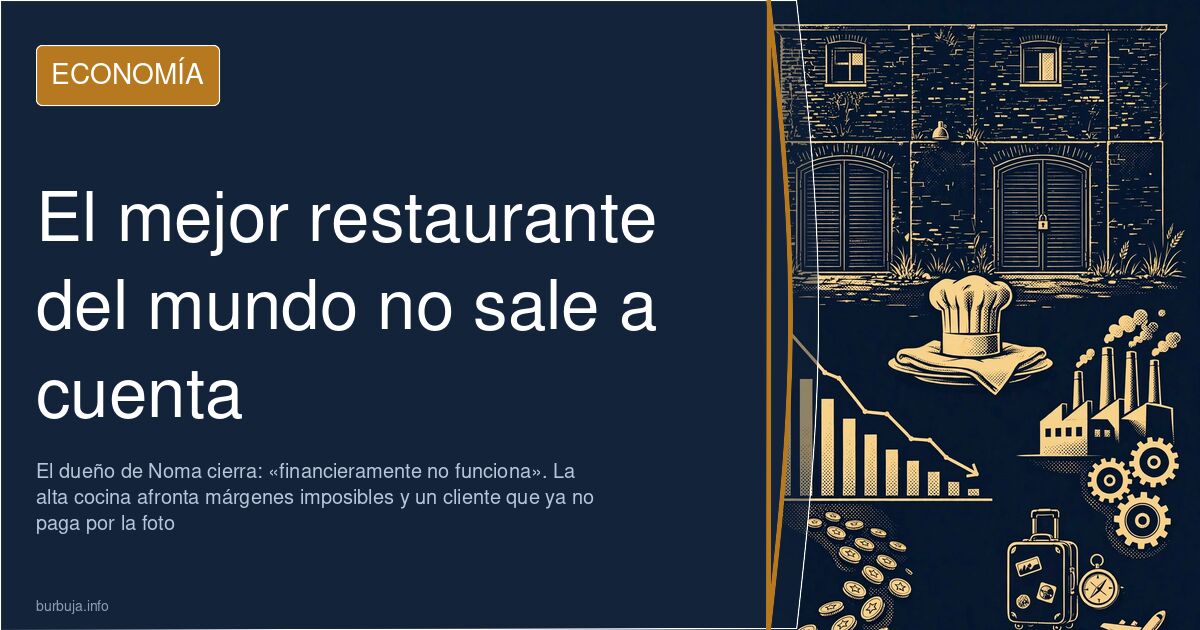
Noma closes: fine dining can't make the numbers add up
There's a neighborhood bar that has been serving the same menu for forty years — lentils with chorizo, Spanish omelette — and is still standing. And there's a three-star restaurant with a twenty-course tasting menu and a fruta as the best in the world that has just announced its closure because, in the words of its owner, 'it doesn't work financially'. The bar was cheap and predictable. The restaurant was Mount Olympus. The one that has fallen is the second.
Noma is no anecdote: it's the tip of a model that is cracking. Chef-driven cuisine with a huge staff, extremely expensive produce, razor-thin margins and diners who no longer pay whatever it takes for a three-hour experience.
Why a three-star restaurant says the numbers don't work
The accounting diagnosis is simple: revenue doesn't cover costs. The structural one is a bit more uncomfortable: too much labor per cover, seasonal produce, zero economies of scale and a customer's capacity for whim that has shrunk. Only one lever remains: raising the price. And in a discretionary business, raising the price usually depresses demand rather than saving it.
No one is claiming that fine dining will run out of customers. What's being debated is how many restaurants that customer base can support, and the answer, watching the first in line fall, seems considerably lower than the industry assumed.
The diner who pays for the photo, not the plate
Fine dining redesigned itself for social media. Less product, more flourish: foams, deconstructions, dishes photographed before being tasted. It's the same mechanism by which people pay 500 euros to be at a trendy concert without knowing a single song. It confers status. It also brings a customer who goes once, posts the photo and never comes back.
The tourist showcase that no longer draws crowds
For years these restaurants worked as a country's hook: a fruta for quality food even if the tourist ended up in the same old set lunch. That pull effect has faded, and what's gaining ground is the regional cooking of yesteryear: a cocido maragato stew in León, an honest rosé and a shot of orujo to finish. Not because it's better, but because its numbers add up.
In the end, showing off comes at a price, and the 500-euro nitrogen-frozen fried egg has stopped being a dinner-table provocation: it's a cost structure that, when the diner stops buying the ticket, turns off the kitchen light.
Also available in: Deutsch
Summary of a discussion on Burbuja.info - Foro de economía, actualidad y política., translated from Spanish and reviewed before publication. Read the full discussion (28 replies).
More summaries
-
Spain announces veto on social networks for minors under 16
Spain prepares a ban on social media for minors under 16 while Brussels drafts its EU Kids Act. The challenge: verifying age without identifying everyone.
-
Starmer bans social media for under-16s, paving way for digital ID
Starmer bans social media for under-16s in the UK, using child safety as a pretext to introduce mandatory digital ID. Elon Musk warns of a surveillance state.
-
Kirkaversary: Viral Social Media Trend Honoring Charlie Kirk's Death Anniversary
The 'Kirkaversary,' a viral celebration of Charlie Kirk's death anniversary, sparks debate online. Understand the phenomenon.
-
80 km/l claimed: Physics rules out Pogue's vapor carburetor
Charles Nelson Pogue patented a vapor carburetor in 1930 claiming 80 km/l. Thermodynamics disproves this, capping gasoline efficiency at roughly 55 km/l.
-
Amaia Montero and Alizée: the price of letting yourself go
A showdown between Amaia Montero and Alizée: an analysis of the financial cost of neglecting your physical image in show business. Data and comparison.
-
Too many ads are driving web users to ad blockers
When ads make browsing impossible, users switch to Brave. The dilemma of monetizing content without driving visitors away.