
Noguera sees only two options on 29-N: abstain or vote PSOE
Blogger Alberto Noguera reviews the PP, Vox, PSOE and Compromís and concludes that on 29 November his only choices are abstention or a socialist vote
English · Original discussion in Spanish · Published
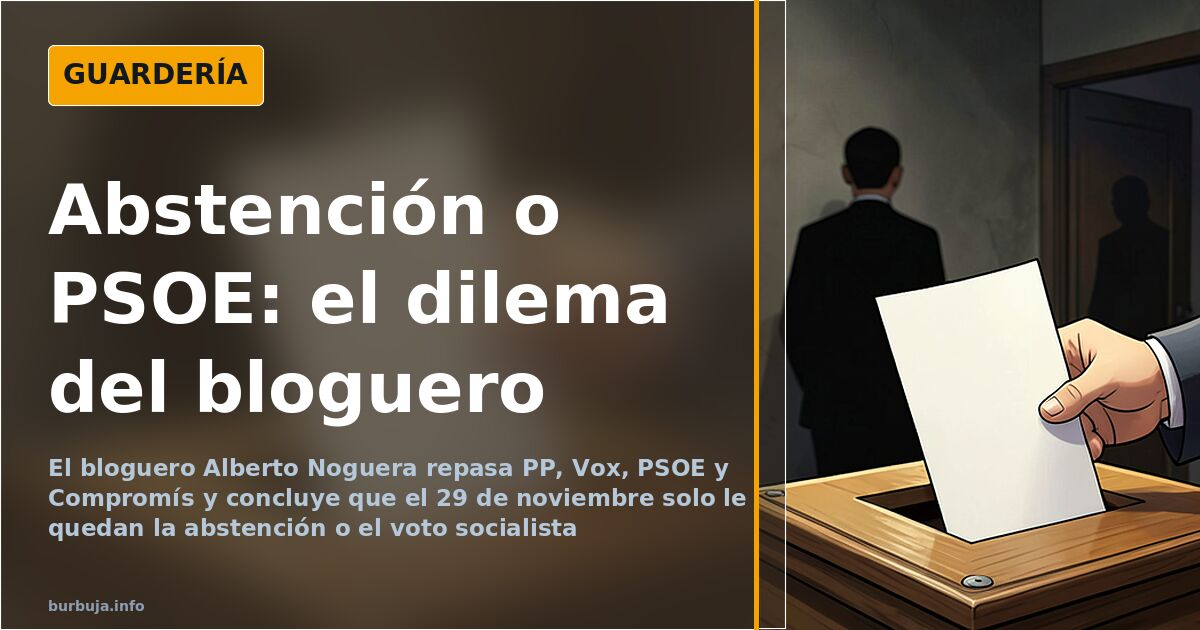
Sánchez or abstention: the voting dilemma of a critical blogger
A voter who has long been attacking what he calls the PSOE's «feminist baggage», who distrusts the PP and who suspects that Vox serves foreign interests has only two boxes to tick on 29 November: abstain or vote socialist. That is the confessed destination of the reflections Alberto Noguera published on his blog on 24 October 2026. He hands out verdicts to everyone and leaves only the PSOE standing, with many reservations. And he ends up where almost nobody ends up: at abstention or a vote for the PSOE at the last minute, at 19:59.
The party-by-party review the text makes
No mercy for the PP. The author describes a party that sells efficient management and modernity while, in his view, dragging along a record of scandals and subordination to foreign interests. He dislikes both the character and the method: he cites the handling of the Valencia floods and its defence of mandatory vaccination as examples of coldness. With Vox, which he says he has voted for in the past, he is even harsher: he claims that after its internal purges it has become a branch office of foreign interests and warns that a PP-Vox government would raise the risk of war. That is his opinion, not a fact.
He credits the PSOE with know-how. Ability to reach agreements, economic knowledge and a priority for Spanish interests over what he calls Zionism and Trumpism. His criticism is cultural: he believes Sánchez has failed to curb a drift within his party that he describes as censorship and dissonance, and he hopes it will be corrected from within, through primaries. The left further to his left looks to him like a fragmented wasteland, with no real threat.
The PP's 12 promises the text holds against it
The piece cites the PP's «12 promises» and reads the ones it reproduces in the same key: crony capitalism and cuts.
It quantifies none of them: no amounts, no dates, no costs.
The axis the author chooses and the one he is criticised for
Here lies the point that breaks the conversation. The text places at the centre the distance from what it calls «Zionist poison», presenting it as key to preserving peace and long-term wages. It is an opinion thesis, with no data in the text itself to support it. The rebuttals go elsewhere: some argue that if the real problems are corruption, immigration, housing and insecurity, the article only brushes past them. He is also taken to task for dismissing the court cases as secondary issues and for failing to explain how entrenchment in power would be stopped.
One of the most repeated replies is the shortest: that the text cannot be taken seriously. A note added at the end, attributed to whoever posted the text to the forum, helps: it disparages another analyst and questions the author's credibility for having also written about extraterrestrials. The detail is used to dismiss the whole, which is a fallacy, however convenient.
Alicante, two impossible seats and the 19:59 vote
At the regional level, the author details the seat allocation of the Compromís and Podemos coalition: Compromís candidacies in Valencia and Castellón, Podemos in Alicante. His calculation is that in Alicante two seats will not be won and that, therefore, he will not repeat the vote he gave the party in the last regional elections. He is grateful for the support given to temporary civil servants and for the regularisation he benefited from, and promises to come back when the party stands alone.
After the whole journey, the decision remains open. If he goes, it will be late.
The uncomfortable question remains: how many voters are at that same point, with no ballot that convinces them and abstention as their only coherent gesture, and how many will end up walking into the polling station when the votes are already being counted?
A voter who has long been attacking what he calls the PSOE's «feminist baggage», who distrusts the PP and who suspects that Vox serves foreign interests has only two boxes to tick on 29 November: abstain or vote socialist. That is the confessed destination of the reflections Alberto Noguera published on his blog on 24 October 2026. He hands out verdicts to everyone and leaves only the PSOE standing, with many reservations. And he ends up where almost nobody ends up: at abstention or a vote for the PSOE at the last minute, at 19:59.
The party-by-party review the text makes
No mercy for the PP. The author describes a party that sells efficient management and modernity while, in his view, dragging along a record of scandals and subordination to foreign interests. He dislikes both the character and the method: he cites the handling of the Valencia floods and its defence of mandatory vaccination as examples of coldness. With Vox, which he says he has voted for in the past, he is even harsher: he claims that after its internal purges it has become a branch office of foreign interests and warns that a PP-Vox government would raise the risk of war. That is his opinion, not a fact.
He credits the PSOE with know-how. Ability to reach agreements, economic knowledge and a priority for Spanish interests over what he calls Zionism and Trumpism. His criticism is cultural: he believes Sánchez has failed to curb a drift within his party that he describes as censorship and dissonance, and he hopes it will be corrected from within, through primaries. The left further to his left looks to him like a fragmented wasteland, with no real threat.
The PP's 12 promises the text holds against it
The piece cites the PP's «12 promises» and reads the ones it reproduces in the same key: crony capitalism and cuts.
- Raising the retirement age
- Returning to the Ebro water transfer
- Wage cuts
- More military spending
- More small businesses and self-employed workers
- More healthcare privatisation
It quantifies none of them: no amounts, no dates, no costs.
The axis the author chooses and the one he is criticised for
Here lies the point that breaks the conversation. The text places at the centre the distance from what it calls «Zionist poison», presenting it as key to preserving peace and long-term wages. It is an opinion thesis, with no data in the text itself to support it. The rebuttals go elsewhere: some argue that if the real problems are corruption, immigration, housing and insecurity, the article only brushes past them. He is also taken to task for dismissing the court cases as secondary issues and for failing to explain how entrenchment in power would be stopped.
One of the most repeated replies is the shortest: that the text cannot be taken seriously. A note added at the end, attributed to whoever posted the text to the forum, helps: it disparages another analyst and questions the author's credibility for having also written about extraterrestrials. The detail is used to dismiss the whole, which is a fallacy, however convenient.
Alicante, two impossible seats and the 19:59 vote
At the regional level, the author details the seat allocation of the Compromís and Podemos coalition: Compromís candidacies in Valencia and Castellón, Podemos in Alicante. His calculation is that in Alicante two seats will not be won and that, therefore, he will not repeat the vote he gave the party in the last regional elections. He is grateful for the support given to temporary civil servants and for the regularisation he benefited from, and promises to come back when the party stands alone.
After the whole journey, the decision remains open. If he goes, it will be late.
The uncomfortable question remains: how many voters are at that same point, with no ballot that convinces them and abstention as their only coherent gesture, and how many will end up walking into the polling station when the votes are already being counted?
Also available in: Deutsch
Summary of a discussion on Burbuja.info - Foro de economía, actualidad y política., translated from Spanish and reviewed before publication. Read the full discussion (21 replies).
More summaries
-
Nicknames for Spain's Pedro Sánchez: from 'Perro' to 'Quinquilino'
An open collection of more than twenty nicknames for Spanish Prime Minister Pedro Sánchez, from 'Perro' to 'Quinquilino de la Moncloa'. The list keeps growing with contributions and no clear favorite.
-
Sánchez, the only candidate not answering Jordi Wild
According to Wild's update of 19 October 2026, Pedro Sánchez is still the only candidate who has not responded to his invitation to be interviewed.
-
Woman Smashing Pedro Sánchez Piñata Claims Half-Anunnaki Origin
A woman smashes a Pedro Sánchez piñata at PSOE headquarters, her 'half-anunnaki' claim fuels conspiracy theories during protests.
-
Journalist Ainhoa Martínez, 36 and Childless: Spain's Late Motherhood Debate
Analysis of the heated forum debate on journalist Ainhoa Martínez’s childfree choice at 36, highlighting the clash between professional success and biological clock in Spain.
-
Aitor Karanka looks noticeably changed at Ballon d'Or event
Aitor Karanka, sporting director of the Spanish national team, spoke ahead of the Ballon d'Or. His appearance caught attention on social media. Here's the context.
-
90s board game Hotel comes back online: server down, no dark mode
A developer has built an online version of the 90s board game Hotel with AI assistance. The server crashed during a test game, and players are asking for dark mode and more.