
No theory can account for the Great Pyramid's 3 million blocks
357 blocks a day for 23 years: the calculation that no theory about how the pyramids were built has ever fully closed
English · Original discussion in Spanish · Published
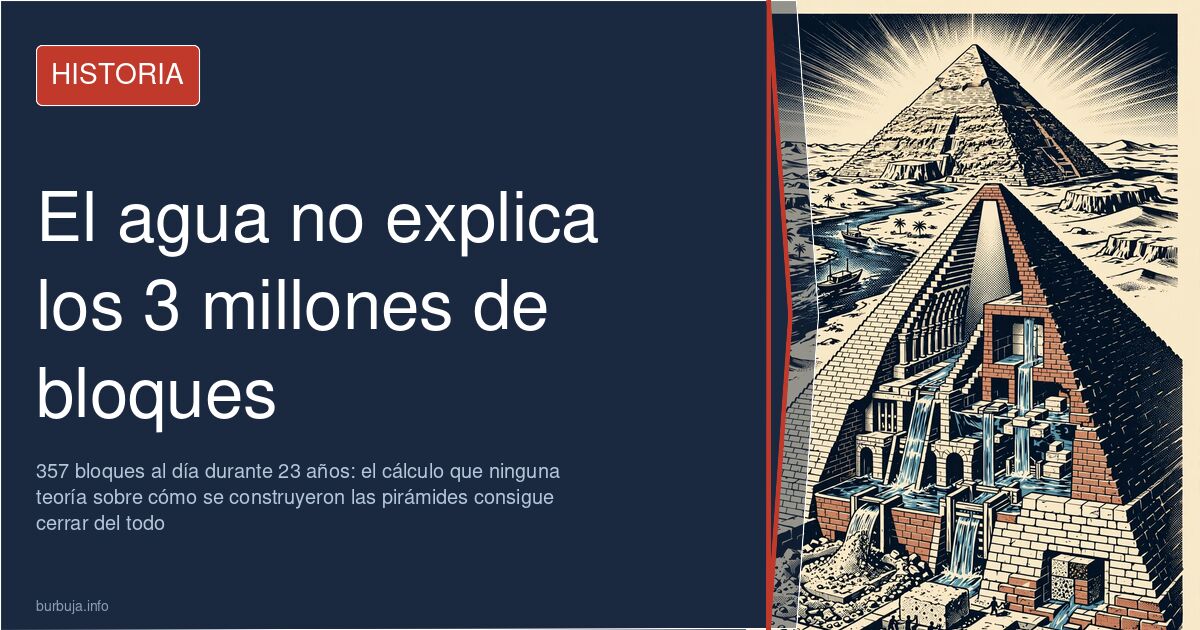
The hydraulic theory of the pyramids runs into the clock
The pyramids were not raised with pressurized water. There is not a single piece of evidence for it, and a simple calculation demolishes the hypothesis in three lines. And yet the idea circulates, is defended vehemently, and forces us to do something almost nobody does: put numbers on the table. That is what is valuable, not the conclusion. The latest version of the enigma claims that the King's and Queen's chambers were watertight reservoirs, that the ventilation shafts were water conduits, and that two 8-meter paddle wheels, driven by jets at 6 bar, lifted blocks of over 100 tons through the Grand Gallery. It sounds like Victorian engineering dropped into the Old Kingdom. And that is where the clash begins.
Six bar, an 11-centimeter tap, and 346 liters per second
The heart of the hydraulic proposal is a sealed chamber that fills by gravity from a height of about 60 meters and compresses the interior air to 6 bar. With those parameters, an outlet orifice of 100 cm² — a diameter of 11 centimeters — would withstand a force of 600 kilos and discharge 346 liters per second at a estimulante ilegal of 34 meters per second. The breakdown of that calculation, with cross-section, velocity and flow rate chained together, leaves no room for imagination and is available piece by piece for anyone who wants to check it.
The definitive blow, however, comes straight from a first-year physics textbook: lifting water 60 meters and then letting it fall to drive a wheel means doing the work twice to get the result once. Whoever can lift the water can lift the stone. Add to that the leaks, the maintenance of seals in a granite building, and the absence of any trace of a hydraulic circuit in the Egyptian records. The machinery described would require a technical culture that left no written trace and has no contemporary parallels.
The bottleneck is not the crane, it's the calendar
Khufu reigned, according to the chronology used in this debate, between 2590 and 2567 BC. Twenty-three years. The pyramid contains some 3 million blocks of limestone and granite, weighing from 2,000 to 40,000 kilos. The division is merciless: 357 blocks a day, twelve hours nonstop, one every two minutes. And that assumes the quarry, transport and dressing worked like a perfect assembly line, with no breakdowns or stock shortages.
The most detailed treatments of the problem raise the minimum time per block to two hours with the available technology. It is the argument that outlives every theory, including the official ones. The water proposal does not fix that arithmetic: it just moves it. It changes the question from "how were they lifted" to "how long did it take to lift them," and on that ground no ancient machine comes out well.
Liquid stone: the chemical route that has gone unrefuted for years
There is a third route, and it is the most unsettling one. The limestone of the great pyramids would contain far more water than natural limestone, according to the petrographic analyses cited in this discussion. That points to manufactured blocks — reagglomerated limestone made through a simple reaction with natron and malachite, two products the country had in abundance — rather than quarried and carved blocks. Some also argue that the exhaustion of the Sinai mines would explain why later pyramids were built smaller and with poorer materials.
The hypothesis has a weak flank, and its own proponents admit it: the casing blocks and later repairs do appear to be cut to size. Moreover, most of the material on the Giza plateau remains anchored in the natural bedrock, visible in the surrounding walls. Nobody has proven the blocks are artificial. Nor the opposite.
Herodotus, a lever per course, and a waterwheel that did not yet exist
The oldest explanation remains the most boring one. Herodotus described lever machines placed on each step that raised the blocks course by course: a slow, replicable, scalable, fail-safe method. A do-it-yourself version of that idea — two inclined beams, no steps, and a lever that rolls the stone from level to level — has been circulating for years in amateur videos and solves the lifting without water, without pressure and without mystery.
Two objections hold it back. The first: the wheel, even in the form of a waterwheel, is not attested in Egypt of that period, though it is in Mesopotamia. The second is philological and quite juicy: in the Greek text of the Histories the pharaoh's name appears as Χέοπα, and forms like "Cheops" or "Khufu" are modern reconstructions of how the hieroglyphs sounded. The classical Greeks already had the aeolipile, the first documented steam engine, and never used it for anything productive. A technology existing does not miccionan it gets applied.
Nobody has found the blueprint, and probably nobody ever will. Given these precedents, the next theory — hydraulic, chemical or simply mechanical — will appear within a few months and run into the same wall again: 357 blocks a day for 23 years. If anyone closes that account with quarry crews and copper tools, they will have rewritten history. Meanwhile, water does not rise on its own.
Also available in: Deutsch
Summary of a discussion on Burbuja.info - Foro de economía, actualidad y política., translated from Spanish and reviewed before publication. Read the full discussion (40 replies).
More summaries
-
Geopolymers: The Theory Suggesting the Egyptian Stone Was Molded
Joseph Davidovits argues that the Giza or Puma Punku blocks were molded using geopolymers, not carved.
-
ETA and GAL: two arms of the same Gladio network in Spain
Investigation linking ETA and GAL as arms of the same NATO Gladio network, with drug trafficking funding and CIA control.
-
Elche vs Alicante: the battle for the Mediterranean's poshest city
A comparison between Elche and Alicante: historic centres, Nordic tourism and the fight to be Spain's poshest Mediterranean city
-
Baptism of Christ in art: Giotto, Piero and Verrocchio
From Giotto's theological nude to the angel that outshone Verrocchio: the baptism of Christ in three key works.
-
Russia's endless pendulum between Europe and Asia: a third attempt?
The war in Ukraine, Chinese demographic pressure and Europe's fading appeal: the factors pushing Russia away from a third European period.
-
AI finds no relatives for Sumerian
Sumerian has been readable since the 19th century but still has no known linguistic family. According to an AI-based project, no relative has been found.