
Russia's endless pendulum between Europe and Asia: a third attempt?
The war in Ukraine, Chinese demographic pressure and Europe's fading appeal: the factors pushing Russia away from a third European period.
English · Original discussion in Spanish · Published
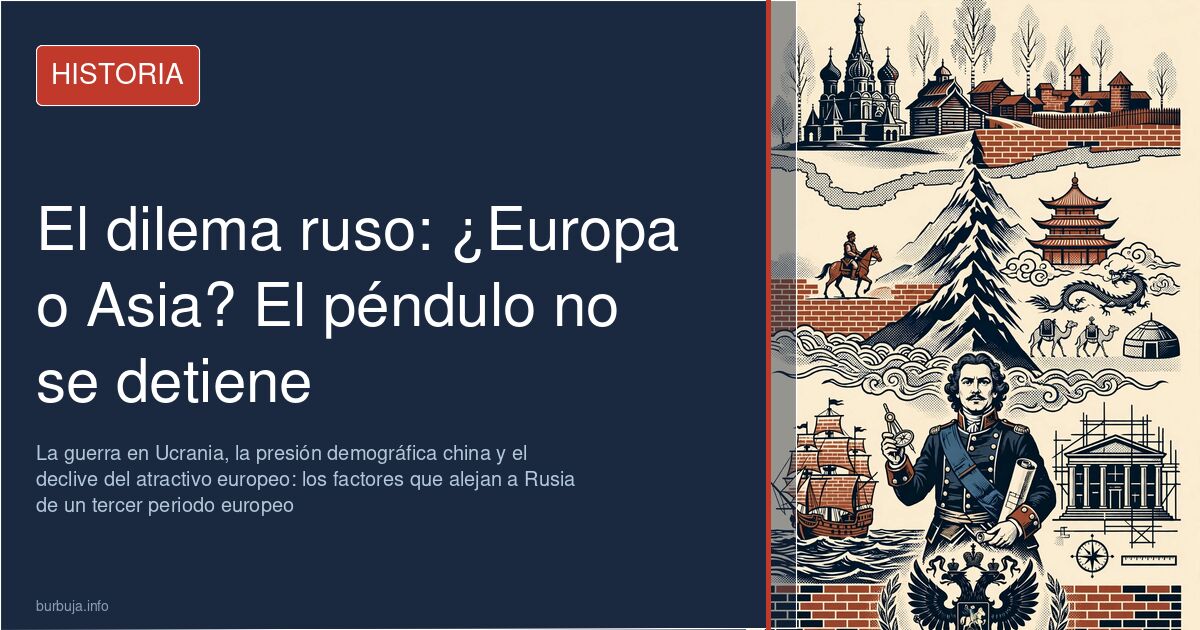
Russia's endless pendulum between Europe and Asia: a third attempt?
Russian history has often been described as a pendulum swinging between two poles. A classic framework divides it into four periods: the first European one (862-1223) with the founding of Kievan Rus; the first Asian one (1223-1682) after the Mongol invasions; the second European one (1682-1917) with Peter the Great's reforms; and a second Asian period that would begin with the 1917 revolution. The question hanging in the air is whether the pendulum will swing back toward the West.
The war in Ukraine as a turning point
The Ukrainian conflict is seen as Russia's third attempt to rejoin the European framework, and the outcome, according to the prevailing analysis, has been a slow bleed. Beyond the human and material cost, the war has generated deep rejection across Eastern Europe. The invasion has cemented an anti-Russian sentiment that makes any future rapprochement difficult. Meanwhile, Chinese influence in Russia's east is growing rapidly, with a repopulation process drawing Moscow closer to Asia and further from Europe.
The demographic factor and social change
Russian society is becoming increasingly multiethnic. The construction of new mosques and the arrival of people from Central Asia are reshaping the cultural landscape. This demographic shift, combined with the loss of influence in the Asian steppe to Turkic peoples, is pushing Russia eastward. The Far East, for its part, is falling ever more under China's demographic and economic orbit.
The cultural appeal: from Peter the Great to today
The era of Peter the Great was marked by the genuine fascination of the Russian elite with European technology and culture. Today, that appeal has faded. From Moscow's perspective, Europe offers mediocre economic growth and an inability to guarantee its own defense. The argument is made that Russia sees the West as a continent in decline, which removes any incentive for a new European turn. Even so, there are those who maintain that Russia's urban, educated classes still feel drawn to European values and lifestyles, in contrast to the deep Russia that underpins the current regime.
The collapse scenario and the final question
Some analyses suggest that only a collapse of the Russian state, similar to that of the USSR in 1991, could return Ukraine, Belarus and the historical territories of Kievan Rus to the European sphere. However, the Asian steppe and the Far East would already be lost to that hypothetical Europe. The underlying question is whether the Russian pendulum, after centuries of swinging, will ever find a point of balance, or whether its future is definitively anchored in Asia.
Also available in: Deutsch
Summary of a discussion on Burbuja.info - Foro de economía, actualidad y política., translated from Spanish and reviewed before publication. Read the full discussion (37 replies).
More summaries
-
The European countries that never became great powers
Ukraine had Europe's best farmland, Bohemia was the only kingdom of the Holy Roman Empire, and Yugoslavia led the Non-Aligned Movement. Yet none of them became…
-
Spain’s Identity Clash: Hispanic Heritage vs. European Integration
A message labeling pro-Europeans as enemies of Spain reignites the debate between Hispanic identity and Europeanism over national narrative.
-
Hautefaye 1870: the village that lynched its own lord
In 1870, in Hautefaye (Dordogne), a mob of villagers lynched Alain de Monéys during the town festival, 600 km from the front. A case that unsettles…
-
Viral apology for 'French Theory' reignites debate over wokeness
A viral text apologizes for 'French Theory' and blames it for wokeness. The debate over Foucault, Derrida and Deleuze reopens with thousands of reactions.
-
Elche vs Alicante: the battle for the Mediterranean's poshest city
A comparison between Elche and Alicante: historic centres, Nordic tourism and the fight to be Spain's poshest Mediterranean city
-
Baptism of Christ in art: Giotto, Piero and Verrocchio
From Giotto's theological nude to the angel that outshone Verrocchio: the baptism of Christ in three key works.