
No kids at 45: the void nothing fills, says forum user
Some argue that without children a void appears after 45 that travel and shopping can't fill; others reply that life without kids can be just as fulfilling.
English · Original discussion in Spanish · Published
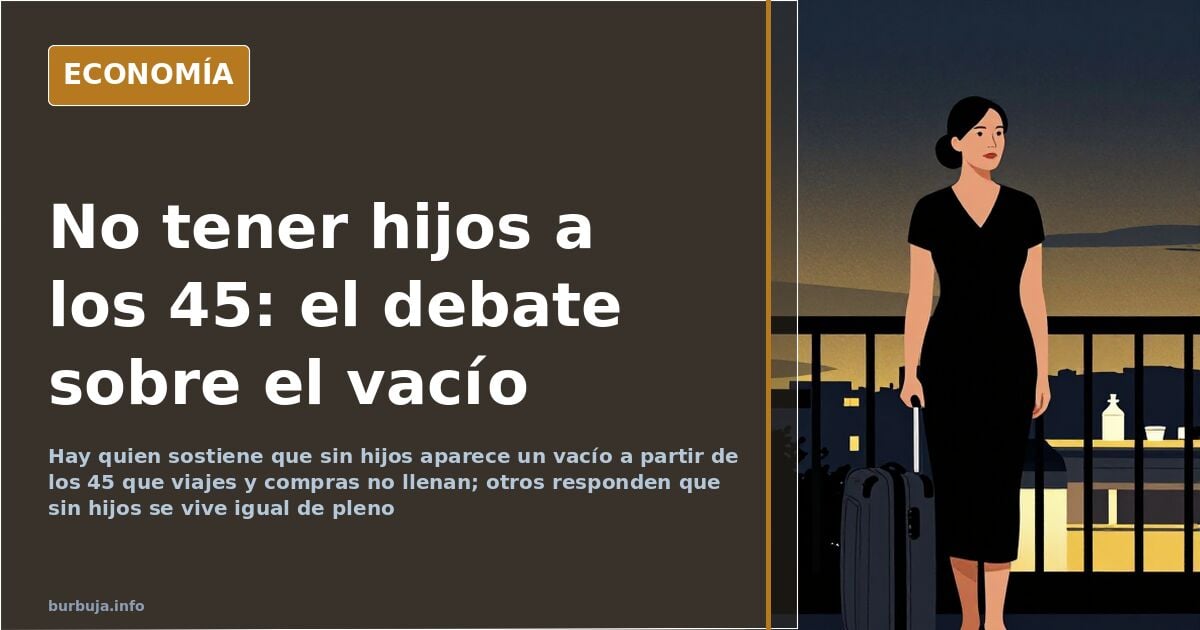
Childless at 45: when the void can no longer be filled by anything
There comes a moment when expensive bikes, trips, and dinners with other childless couples stop making up for it. Whoever holds this thesis places the turning point at 45 and does so not with official statistics in hand, but with observation of their own circle. The sequence described is always the same: a thirties of spending, leisure, and consumption; a forties that starts with the same momentum; and then, suddenly, a gap that nothing fills. The decision not to have children has consequences, they argue, and they almost never show up where you expect them.
The 45 thesis: the void that appears when there's no turning back
The starting premise is almost clinically precise. During the thirties and early forties, childless couples spend time and money on travel, socializing, and consumer goods: bikes worth thousands of euros, cars, getaways. From 45 onward, that same repertoire stops making up for it. It's not a textbook crisis: it's, they say, the realization that what used to cover the gap now leaves it in plain sight.
The mechanism they describe is comparative. Couples with children start having children who are already their own people, who bring family plans and human warmth. Childless couples, by contrast, reach an age where the option has closed and alternatives run out. The conclusion drawn is evolutionary: we were born to reproduce, and going against millions of years of selection has a price. It sounds like a verdict. It could also be, simply, the script of a well-told nostalgia.
Who says they live better without children: the counterexamples pile up
The void thesis gets concrete rebuttals. There are married friends who decided not to have children years ago and who, past 50, are still traveling, eating in expensive restaurants, and living for each other without complications. It's not an exception or a pose: it's a way of life sustained by facts, not slogans.
The most detailed case is that of a 47-year-old woman who has not had children and says she lacks time for everything she wants to do. She doesn't travel anywhere and doesn't spend on anything, but she lives surrounded by mountains and sea, works as a graphic and web designer, plays electric bass, tries to learn to draw, and reads as much as the day allows. She met her partner at 42 and tells it without drama: not everyone finds the person to share life with at childbearing age. Her conclusion, uncomfortable for the other side, is that whoever can't be happy without children won't be happy with them either.
On the opposite side, the portrait of a 46-year-old single relative is more ambiguous than it seems. Paid-off house, car, stable and well-paid job, good fitness, 6,000-euro bikes and getaways with the cycling crew. Paradise, until you notice that every day ends at his parents' house with the TV on and the hours passing without a word. The reasonable doubt raised by the other side is whether his friends, the ones pushing strollers, are much better off.
Having children according to wealth: if you're poor, you bring a slave into the world
The economic filter runs through the whole discussion and, deep down, is the argument with the most weight. The thesis is stated bluntly: if you have money, property, or inheritances, have children, they'll have a future. If you're a precarious wage earner, with an equally precarious partner and living in a tough neighborhood, what you bring into the world is labor for someone else. It's not a comfortable statement, but it explains why birth rates have become a class issue.
From there comes a timeline proposal with some internal logic: for a middle-class male, the best age to become a father is 38. By then the career is built and the salary allows giving the child a life that wouldn't have been possible at 28; besides, the previous years served to travel and do what was easier without children. The rich, by contrast, have them whenever they want.
The fine print of adoption and foster care
When someone points out that not all is lost and that adopting is still a path, the response isn't an automatic yes. One participant raises an age condition: according to him, the difference between the child and the parents cannot be more than 45 years, which would narrow the margin for those who come late to the matter. Other voices add legal and administrative hurdles, and part of the analysis dismisses the alternative with a cold phrase: adopting would be a substitute.
Intermediate formulas also appear. There's fostering minors during summers, long-distance sponsorship through humanitarian organizations, and entities that manage temporary stays. They are real solutions, but none equals the experience claimed by the other side. And there the exchange stops being economic and becomes existential.
Parenting: from 'it's what you do' to 'the best thing I've done in my life'
On the parents' side, testimonies range from epic to everyday exhaustion. Some claim that having children has been the best decision of their life, while others describe a day with kids as a succession of tiny tasks: dressing them, washing their clothes, removing stones from their shoes, teaching them to tie their shoelaces. Boredom, in that context, is a word that disappears from the vocabulary. The one who has just made Play-Doh figures and watches The Lion King with his child for the first time in twenty years describes it as a discovery.
But the other side also has ammunition. There's the divorced man paying alimony while the mortgage keeps being paid, the one who argues that the family as an institution has deteriorated, and the one who points out that many parents couldn't explain why they had children beyond an it's what you do. The expression law of life is quoted with a smirk, as a cover for a decision made by inertia.
Even those who defend parenthood acknowledge the wear and tear. A father separated 14 years ago maintains a good relationship with his ex and still thinks having children was the best thing he's done, even though the daily routine of shared parenting is organized in shifts. At the bitterest point, the question left hanging is not whether children bring happiness, but whether anyone can know without having lived both lives.
The discussion doesn't close, and perhaps it can't. The indicator some use is their own circle; the one others use is available time. The only honest comparison would be double, and that doesn't exist. What has changed is the framework: having children has stopped being an automatic stage and become a decision that must be justified, and not having them too. While the reason is sought, some argue just the opposite: that the unhappy ones are, precisely, those who do have them.
There comes a moment when expensive bikes, trips, and dinners with other childless couples stop making up for it. Whoever holds this thesis places the turning point at 45 and does so not with official statistics in hand, but with observation of their own circle. The sequence described is always the same: a thirties of spending, leisure, and consumption; a forties that starts with the same momentum; and then, suddenly, a gap that nothing fills. The decision not to have children has consequences, they argue, and they almost never show up where you expect them.
The 45 thesis: the void that appears when there's no turning back
The starting premise is almost clinically precise. During the thirties and early forties, childless couples spend time and money on travel, socializing, and consumer goods: bikes worth thousands of euros, cars, getaways. From 45 onward, that same repertoire stops making up for it. It's not a textbook crisis: it's, they say, the realization that what used to cover the gap now leaves it in plain sight.
The mechanism they describe is comparative. Couples with children start having children who are already their own people, who bring family plans and human warmth. Childless couples, by contrast, reach an age where the option has closed and alternatives run out. The conclusion drawn is evolutionary: we were born to reproduce, and going against millions of years of selection has a price. It sounds like a verdict. It could also be, simply, the script of a well-told nostalgia.
Who says they live better without children: the counterexamples pile up
The void thesis gets concrete rebuttals. There are married friends who decided not to have children years ago and who, past 50, are still traveling, eating in expensive restaurants, and living for each other without complications. It's not an exception or a pose: it's a way of life sustained by facts, not slogans.
The most detailed case is that of a 47-year-old woman who has not had children and says she lacks time for everything she wants to do. She doesn't travel anywhere and doesn't spend on anything, but she lives surrounded by mountains and sea, works as a graphic and web designer, plays electric bass, tries to learn to draw, and reads as much as the day allows. She met her partner at 42 and tells it without drama: not everyone finds the person to share life with at childbearing age. Her conclusion, uncomfortable for the other side, is that whoever can't be happy without children won't be happy with them either.
On the opposite side, the portrait of a 46-year-old single relative is more ambiguous than it seems. Paid-off house, car, stable and well-paid job, good fitness, 6,000-euro bikes and getaways with the cycling crew. Paradise, until you notice that every day ends at his parents' house with the TV on and the hours passing without a word. The reasonable doubt raised by the other side is whether his friends, the ones pushing strollers, are much better off.
Having children according to wealth: if you're poor, you bring a slave into the world
The economic filter runs through the whole discussion and, deep down, is the argument with the most weight. The thesis is stated bluntly: if you have money, property, or inheritances, have children, they'll have a future. If you're a precarious wage earner, with an equally precarious partner and living in a tough neighborhood, what you bring into the world is labor for someone else. It's not a comfortable statement, but it explains why birth rates have become a class issue.
From there comes a timeline proposal with some internal logic: for a middle-class male, the best age to become a father is 38. By then the career is built and the salary allows giving the child a life that wouldn't have been possible at 28; besides, the previous years served to travel and do what was easier without children. The rich, by contrast, have them whenever they want.
The fine print of adoption and foster care
When someone points out that not all is lost and that adopting is still a path, the response isn't an automatic yes. One participant raises an age condition: according to him, the difference between the child and the parents cannot be more than 45 years, which would narrow the margin for those who come late to the matter. Other voices add legal and administrative hurdles, and part of the analysis dismisses the alternative with a cold phrase: adopting would be a substitute.
Intermediate formulas also appear. There's fostering minors during summers, long-distance sponsorship through humanitarian organizations, and entities that manage temporary stays. They are real solutions, but none equals the experience claimed by the other side. And there the exchange stops being economic and becomes existential.
Parenting: from 'it's what you do' to 'the best thing I've done in my life'
On the parents' side, testimonies range from epic to everyday exhaustion. Some claim that having children has been the best decision of their life, while others describe a day with kids as a succession of tiny tasks: dressing them, washing their clothes, removing stones from their shoes, teaching them to tie their shoelaces. Boredom, in that context, is a word that disappears from the vocabulary. The one who has just made Play-Doh figures and watches The Lion King with his child for the first time in twenty years describes it as a discovery.
But the other side also has ammunition. There's the divorced man paying alimony while the mortgage keeps being paid, the one who argues that the family as an institution has deteriorated, and the one who points out that many parents couldn't explain why they had children beyond an it's what you do. The expression law of life is quoted with a smirk, as a cover for a decision made by inertia.
Even those who defend parenthood acknowledge the wear and tear. A father separated 14 years ago maintains a good relationship with his ex and still thinks having children was the best thing he's done, even though the daily routine of shared parenting is organized in shifts. At the bitterest point, the question left hanging is not whether children bring happiness, but whether anyone can know without having lived both lives.
The discussion doesn't close, and perhaps it can't. The indicator some use is their own circle; the one others use is available time. The only honest comparison would be double, and that doesn't exist. What has changed is the framework: having children has stopped being an automatic stage and become a decision that must be justified, and not having them too. While the reason is sought, some argue just the opposite: that the unhappy ones are, precisely, those who do have them.
Also available in: Deutsch
Summary of a discussion on Burbuja.info - Foro de economía, actualidad y política., translated from Spanish and reviewed before publication. Read the full discussion (781 replies).
More summaries
-
38-year-old blames feminism for delayed motherhood
A woman says she feels 'betrayed' by feminism for not having children earlier, reigniting the debate on birth rates and family planning in Spain.
-
Economist Urges Higher Birth Rate in Spain Despite Having No Children
An economist advocates for higher birth rates in Spain without having children herself. The debate highlights data on divorce, custody, and Viogen.
-
Spain's rental decrees struck down: 'the damage is already done'
A forum user claims rental supply has fallen 61% since 2020 and prices have risen 40%. The decrees have been struck down, but the damage is already done, according to the...
-
Spain's Parasite Debate: Cultural Shock or Marketing?
Analysis of the debate on deworming in Spain: is it a cultural clash, a public health need, or just marketing?
-
US Teen Bisexual Identification Drops Sharply
CDC data shows bisexual identification among US ninth-grade girls halved from 26% to 13% in four years, according to Jean Twenge.
-
Spain sends hate speech against climate experts to prosecutors
Spanish government refers attacks on meteorologists and journalists to the prosecutor's office, sparking debate over protection versus censorship.