
No honest person would drink wine if there was a Coke at hand
A forum user starts a debate on wine versus CocaCola, accusing wine drinkers of playing at being adults, having no palate or simply being drunk. The thread drifts into nostalgia and…
English · Original discussion in Spanish · Published
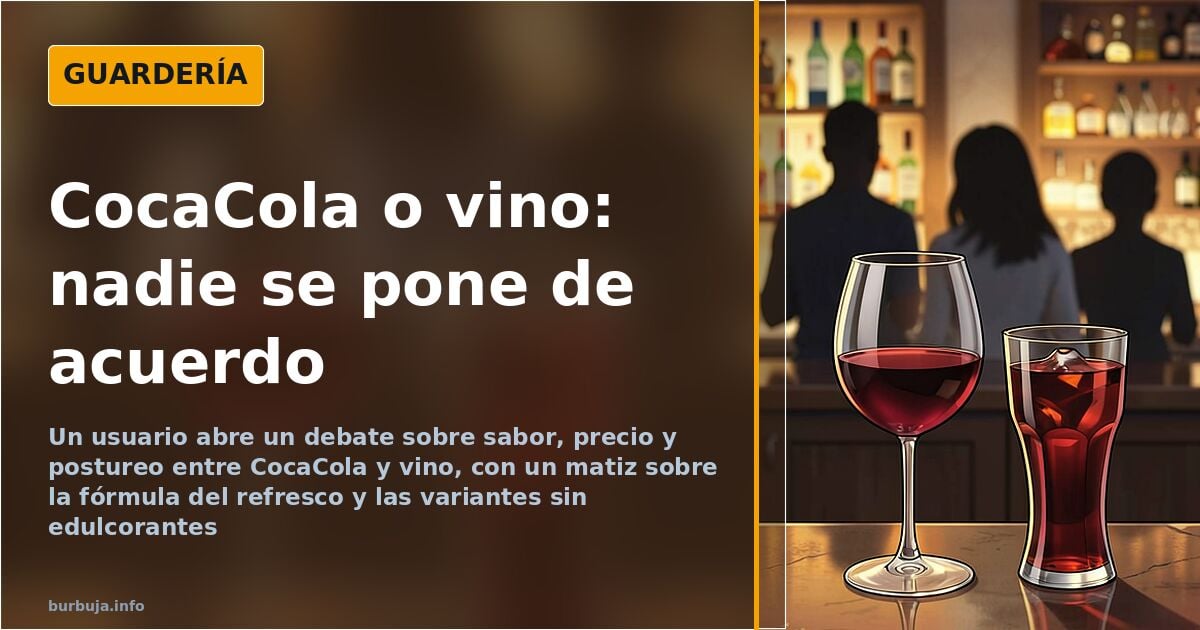
Coke versus wine: when the soft drink wins the battle of the palate
Picture the scene: a kitchen table, a two-liter bottle of CocaCola and a '56 Chateau nobody dares to open. Someone drops the bomb: "No honest person would drink wine if they had a CocaCola at hand." The remark, posted on an internet forum, has sparked 56 replies and a civil war between foodies and soft-drink teetotalers. The author pulls no punches: anyone who prefers wine is either a son of a bitch who wants to play grown-up, a guy with no palate, or a shitfaced drunk who couldn't care less about taste. Three categories, no room for doubt.
People quickly took sides. A few came out to defend the fermented brew with arguments ranging from chemistry to theology. Others, meanwhile, seized the chance to settle scores with the alcohol industry and with CocaCola itself. And amid the crossfire, the voice of experience emerged: today's CocaCola doesn't taste like it did in the eighties. Sweeteners have changed everything.
The palate as a battleground
The first trench line peine around taste. The CocaCola defender stood his ground: "Wine is disgusting to anyone with a palate." He added that those who say otherwise are like people who claim smoking is better than vaping. The comparison is not trivial: it equates wine drinking with a socially accepted addiction, a vice dressed up as culture.
On the other side, a participant with delusions of being an amateur sommelier snapped back that he had probably never drunk "real" wine in his life. And he finished off: CocaCola is water with sugar and poisons, a satanic drink that hooks you through its addictive ingredients. The exchange heated up when the Coca-Cola factory came up: whoever has visited it swears the smell "stinks." The reply was not long in coming: that's because of the artificial sweeteners, not the sugar.
CocaCola no longer tastes like it used to
Here the debate took an unexpected turn. Several contributors agreed that the current formula is inferior to the eighties version. "Ever since they added sweeteners it's vomit-inducing," one declared. Another pointed out that the classic version contains no sweeteners, just sugar in industrial quantities, but the fruta damage was already done. Nostalgia became the only point of agreement between irreconcilable camps.
The conversation drifted toward the container: why does it taste better in a glass bottle than in a can, and both better than in plastic? Nobody offered a scientific explanation, but everyone nodded. The temperature, the feel, the ritual of opening the bottle. The packaging matters, and a lot. Price also came up: a liter of colored sugar water at the price of fresh milk. The irony was served.
Wine as a status symbol
The accusation of "playing adult" hung over the whole exchange. The author of the opening post insisted: people drink wine to show off, not because they like it. And he lashed out at doctors who recommend a glass of wine with meals: "They get invited to workshops where they're told the Mediterranean diet is the greatest thing ever, and they obey." A dinner-table conspiracy theory that, however, found an echo among those who see alcohol as a socially imposed vice.
One participant put forward a more elaborate thesis: ancient civilizations, like Rome and Greece, diluted wine with water or cooked it with spices and honey. What we today call tinto de verano would be a modern version of that invention. The implicit conclusion is that pure wine is an invention of drunks, not gourmets. History, in this case, proved the CocaCola defender right.
Kalimotxo as a compromise solution
When the debate seemed headed for a technical draw, the middle way emerged: mixing wine and cola. Kalimotxo, that party drink elevated to cocktail status, was proposed by several as the squaring of the circle. Why choose when you can have it all? The idea was received with some mockery, but nobody dismissed it entirely.
The problem is that the mix pleases no one: neither the wine purist nor the CocaCola defender. The former thinks it destroys the flavor of the grape; the latter, that it contaminates the soft drink with alcohol. A solution that only satisfies those who were already willing to get drunk on whatever was available. In the end, the kalimotxo revealed itself for what it is: a patch, not a synthesis.
The sweetener battle
The exchange over ingredients left one thought-provoking fact: classic CocaCola contains no sweeteners, but it does contain an amount of sugar that makes any nutritionist blush. The factory visit, that school alucinación everyone remembers, served to confirm that the smell is cloying. "If you drink juice, I'll forgive you," said the soft drink's defender, in a burst of magnanimity. Water, of course, too.
The discussion drifted toward daily consumption: four liters a day? Someone asked whether the author of the opening post was drinking that amount. There was no answer. But the question hung in the air like a warning. CocaCola may be tastier than wine, but it is hardly a healthy drink. On that, nobody disagreed.
In the end, the scoreboard was tied. The wine defenders failed to convince the soft-drink lovers, and vice versa. But the debate left one certainty: today's CocaCola is no longer what it used to be, and wine, that brew some consider nectar and others poison, remains the king of meals. That said, nobody dared to order a bottle of '56 Chateau to go with a burger. The unsettling stat: 56 replies and not a single blind tasting.
Summary of a discussion on Burbuja.info - Foro de economía, actualidad y política., translated from Spanish and reviewed before publication. Read the full discussion (60 replies).
More summaries
-
Forum user claims to lose 14 kilos in two months on keto diet
An internet user claims to have lost 14 kilos in two months on a ketogenic diet and intermittent fasting, starting from 207 kilos. The debate over whether it's possible and…
-
Spain vs France: How marketing defines the battle of food and wine
A debate reveals that French products dominate the market through superior branding rather than inherent quality compared to Spanish goods.
-
The War on Bread: Diet, Guilt, and Culture Wars
A forum user claims 300 years ago people ate a kilo of bread daily without obesity. Bread is now caught between diet, guilt, and cultural conflict.
-
Diomande’s Girlfriend Sparks AI Debate: Real or Generated?
The girlfriend of footballer Diomande divides social media: is the photo real or AI-generated? A betting house pendant fuels the controversy.
-
Women traveling solo through Africa spark debate over risk and ego
Solo female travel in Africa fuels debate about risk and ego. Agencies say 80% of solo travelers are women. Read on.
-
Spain's 'chuletón Paco': accidental cooking meets small-town pride
An overcooked low-temperature steak and a sloppy salad spark a debate in Spain: is the chuletón Paco just country bumpkin food?