
No decent new car under €40,000 in Spain
Forum debate on car buying: users claim no decent new model is under €40k, recommending Japanese and German diesel options.
English · Original discussion in Spanish · Published
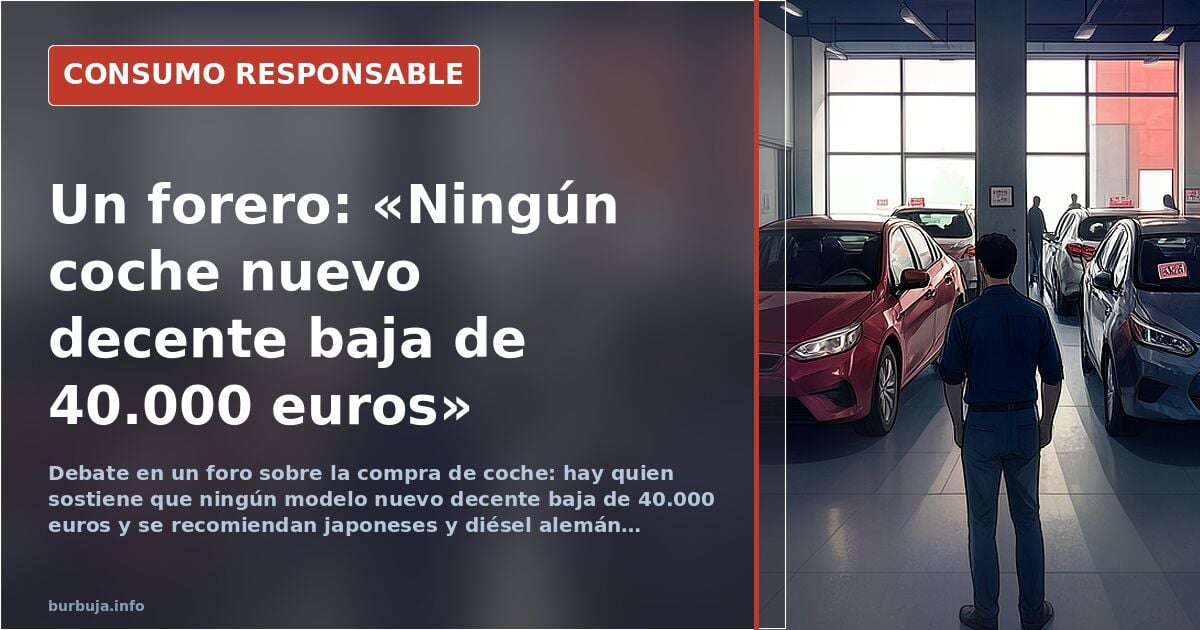
No decent new car under €40,000 in Spain
Is it worth buying a car today? In a forum debate, one participant claims that no decent model costs less than €40,000, using this figure as the starting point for various recommendations. The buyer in this conversation isn't looking for emotion; they want a car that won't ruin them financially. And there, according to participants, the current market fails.
The question was simple—if you had to change cars, which would you choose?—and the answer split into two camps: those recommending Japanese engines from the 90s and 2000s, and those defending pre-electronic German diesels. Neither faction buys new.
Toyota, Honda, and the cult of the unbreakable engine
The most repeated trend points to Japanese manufacturers. Toyota and Honda appear again and again as the safe bet, with the second-hand Corolla being the option for those who don't want to spend much on something that depreciates quickly. The argument isn't aesthetic: it's that the car starts every morning.
Some go further, defending 90s and 2000s petrol Japanese sedans as the pinnacle of reliability. The Honda Accord is cited as a sure value, with some claiming it's the best car you can buy without going bankrupt. The downside, admitted by its defenders, is spare parts: if you have an accident, parts may take longer to arrive than public aid.
The counterpoint comes from a camp that doesn't want to hear about old engines. Their bet is the Lexus ES300H from 2017 onwards or its cheaper sibling, the Toyota Camry: 2.5-liter naturally aspirated petrol plus hybrid motor, 218 horsepower, no clutch, no turbo, no EGR, no AdBlue, and physical buttons for everything. ECO label and ten-year warranty. Nearly five meters long. The problem is the size.
The German diesel that refuses to die
Opposing the Japanese block, an equally vocal faction defends Volkswagen Group engines. The 1.9 TDI 130hp from 2002 is described as having good mechanics, safety, and comfort comparable to modern models, with durability many new cars would envy. The Passat of that generation is remembered as an aesthetic marvel at the time.
The recommendation extends to any group car with that engine: Audi A4, A6, Golf, A3, or Seat, though the latter has worse soundproofing and materials. From the PSA group, HDI 2.0 160hp engines are rescued as alternatives. For those wanting something more modern but still diesel, the pre-2010 Mercedes C-Class appears as a guaranteed success.
The most extreme view is from those who don't want labels or complications: a naturally aspirated petrol engine between 2009 and 2016, or directly a car without an environmental badge for weekend drives, taking advantage of how easy it seems to declare it historic. Being the antichrist with two old diesels doesn't seem to worry anyone.
SBC brakes, the stopping power dividing engineers
One of the most technical debates concerns Mercedes' SBC brake system. Some defend it enthusiastically: it distributes braking force to each wheel in a way described as delightful and an engineering gem, especially in emergency stops. Those who've tried it assure it's superior to conventional systems even today.
The problem is fruta. Mentioning SBC to someone unfamiliar generates immediate distrust, and some admit owning two cars with this system while dodging others' prejudice. The conversation shifted to the W211 with OM648 engine and SBC as a niche recommendation for those who know what they're looking for.
Dacia, electric cars, and the budget question
The Romanian brand appears as the only rational answer to price chaos. A Dacia is the only sensible choice, argues a camp that doesn't understand paying double for the same thing. The rebuttal arrives quickly: 0% financing doesn't exist, and paying cash usually saves about €1,800 compared to financing. The full calculation, including down payment, installments, and final balloon payment, dismantles many "€99 per month" offers.
At the opposite end, electric cars start entering the equation. A second-hand e-Golf is considered for those with a house, solar panels, and access to public subsidies. The doubt is whether these subsidies will materialize or remain in administrative limbo, like others before.
Then there's the person who wants none of this. They sold their car due to low-emission zones and now find nothing appealing: not hybrid, not electric, nor paying a fortune for half the value. I have the money, but everything has flaws, summarizes a position shared by many.
In the end, the most honest answer in the entire discussion is also the most boring: it depends on annual mileage and where you drive. No one disputes that. What no one accepts is paying €40,000 for a car that sounds like a washing machine.
Is it worth buying a car today? In a forum debate, one participant claims that no decent model costs less than €40,000, using this figure as the starting point for various recommendations. The buyer in this conversation isn't looking for emotion; they want a car that won't ruin them financially. And there, according to participants, the current market fails.
The question was simple—if you had to change cars, which would you choose?—and the answer split into two camps: those recommending Japanese engines from the 90s and 2000s, and those defending pre-electronic German diesels. Neither faction buys new.
Toyota, Honda, and the cult of the unbreakable engine
The most repeated trend points to Japanese manufacturers. Toyota and Honda appear again and again as the safe bet, with the second-hand Corolla being the option for those who don't want to spend much on something that depreciates quickly. The argument isn't aesthetic: it's that the car starts every morning.
Some go further, defending 90s and 2000s petrol Japanese sedans as the pinnacle of reliability. The Honda Accord is cited as a sure value, with some claiming it's the best car you can buy without going bankrupt. The downside, admitted by its defenders, is spare parts: if you have an accident, parts may take longer to arrive than public aid.
The counterpoint comes from a camp that doesn't want to hear about old engines. Their bet is the Lexus ES300H from 2017 onwards or its cheaper sibling, the Toyota Camry: 2.5-liter naturally aspirated petrol plus hybrid motor, 218 horsepower, no clutch, no turbo, no EGR, no AdBlue, and physical buttons for everything. ECO label and ten-year warranty. Nearly five meters long. The problem is the size.
The German diesel that refuses to die
Opposing the Japanese block, an equally vocal faction defends Volkswagen Group engines. The 1.9 TDI 130hp from 2002 is described as having good mechanics, safety, and comfort comparable to modern models, with durability many new cars would envy. The Passat of that generation is remembered as an aesthetic marvel at the time.
The recommendation extends to any group car with that engine: Audi A4, A6, Golf, A3, or Seat, though the latter has worse soundproofing and materials. From the PSA group, HDI 2.0 160hp engines are rescued as alternatives. For those wanting something more modern but still diesel, the pre-2010 Mercedes C-Class appears as a guaranteed success.
The most extreme view is from those who don't want labels or complications: a naturally aspirated petrol engine between 2009 and 2016, or directly a car without an environmental badge for weekend drives, taking advantage of how easy it seems to declare it historic. Being the antichrist with two old diesels doesn't seem to worry anyone.
SBC brakes, the stopping power dividing engineers
One of the most technical debates concerns Mercedes' SBC brake system. Some defend it enthusiastically: it distributes braking force to each wheel in a way described as delightful and an engineering gem, especially in emergency stops. Those who've tried it assure it's superior to conventional systems even today.
The problem is fruta. Mentioning SBC to someone unfamiliar generates immediate distrust, and some admit owning two cars with this system while dodging others' prejudice. The conversation shifted to the W211 with OM648 engine and SBC as a niche recommendation for those who know what they're looking for.
Dacia, electric cars, and the budget question
The Romanian brand appears as the only rational answer to price chaos. A Dacia is the only sensible choice, argues a camp that doesn't understand paying double for the same thing. The rebuttal arrives quickly: 0% financing doesn't exist, and paying cash usually saves about €1,800 compared to financing. The full calculation, including down payment, installments, and final balloon payment, dismantles many "€99 per month" offers.
At the opposite end, electric cars start entering the equation. A second-hand e-Golf is considered for those with a house, solar panels, and access to public subsidies. The doubt is whether these subsidies will materialize or remain in administrative limbo, like others before.
Then there's the person who wants none of this. They sold their car due to low-emission zones and now find nothing appealing: not hybrid, not electric, nor paying a fortune for half the value. I have the money, but everything has flaws, summarizes a position shared by many.
In the end, the most honest answer in the entire discussion is also the most boring: it depends on annual mileage and where you drive. No one disputes that. What no one accepts is paying €40,000 for a car that sounds like a washing machine.
Also available in: Deutsch
Summary of a discussion on Burbuja.info - Foro de economía, actualidad y política., translated from Spanish and reviewed before publication. Read the full discussion (105 replies).
More summaries
-
Toyota, Honda, or Lexus: Which Japanese Brand Lasts 400,000 km?
A study of 395 million vehicles measures durability, clashing with parts availability and the real condition of Japanese used cars.
-
Fiat Tipo vs Dacia Logan: Which cheap car truly offers the best value?
The Fiat Tipo starts at €10,800 but requires financing a used car, totaling €14,336. The Dacia Logan GLP offers a lower cash price without mandatory loans.
-
Mercedes C-Class Wins 2015 World Car of the Year Amid Quality Debate
The Mercedes C-Class wins the 2015 World Car award, sparking debate among owners about whether the brand is at its peak or in decline.
-
Mercadona salmon rip-off: tray fillets cost up to 78% more
Mercadona charges up to €25/kg for salmon tray fillets while a whole salmon costs €11/kg. Data and tips to save.
-
Double Paternity in Spain: Legal Implications of Conflicting Civil Registry Entries
Can a minor have two fathers registered in different countries? We analyze the legal case of a girl with double paternity and the avenues for challenging it under Spanish law.
-
Tinnitus relief: effective strategies without miracles
Caffeine, stress, noise or jaw issues cause tinnitus. Discover what actually relieves the ringing based on patient experiences.