
Night bypass stretches a solar battery to 11,600 Wh
A 3,600 Wh battery can handle up to 11,600 Wh overnight if the grid powers the home in bypass mode while the battery recharges on off-peak rates.
English · Original discussion in Spanish · Published
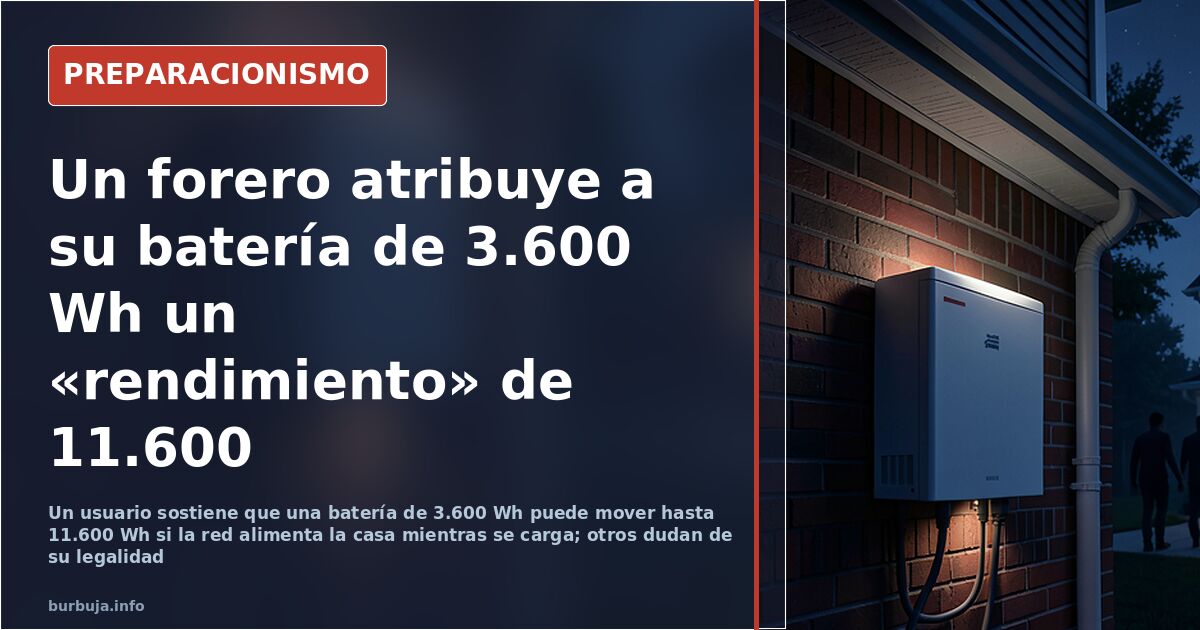
Night bypass stretches a solar battery to 11,600 Wh
Can you increase the capacity of a solar battery without buying another one? Yes, if you stop thinking of it as a tank and start thinking of it as a UPS. The thesis that opens this discussion is simple and somewhat sneaky: a 3,600 Wh portable power station doesn't store more at night, but if while recharging from the grid on off-peak rates it simultaneously powers the home in bypass mode, the system delivers in one night what the battery alone couldn't. The calculation used by the thread author: **3,600 Wh** of recharging at 450 W over eight off-peak hours plus up to **8,000 Wh** of direct grid consumption, in other words, an operating ceiling of **11,600 Wh** that never touches the lithium.
The key is that most consumption shifts to nighttime. Indoor garden lighting, radiant heating, distillers, dehumidifiers and air conditioning run during off-peak hours while the battery fills up. During the day, the home hangs off the inverter in pure island mode. With that split, the bill increase has reportedly stayed around **4 or 5 euros** a month.
What exactly is a solar battery's bypass
The concept gets confused with storage, but it isn't. Bypass doesn't store energy: it lets the grid power the home directly while the battery charges in parallel. The lithium capacity doesn't grow by a single watt. What grows is the useful energy the system can handle in a specific time window.
Some argue this is just creative accounting with someone else's kilowatts. And they're right in essence: those 8,000 Wh come from the grid, not the battery. The merit isn't in storing more, but in **buying cheap and consuming when it makes sense**.
Why the setup is described as a giant UPS and not self-consumption
The installation is treated like just another appliance: the grid feeds the station's charger, the station powers the home, and there's never a parallel between the two sources. No export, no zero-export toroid, no self-consumption paperwork. The author claims the equipment's CE marking is enough because nothing is injected into the grid.
That's where the first serious technical objection comes in. Spain's **REBT** (the national low-voltage electrical regulations), in its ITC-BT-40, classifies own sources as isolated, assisted and interconnected, and an installation that can power the home instead of the grid falls into the assisted category, with switching and protection requirements. CE marking certifies the product; it doesn't certify how it's connected to the panel. They are two different sets of rules and it's best not to confuse them.
The weak point: switching and the neutral
If the equipment truly switches and the home always hangs off the inverter, the scheme is coherent. If it's a UPS that cuts over, during the switchover there's an instant when the home and the inverter both touch the grid. And in homes the scheme is TT, with an RCD and earthing that must be respected.
The floating neutral detail is cited as solved with intermediate circuitry, without further specifics. It's exactly the kind of thing a licensed electrician should check on site before giving the green light.
The butane generator and CO: where consensus breaks down
To extend runtime during a blackout, a butane generator is proposed that recharges the battery in a few hours. One cylinder would cover several recharges. The problem isn't electrical, it's combustion: a small engine emits far more carbon monoxide than a kitchen stove, and the extractor hood isn't designed to vent those gases. CO has no smell and can't be seen.
The sensible recommendation, and here there's no debate, is to take it outside to an open terrace or balcony and never leave it running with no one awake nearby.
How long a portable battery lasts compared to a fixed one
The premise itself acknowledges the cost: portables last around **6,000 cycles** versus the **10,000** of a fixed installation. It's offset by price, easy setup and not depending on third parties. The open question is how many of those cycles actually get used when most consumption goes through bypass rather than the lithium.
In the end, the technique works. Calling it a capacity increase with a straight face is another matter.
Also available in: Deutsch
Summary of a discussion on Burbuja.info - Foro de economía, actualidad y política., translated from Spanish and reviewed before publication. Read the full discussion (54 replies).
More summaries
-
Scaling Up Non-Scalable Battery with Transfer Switch
A DIY enthusiast attempts to expand his non-scalable 10,800Wh battery system to 12,850Wh using a transfer switch. Is it safe? Risk and cost analysis.
-
Francisco Llinares, Spanish prepping figure, dies at 77
Francisco Llinares, a leading figure in Spain's prepping movement, has died at 77. His community debates his legacy and the paradox of never seeing a doctor.
-
Six months of food and a remote garden: Spain's doomsday preppers
Rice, legumes and 30 or 40 water jugs: the six-month pantry plan that goes far beyond the 72 hours recommended by the EU.
-
Out-of-print wild plant guide sparks prepper interest in Spain
An out-of-print guide to edible wild plants has revived interest in foraging in Spain: potatoes, Jerusalem artichokes and a warning about solanine.
-
Engineer Omar Suárez builds the world's most efficient house
Engineer Omar Suárez built a home in Asturias, Spain, that has gone 6 years without grid electricity or fuel. His system uses microconcrete and low enthalpy.
-
CO2 pistols: legal at home, pulled from store shelves in Spain
Spain's Guardia Civil removed a CO2 pistol model from stores over packaging reading "home defense", even though keeping it at home remains legal with a simple sales declaration.