
Six months of food and a remote garden: Spain's doomsday preppers
Rice, legumes and 30 or 40 water jugs: the six-month pantry plan that goes far beyond the 72 hours recommended by the EU.
English · Original discussion in Spanish · Published
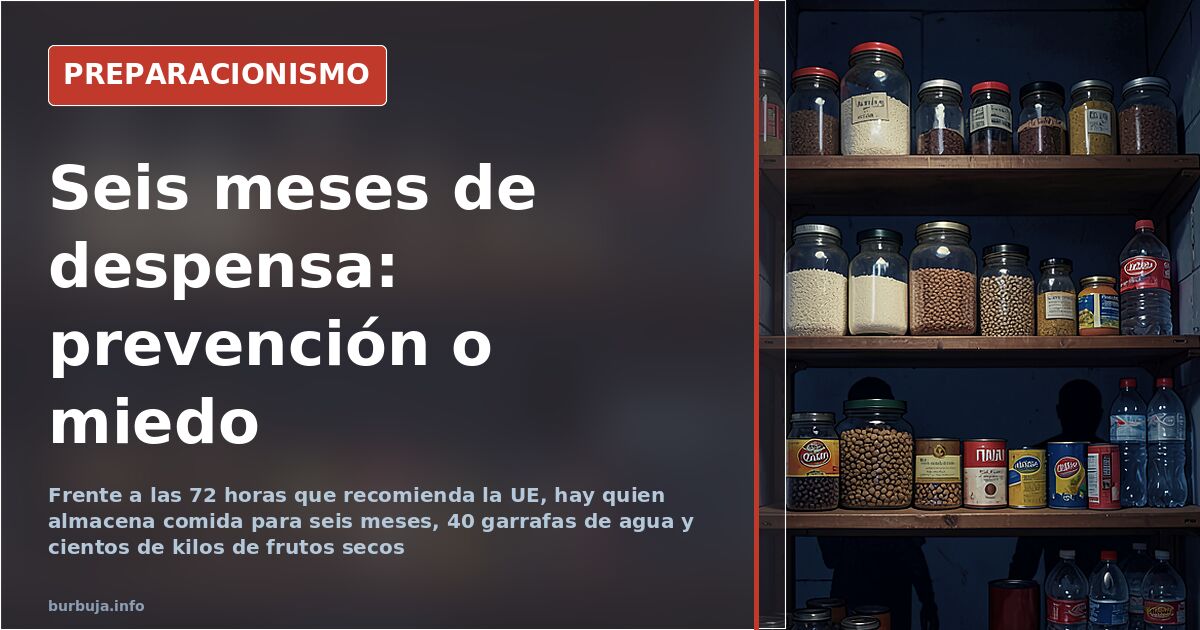
A six-month pantry: the bunker savings that are no longer a joke
How much rice do you need to stockpile to sleep soundly at night? The question, which sounds like a bad joke, has an increasingly elaborate answer in certain circles: about six months of non-perishable food, water jugs and a remote plot of land with a vegetable garden. The plan, which starts with a "you're going to laugh" and ends with a "consider yourselves warned", has stopped being a basement eccentricity and become a conversation about logistics, stock rotation and, above all, antiestéticar that the supply chain will break down. It's not a prediction: it's a shopping alucinación.
According to one participant, the EU has recommended since 2025 keeping supplies for around 72 hours, and Spain's Civil Protection agency (the national emergency body) says about 3 days. Most Spanish households don't even reach that. Against that benchmark, the scenario described in this discussion —six months of rice, legumes, canned goods, honey and hundreds of kilos of shelled nuts— sounds like an NGO warehouse, and those who have actually done it admit as much. The conversation quickly turns practical: how to rotate stock, how to purify water, what to do with salt and oil, and where to put it all if you live in an apartment.
The 72-hour rule and the leap to six months
The figure that frames the whole debate is the official recommendation: 3 days of supplies according to Civil Protection, 72 hours according to the EU since 2025, as stated in the thread. Any pantry that exceeds that figure is already above average. The leap to six months doesn't come from an institution: it comes from gut feeling. "I have very good intuition and I'm a natural pattern analyst," reads the original post, which lists scenarios: a solar electromagnetic pulse, a prolonged blackout, street riots, a conflict that turns the Sahara into a new Ukraine. The list is varied, but the underlying reasoning is the same: if the supply chain breaks, better to have the chain at home.
The problem is that a pantry isn't a static snapshot. It's a system. And like any system, it degrades. The key point that keeps coming up is rotation: first in, first out. A pantry that isn't consumed eventually expires, and an expired pantry is money thrown away. Hence the idea of keeping "another logistics line open": travelling to the stash to do the shopping, replacing what gets used and always maintaining the stock. It's prepping with permanent inventory, almost an accounting firm.
Water: 30 jugs is not six months
The point that most quickly punctures the enthusiasm is water. 30 or 40 eight-litre jugs sound like a lot until you do the maths. The WHO recommends 15 litres per person per day as the emergency minimum, according to a calculation circulating in the thread; for drinking and cooking, the figure quoted is 3-4 litres per person per day. With 300 litres, a family of four has enough for weeks, not months. The author of the plan himself clarifies: the water isn't for the six months, it's a reserve in case scarcity bites.
The conversation then drifts towards water purification. Membrane filters of 0.1-0.2 microns are mentioned, ultraviolet light, boiling for 1 to 3 minutes and bleach suitable for drinking water. Each method removes something different: microbes, turbidity, chemicals. And then comes one of the most instructive anecdotes in the exchange: the idea of making bleach from chimney ash. The chemical correction is blunt: ash contains no chlorine; what you get from it is a caustic alkaline solution, not hypochlorite. It won't purify water. It's a perfect example of how poorly digested knowledge can be more dangerous than thirst.
The remote garden and the defence dilemma
The plan doesn't end at the pantry. It includes a plot with a house, hidden solar panels, a gas stove, battery-powered tools, a nearby river and a "well-stocked" chicken coop with incubators and rooster swaps to refresh the bloodline. The idea is to hold out on stored supplies until the garden produces. And here another classic arises: security. "You're missing the most important thing: a weapon and ammunition to defend it," someone even says. The majority response is not the lone-wolf one but the community one: in documented crises, mutual aid is more common than looting, and a rural area with 30 or 40 organised neighbours is worth more than a fortress.
The other big oversight is keeping a low profile. "If the bad guys come, it's not a good thing for everyone to know you have a full pantry," goes the warning. Hence the idea of hiding part of the stock in airtight drums underground and presenting the appearance of an austere home. Discretion as a security layer.
Calorie-dense food: oil, salt and tinned fruit
The shopping list is refined with nutritional criteria. Rice alone isn't enough: olive oil and fatty foods are what "will feed you and keep you healthy", the argument goes. Salt is critical: without it, you won't last long. Sugar too. And for vitamin C, tinned pineapple in syrup. Mashed potato powder is mentioned as a cheap, calorie-rich option, along with condensed milk, foie gras and canned chicken and tuna. The conversation, without meaning to, becomes a budget emergency nutrition manual.
The final irony comes from the calendar: if the collapse never arrives, all that stock will gradually be consumed and replaced. You'll have to do the shopping at the stash. And if it does arrive, we'll see who's laughing then.
Also available in: Deutsch
Summary of a discussion on Burbuja.info - Foro de economía, actualidad y política., translated from Spanish and reviewed before publication. Read the full discussion (75 replies).
More summaries
-
Prepper pre-buying: months of normal food without spending extra
The prepper pre-buying strategy suggests stockpiling months of regular food without extra spending. Data, debate, and lockdown lessons in a no-holds-barred analysis.
-
Hiding Food During Collapse: The Pit Digging Mistake
Burying barrels is a common survival plan, but if you aren't starving after three months, your secret is exposed.
-
Francisco Llinares, Spanish prepping figure, dies at 77
Francisco Llinares, a leading figure in Spain's prepping movement, has died at 77. His community debates his legacy and the paradox of never seeing a doctor.
-
Out-of-print wild plant guide sparks prepper interest in Spain
An out-of-print guide to edible wild plants has revived interest in foraging in Spain: potatoes, Jerusalem artichokes and a warning about solanine.
-
Engineer Omar Suárez builds the world's most efficient house
Engineer Omar Suárez built a home in Asturias, Spain, that has gone 6 years without grid electricity or fuel. His system uses microconcrete and low enthalpy.
-
CO2 pistols: legal at home, pulled from store shelves in Spain
Spain's Guardia Civil removed a CO2 pistol model from stores over packaging reading "home defense", even though keeping it at home remains legal with a simple sales declaration.