
New EU rules make engine swaps illegal, forcing car scrapping
Proposed regulations ban legal engine replacements for combustion vehicles, effectively rendering broken cars scrap and boosting the black market.
English · Original discussion in Spanish · Published
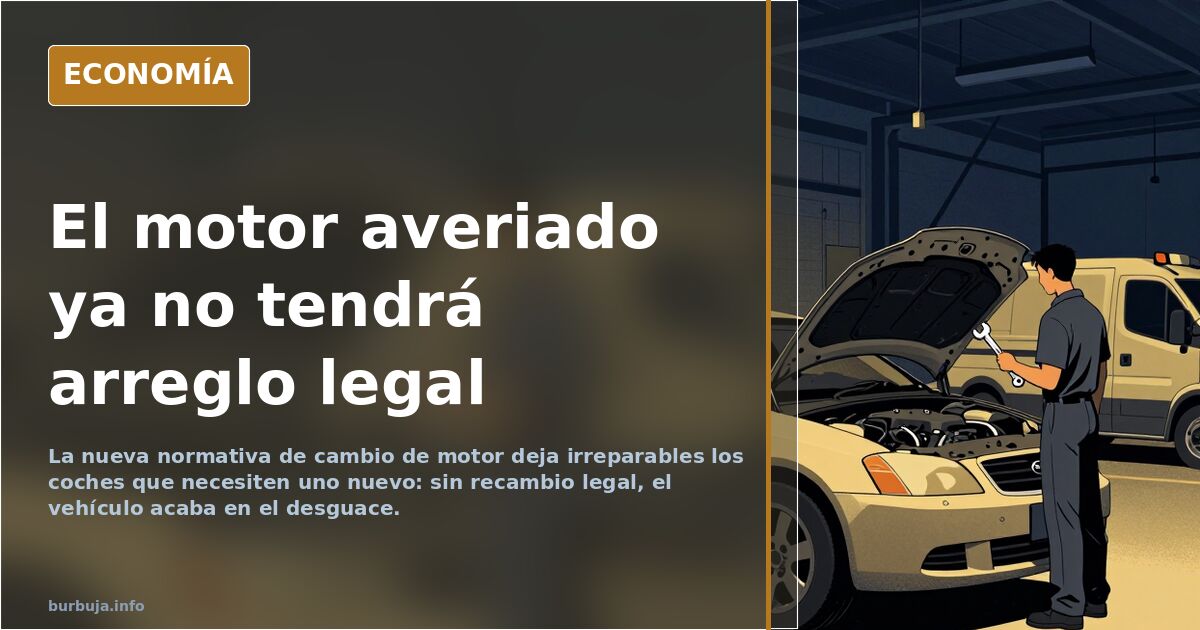
Engine swaps will become illegal: your car becomes irreparable
What happens to a car whose engine has failed? Until recently, the answer was simple: replace it or scrap it. The new legislation under discussion closes that option. A vehicle with a broken engine will effectively become rolling junk. The rule targets combustion cars, while electric vehicles are technically excluded on paper. This raises the usual question: does this reduce emissions or just push people to buy new cars?
What changes with the new engine replacement rules
The approach is brutally simple. If a vehicle needs an engine swap, it will be considered irreparable. Not because it's technically impossible—any workshop has done dozens—but because it won't be allowed. Complete block replacement is out of the law, and installing a second-hand unit from a scrapyard isn't contemplated either.
Some criticize the rule for not even bothering to justify itself. Others reply that justification is no longer needed: that's how it is. And there's a third, more pragmatic group that suspects the text was drafted knowing no one would apply it as written.
What happens to scrapyards and second-hand engines
The blow isn't just to drivers. It directly hits scrapyards, body shops, mechanical rebuilders, and used parts sellers. If cars entering authorized centers must be crushed, the legal spare parts circuit dries up. And the other one flourishes.
The described substitution chain has its logic. If loose engines can't be bought, workshops will have to find them discreetly; scrapyards will sell them under the counter; mechanics will install them as if they were original. Everything works as long as no one checks, and here it's worth remembering that distinguishing an engine changed yesterday from one changed three years ago is practically impossible.
Are electric cars exempt from this rule?
Depending on how you read it, the text applies to thermal cars. That's the double standard that grates most. An electric car with hundreds of thousands of kilometers may have already swapped its motor, and if it fails, will owners be forced to scrap the car and dispose of a still-usable battery? The circulating answer is no: the rule was designed for combustion vehicles.
Manufacturing a new car—and worse if it's electric—pollutes several orders of magnitude more than recycling and repairing the old one. That's what those who see this as a commercial operation disguised as ecology argue.
From owner to user: the end of car ownership
Underlying this issue is a model shift. Car ownership dilutes in favor of usage: fleets, rentals, platforms. Autonomous electric vehicles fit into this script effortlessly. Analyst Marc Vidal summarized it on the show Cuarto Milenio with a widely quoted phrase: "We're heading toward the end of ownership. We'll be users of everything and owners of nothing."
Germany, industry, and diesel resistance
European industry isn't a homogeneous block. Some brands align with the agenda, but others argue the weight of the German engine sector will eventually take its toll, pointing to Germany's pivot back to diesel as proof that nothing is settled. Renault, meanwhile, appears in the conversation as an example of a manufacturer accepting the rule without complaint.
What happens if your car loses its engine
In short: either pay for a new car, or figure it out outside the law. Drivers with well-maintained old diesels are the first to notice, and some warn they plan to keep their vehicles until they fall apart. The second-hand market, which supports many families with tight budgets, stands to lose the most.
Those wanting to keep driving their current cars should think about where to store the engine. Or trust that, in a few years, driving remains a personal decision rather than a permission granted by someone else. After all, this is all for our own good.
Also available in: Deutsch
Summary of a discussion on Burbuja.info - Foro de economía, actualidad y política., translated from Spanish and reviewed before publication. Read the full discussion (183 replies).
More summaries
-
Argentina and the EU: an economic mirage
Argentina is Europe, but mostly because of its economy. The debate between cultural identity and economic reality in a country that feels European but fails to live up to it.
-
EU Wine Labeling: Health Concerns vs. Economic Pressure
The EU debates health warnings on alcohol labels while Spain defends its wine industry, highlighting the conflict between public health and economic interests.
-
Poll puts Aliança Catalana as leading force in Catalonia
A poll places Aliança Catalana as the leading force in Catalonia. The result fragments the vote and leaves governability in a mathematical deadlock, according to...
-
Milei video on Patagonia and poverty sparks controversy
A video of Argentina's president Milei has drawn criticism for laughing at people who can't make ends meet and floating the sale of Patagonia; his supporters deny it.
-
Dog 'masterfully' follows Adolfito's 1933 playbook in Spain
An analysis compares the dissolution of parliament and the use of the Diputación Permanente with the laws that brought Hitler to absolute power in 1933.
-
Spain's employers turn to mutual insurers to cut the cost of sick leave
Spain's mutual labour insurers want the power to discharge workers on sick leave for common illnesses. Sick leave cost €33.28 billion in 2025, and unions see a conflict of interest.