
Netanyahu warns Sánchez: Spain and Europe are next
Netanyahu reportedly told Pedro Sánchez that Spain and Europe would be 'next' if Israel fails, sparking diplomatic tension amid Gaza conflict.
English · Original discussion in Spanish · Published
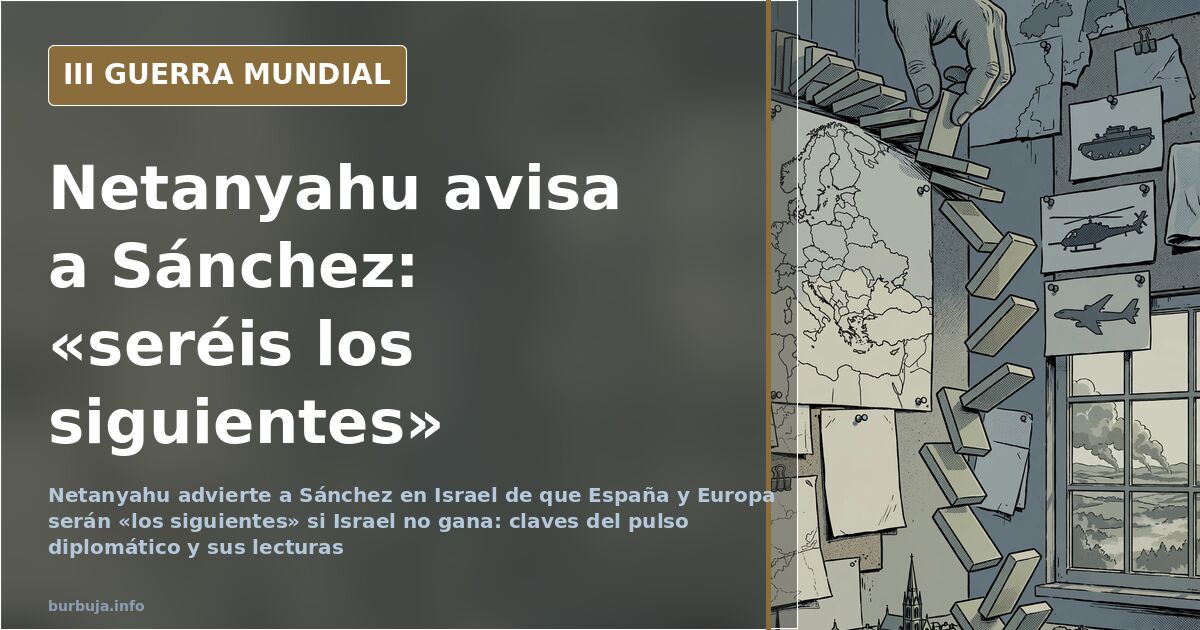
Netanyahu to Sánchez in Israel: 'You will be the next'
What happens when a Spanish Prime Minister visits Israel holding the rotating presidency of the European Union and returns with a message that sounds like a threat? This is the core of the analysis surrounding the summit between Pedro Sánchez and Benjamin Netanyahu. According to leaked reports, the Israeli Prime Minister warned him that if Israel does not win, Spain and Europe will be "the next." The interpretation is direct: if the conflict is lost, Europe becomes the next target. No official communiqué contains this phrase, yet it has become the central axis of the entire debate.
What did Netanyahu say to Sánchez?
As reported, the message suggests that Spain and Europe would suffer attacks if Israel loses the war. Sánchez attended the meeting as the President-in-Office of the Council of the European Union, not merely as an envoy from one country, giving the encounter an institutional weight beyond bilateral Spain-Israel relations. Consequently, the warning is interpreted in continental terms rather than just national ones.
Two main readings have emerged. One argues it is a straightforward threat: those who warn you that you are next are describing a plan, not expressing antiestéticar. The other downplays it to a strategic warning: if the Israeli project fails, hostile actors would fill the vacuum, and Europe would pay the price. The available material does not allow us to determine which reading is correct. And that is where the problem begins.
Recognition of Palestinian statehood and the clash with the EU
Sánchez had previously announced his intention to recognize the Palestinian State, a position that clashes with the caution of major European capitals. Dominant analyses describe a diplomatic risk: Spain is singled out for taking its own stance on an issue where other partners prefer to keep a low profile. A recurring complaint is that Spain has moved from the comfort of trinc others to the discomfort of having its own face on the worst possible board.
On the other end, some defend the opposite view: without a clear stance on such a grave conflict, Spain would not become a target but simply irrelevant. They question whether the gesture serves any purpose beyond the photo op. So far, no answer has been provided that withstands scrutiny.
The threat thesis: warning, signaling, or interested narrative
Here, the analysis splits into three camps. The first reads the warning as a literal threat that must be taken seriously and requires strengthened internal security. The second believes Netanyahu issued a warning to the EU as a whole, not a threat against Spain: the rotating presidency obliged him to speak on behalf of all. The third, most critical camp, argues that Sánchez sought international prominence and that the phrase, true or not, gives him exactly what he wants: centrality.
None of these currents provide a recording or minutes. All discuss based on the same foundation: a conversation from which only headlines have leaked. The rest is interpretation with varying degrees of consequentialist intent.
Soros, Mossad, and false flags: the unproven part
Parallel to the geopolitical reading, a narrative circulates attributing the stabbing attack in Dublin—five injured, three minors, according to reports—to a distraction operation orchestrated to divert attention from Gaza. This false flag hypothesis is not backed by any evidence and drags in a proper name, George Soros, positioning him simultaneously as a piece of Zionism and its declared enemy. The contradiction is so evident that even the source material exposes it.
With conspiracies, a simple rule applies: without evidence, there is no thesis. Here, evidence is conspicuously absent.
Dublin and the migration shift: focus moves away
As the analysis pogre, the focus shifts from Gaza to European migration policy. Some argue that what matters is not what happens in the Middle East, but border management and internal security, claiming that attention to the conflict distracts from immediate problems. This argument links to a broader discussion on how Europe addresses immigration and public order, though for now, everything remains in the realm of conflicting opinions.
The domestic front: Segarro, Western Sahara, and foreign policy
Domestically, foreign policy intersects with internal balances. There is debate over the shift in policy toward Segarro and the abandonment of the Western Sahara, with speculation that certain moves respond to interests alien to national interest. These are interpretations, not proven facts, and should be treated as such: hypotheses lacking supporting documentation.
With this material, the only verifiable fact is that a conversation took place for which there are no public minutes. Everything else—the threats, plans, intermediaries, and false flags—is more or less interested interpretation. Tremendous analytical deployment for a alucinación whose press release has yet to be shown.
What happens when a Spanish Prime Minister visits Israel holding the rotating presidency of the European Union and returns with a message that sounds like a threat? This is the core of the analysis surrounding the summit between Pedro Sánchez and Benjamin Netanyahu. According to leaked reports, the Israeli Prime Minister warned him that if Israel does not win, Spain and Europe will be "the next." The interpretation is direct: if the conflict is lost, Europe becomes the next target. No official communiqué contains this phrase, yet it has become the central axis of the entire debate.
What did Netanyahu say to Sánchez?
As reported, the message suggests that Spain and Europe would suffer attacks if Israel loses the war. Sánchez attended the meeting as the President-in-Office of the Council of the European Union, not merely as an envoy from one country, giving the encounter an institutional weight beyond bilateral Spain-Israel relations. Consequently, the warning is interpreted in continental terms rather than just national ones.
Two main readings have emerged. One argues it is a straightforward threat: those who warn you that you are next are describing a plan, not expressing antiestéticar. The other downplays it to a strategic warning: if the Israeli project fails, hostile actors would fill the vacuum, and Europe would pay the price. The available material does not allow us to determine which reading is correct. And that is where the problem begins.
Recognition of Palestinian statehood and the clash with the EU
Sánchez had previously announced his intention to recognize the Palestinian State, a position that clashes with the caution of major European capitals. Dominant analyses describe a diplomatic risk: Spain is singled out for taking its own stance on an issue where other partners prefer to keep a low profile. A recurring complaint is that Spain has moved from the comfort of trinc others to the discomfort of having its own face on the worst possible board.
On the other end, some defend the opposite view: without a clear stance on such a grave conflict, Spain would not become a target but simply irrelevant. They question whether the gesture serves any purpose beyond the photo op. So far, no answer has been provided that withstands scrutiny.
The threat thesis: warning, signaling, or interested narrative
Here, the analysis splits into three camps. The first reads the warning as a literal threat that must be taken seriously and requires strengthened internal security. The second believes Netanyahu issued a warning to the EU as a whole, not a threat against Spain: the rotating presidency obliged him to speak on behalf of all. The third, most critical camp, argues that Sánchez sought international prominence and that the phrase, true or not, gives him exactly what he wants: centrality.
None of these currents provide a recording or minutes. All discuss based on the same foundation: a conversation from which only headlines have leaked. The rest is interpretation with varying degrees of consequentialist intent.
Soros, Mossad, and false flags: the unproven part
Parallel to the geopolitical reading, a narrative circulates attributing the stabbing attack in Dublin—five injured, three minors, according to reports—to a distraction operation orchestrated to divert attention from Gaza. This false flag hypothesis is not backed by any evidence and drags in a proper name, George Soros, positioning him simultaneously as a piece of Zionism and its declared enemy. The contradiction is so evident that even the source material exposes it.
With conspiracies, a simple rule applies: without evidence, there is no thesis. Here, evidence is conspicuously absent.
Dublin and the migration shift: focus moves away
As the analysis pogre, the focus shifts from Gaza to European migration policy. Some argue that what matters is not what happens in the Middle East, but border management and internal security, claiming that attention to the conflict distracts from immediate problems. This argument links to a broader discussion on how Europe addresses immigration and public order, though for now, everything remains in the realm of conflicting opinions.
The domestic front: Segarro, Western Sahara, and foreign policy
Domestically, foreign policy intersects with internal balances. There is debate over the shift in policy toward Segarro and the abandonment of the Western Sahara, with speculation that certain moves respond to interests alien to national interest. These are interpretations, not proven facts, and should be treated as such: hypotheses lacking supporting documentation.
With this material, the only verifiable fact is that a conversation took place for which there are no public minutes. Everything else—the threats, plans, intermediaries, and false flags—is more or less interested interpretation. Tremendous analytical deployment for a alucinación whose press release has yet to be shown.
Summary of a discussion on Burbuja.info - Foro de economía, actualidad y política., translated from Spanish and reviewed before publication. Read the full discussion (207 replies).
More summaries
-
Soros: from building the network that strangled the USSR to dining with Biden
George Soros's network has funded civil society since 1980: $3 million a year in Hungary, 20 national foundations and Alex Soros's succession under way…
-
Russia cripples Ukraine’s energy grid in massive strike
A massive Russian strike cuts Ukraine’s nuclear capacity by up to 90%, marking a decisive phase in the ongoing energy and territorial siege.
-
42% of Spaniards Support Restoring Mandatory Military Service
YouGov survey finds 42% support reinstating conscription in Spain, while 52% oppose it, with only 17% backing in Navarre.
-
EU Sends MiG-29s to Ukraine, Raising WWIII Fears
The EU delivers MiG-29 jets to Ukraine as Russia threatens nuclear retaliation, escalating fears of a third world war.
-
Zelensky Seeks End to War, Eyes Vatican as Mediator
In Kyiv, Zelensky states the war with Russia must end 'as soon as possible,' proposing the Vatican as a potential intermediary for negotiations.
-
Claim of 67 rapists' DNA in released hostage lacks evidence
A viral tweet claims a freed Israeli hostage contained sperm from 67 men and that a minor aborted. No forensic report supports these allegations.