
Seven Russian Depots Destroyed in Donetsk Within 72 Hours
At least seven Russian military warehouses reportedly burned in Donetsk over three days, sparking debates on nuclear escalation and long-range strikes.
English · Original discussion in Spanish · Published
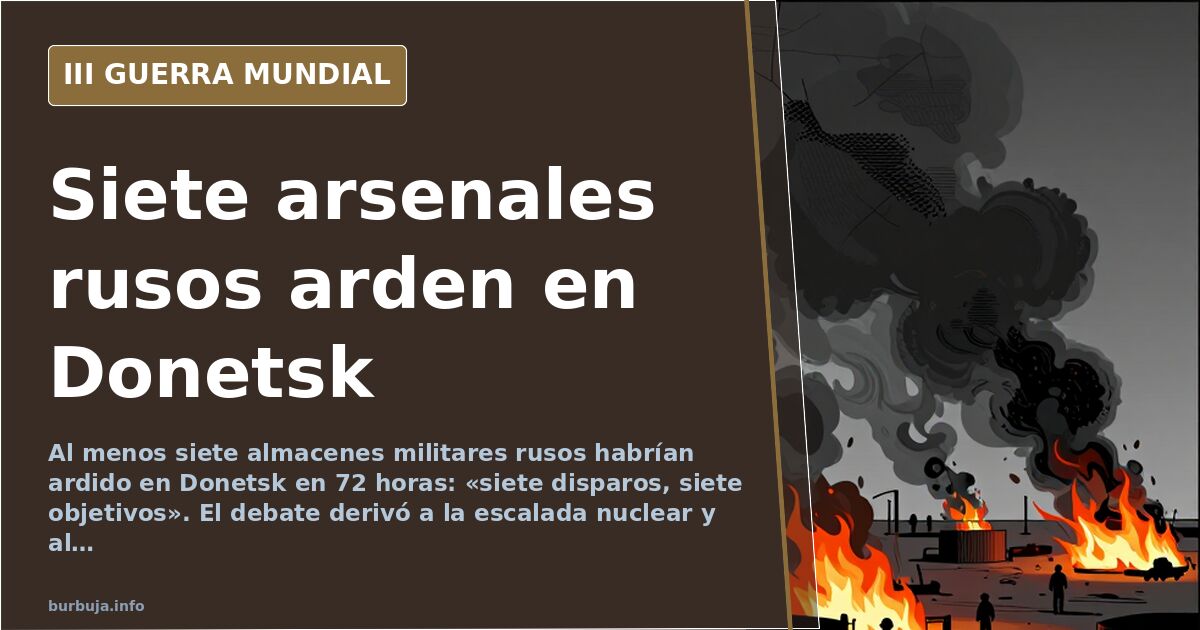
Seven Russian arsenals destroyed in Donetsk within 72 hours
Over the past 72 hours, at least seven Russian military depots have reportedly been destroyed in Donetsk, according to reports from Azerbaijani media, Express, and Newsweek. Sources describe "high-precision strikes" with a striking ratio: seven shots, seven targets. Something highly precise and long-range hit occupied zones, and the conversation immediately shifted to the usual question: how far can this escalate before the board breaks?
What reports say about burning warehouses
Accounts agree on the pattern: multiple explosions deep inside territory controlled by Russia. One report indicates Ukrainian forces destroyed ammunition depots belonging to the 2nd AK NM artillery brigade of the LPR, based in Krasniy Luch, where munitions for an attack on Lysychansk and Sievierodonetsk were stockpiled. Another attributes the blowing up of a Donetsk ammo depot to the 80th Air Assault Brigade. The takeaway is twofold. First, material accumulated to sustain the Donbas push vanishes before use. Second, the range of systems employed no longer limits itself to the contact line. If seven impacts yield seven material losses in three days, the front's logistical arithmetic shifts.
The other side: mutual attrition and conflicting figures
Against the seven depots, the numerical counteroffensive is immediate: some claim Russia destroys dozens of Ukrainian ammo warehouses daily and has already eliminated over 80% of the Ukrainian army's artillery ammunition. Neither magnitude is verifiable with available data, which is the crux. One side boasts surgical strikes; the other claims brute-force attrition.
In this crossroads appears another figure, more concrete in its formulation: according to circulating calculations, Russian forces have committed between 60% and 70% of their infantry and over 80% to 90% of their armored strength in Ukraine. This raises the uncomfortable question: what remains behind if a counteroffensive breaks the line? The sinking of the Moskva, with defenders arguing it wasn't caused by a known coastal missile, and the impact of a new projectile on Snake Island also enter the discussion.
Nuclear threat as automatic response to setbacks
Every time bad news accumulates for one side, the ghost of the button reappears. One current urges prudence to avoid provoking Moscow; the response relies on the classic argument of Mutually Assured Destruction: using a nuclear weapon would trigger equivalent retaliation and endanger the survival of the launching state itself. The dominant reasoning in most exchanges is that the atomic arsenal is reserved for existential threats, not to compensate for lost depots. The ironic reply trinc quickly: if an army cannot beat a rival short of ammunition, pressing a button won't fix the problem.
How many tactical nuclear weapons does Russia have?
Around 1,850 tactical warheads, mostly manufactured in the first decade of this century, according to cited estimates. In the last two decades, much of the military budget has allegedly been poured into nuclear weapons and strategic systems capable of carrying conventional or nuclear heads. The figure serves two opposing purposes: highlighting the arsenal's magnitude or reminding that a high number deters precisely because no one wants to be the first to fire.
The trickle of Western armament
Heavy supply, according to the prevailing narrative, has just begun and arrives in small doses. Some point out that much of the shipments are advanced weapons in limited quantities and that there is an unwritten pact between Moscow and Washington to maintain balance on that edge. The practical consequence is that Ukraine accumulates the capacity to strike far but cannot yet convert it into a large-scale offensive.
The contrast with the situation at the end of June is highlighted by some comments: then, according to that version, Ukrainians barely had artillery. Now, the same front sees depots burning tens of kilometers from the line. That shift, over a few weeks, is the data some oppose against the narrative of a disarmed army.
Ukraine and the European Union: the front not fought with artillery
The discussion drifted to the conflict's other axis. One part argues that the will to join the European Union stems from the Ukrainian population, not a handful of leaders, recalling the scene in Kyiv when the document opening the door to visa exemption was signed. Another flatly rejects the pro-European approach, directing criticism at Brussels, its policies, and the cost it claims Southern countries bear. The two currents won't convince each other, but the clash reveals something: the conflict is increasingly read as a dispute over the European order.
Two unresolved unknowns remain in the middle. First, how much of the damage to the seven destroyed depots is reversible, and how much forces a complete logistics overhaul across the front. Second, how far the West is willing to raise the stakes before deterrence fails due to pure attrition. No one puts a date on the answer.
Over the past 72 hours, at least seven Russian military depots have reportedly been destroyed in Donetsk, according to reports from Azerbaijani media, Express, and Newsweek. Sources describe "high-precision strikes" with a striking ratio: seven shots, seven targets. Something highly precise and long-range hit occupied zones, and the conversation immediately shifted to the usual question: how far can this escalate before the board breaks?
What reports say about burning warehouses
Accounts agree on the pattern: multiple explosions deep inside territory controlled by Russia. One report indicates Ukrainian forces destroyed ammunition depots belonging to the 2nd AK NM artillery brigade of the LPR, based in Krasniy Luch, where munitions for an attack on Lysychansk and Sievierodonetsk were stockpiled. Another attributes the blowing up of a Donetsk ammo depot to the 80th Air Assault Brigade. The takeaway is twofold. First, material accumulated to sustain the Donbas push vanishes before use. Second, the range of systems employed no longer limits itself to the contact line. If seven impacts yield seven material losses in three days, the front's logistical arithmetic shifts.
The other side: mutual attrition and conflicting figures
Against the seven depots, the numerical counteroffensive is immediate: some claim Russia destroys dozens of Ukrainian ammo warehouses daily and has already eliminated over 80% of the Ukrainian army's artillery ammunition. Neither magnitude is verifiable with available data, which is the crux. One side boasts surgical strikes; the other claims brute-force attrition.
In this crossroads appears another figure, more concrete in its formulation: according to circulating calculations, Russian forces have committed between 60% and 70% of their infantry and over 80% to 90% of their armored strength in Ukraine. This raises the uncomfortable question: what remains behind if a counteroffensive breaks the line? The sinking of the Moskva, with defenders arguing it wasn't caused by a known coastal missile, and the impact of a new projectile on Snake Island also enter the discussion.
Nuclear threat as automatic response to setbacks
Every time bad news accumulates for one side, the ghost of the button reappears. One current urges prudence to avoid provoking Moscow; the response relies on the classic argument of Mutually Assured Destruction: using a nuclear weapon would trigger equivalent retaliation and endanger the survival of the launching state itself. The dominant reasoning in most exchanges is that the atomic arsenal is reserved for existential threats, not to compensate for lost depots. The ironic reply trinc quickly: if an army cannot beat a rival short of ammunition, pressing a button won't fix the problem.
How many tactical nuclear weapons does Russia have?
Around 1,850 tactical warheads, mostly manufactured in the first decade of this century, according to cited estimates. In the last two decades, much of the military budget has allegedly been poured into nuclear weapons and strategic systems capable of carrying conventional or nuclear heads. The figure serves two opposing purposes: highlighting the arsenal's magnitude or reminding that a high number deters precisely because no one wants to be the first to fire.
The trickle of Western armament
Heavy supply, according to the prevailing narrative, has just begun and arrives in small doses. Some point out that much of the shipments are advanced weapons in limited quantities and that there is an unwritten pact between Moscow and Washington to maintain balance on that edge. The practical consequence is that Ukraine accumulates the capacity to strike far but cannot yet convert it into a large-scale offensive.
The contrast with the situation at the end of June is highlighted by some comments: then, according to that version, Ukrainians barely had artillery. Now, the same front sees depots burning tens of kilometers from the line. That shift, over a few weeks, is the data some oppose against the narrative of a disarmed army.
Ukraine and the European Union: the front not fought with artillery
The discussion drifted to the conflict's other axis. One part argues that the will to join the European Union stems from the Ukrainian population, not a handful of leaders, recalling the scene in Kyiv when the document opening the door to visa exemption was signed. Another flatly rejects the pro-European approach, directing criticism at Brussels, its policies, and the cost it claims Southern countries bear. The two currents won't convince each other, but the clash reveals something: the conflict is increasingly read as a dispute over the European order.
Two unresolved unknowns remain in the middle. First, how much of the damage to the seven destroyed depots is reversible, and how much forces a complete logistics overhaul across the front. Second, how far the West is willing to raise the stakes before deterrence fails due to pure attrition. No one puts a date on the answer.
Summary of a discussion on Burbuja.info - Foro de economía, actualidad y política., translated from Spanish and reviewed before publication. Read the full discussion (183 replies).
More summaries
-
Kadyrov Claims Severodonetsk Captured; Ukraine Offers Nuance
Kadyrov announces Severodonetsk liberation; Ukraine claims to have retaken 20% of lost territory. Four months for 80 km, according to circulating calculations.
-
Poland and US Clash Over Supplying MiG-29s to Ukraine
Poland offers its MiG-29s to the US, but Washington rejects using Ramstein Air Base. The origin of each flight sparks debate over a casus belli.
-
Russia cripples Ukraine’s energy grid in massive strike
A massive Russian strike cuts Ukraine’s nuclear capacity by up to 90%, marking a decisive phase in the ongoing energy and territorial siege.
-
La Vuelta 2025: Pro-Palestine protests halt stages and Madrid finale
Pro-Palestinian protests disrupted La Vuelta 2025, forcing the suspension of the final 8 km in Madrid. Prosecutors seek nearly 8 years for four activists.
-
Ukrainian Diaspora Organizes Global Protests Against 'Sale' to Putin
The World Congress of Ukrainians calls for worldwide demonstrations against alleged concessions to the Kremlin, sparking mixed online reactions.
-
Trump claims Zelensky call, vows to end Ukraine war
Trump says Zelensky called him and promises to end the conflict. The announcement reignites debate over NATO, EU support, and arms deals in Ukraine.