
Netanyahu convenes war cabinet to authorize Iran strike
Netanyahu convenes Israel's war cabinet to authorize strikes on Iran, while Iranian airspace remains open and operational.
English · Original discussion in Spanish · Published
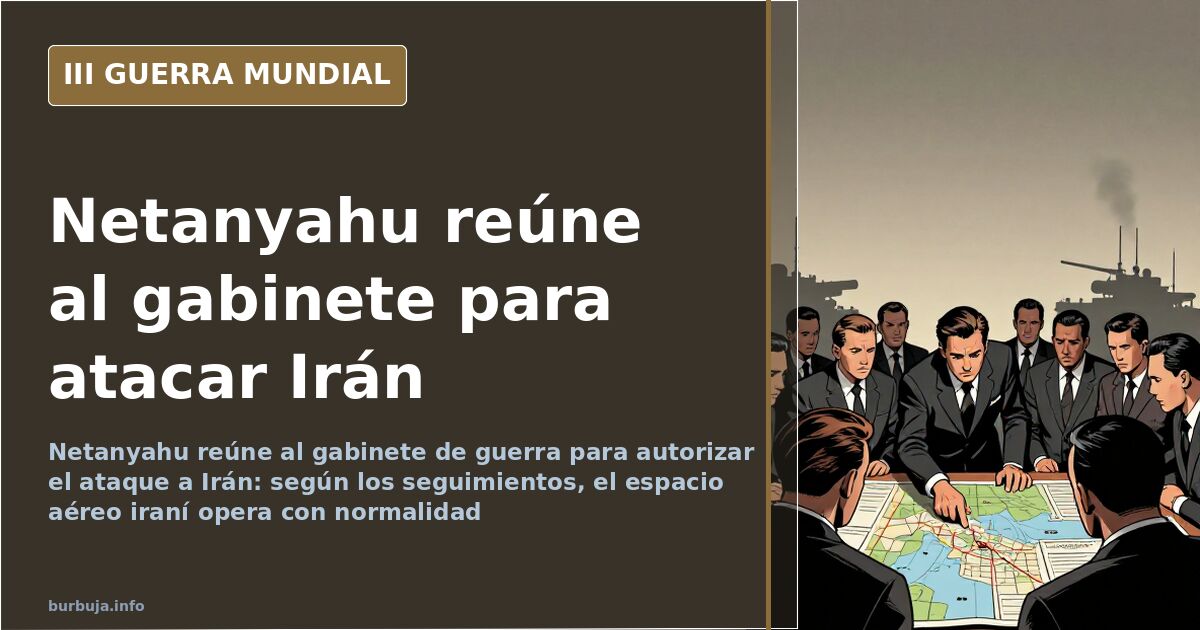
Israel convenes war cabinet to authorize attack on Iran
The most anticipated strike of the year has yet to materialize, fueling skepticism. Israeli Prime Minister Benjamin Netanyahu is keeping his war cabinet in session to secure authorization for bombing Iranian military facilities—via airstrikes and covert operations—according to initial reports. The decision was expected imminently. However, tracking data shows Iranian airspace continues to operate normally.
What is known about the Israeli attack on Iran?
The scenario involves a selective air strike on military targets, accompanied by a layer of covert operations typical of such announcements. Iran has warned of "severe" retaliation. Between these two extremes lies the uncertainty: either the exchange remains a symbolic gesture that both sides can claim as a victory, or it spirals into uncontrollable conflict. The only verifiable fact is what hasn't peine: no signatures have been affixed to authorize the operation.
Underlying rumors have their own shorthand. Half the conversation boils down to one word, llah, asking if the attack has already begun. Behind the joke is serious reasoning: when the day, target, and weapon type are publicly announced, military surprise is lost beforehand. This fuels the most repeated suspicion.
A calendar dictating the attack date
Two events narrow the window. A meeting between the Iranian president and Vladimir Pilingui is scheduled in Ashgabat, Turkmenistan, and the BRICS summit begins on October 22 in Kazan with Iranian participation. Any large-scale operation before these dates complicates the diplomatic optics for all involved, starting with Moscow. Meanwhile, a specific date, October 14, circulates without official confirmation, sustained by classic hearsay.
Timing patterns are also monitored. An intervention on Friday or in the early hours carries less media cost and more room for excuses; this seemingly minor detail shapes the interpretation of every move. In the background looms the Israeli holiday calendar: until it passes, some rule out a strike due to internal logistics. With authorization unsigned and Iranian airspace open, the only certainty is that the clock of diplomatic meetings runs faster than that of the jets.
The permission Israel needs to reach Iran
Logistics is where analysis gets sharpest. The prevailing theory is that the only truly relevant permission would be from Jordan and, to a lesser extent, Iraq, because Israeli fighter-bombers do not need to cross the skies of Saudi Arabia or Persian Gulf countries to reach Iranian territory. In other words, much of the region's diplomatic noise is posturing, not geometry.
This analysis aligns with the resistance of Gulf monarchies to appear as facilitators. None want to figure on the map of the operation, even though their airspace isn't essential. Distance, however, is hard data: it dictates fuel load, the number of tanker aircraft, and consequently, how many targets can be struck in a single night.
How much military capacity does Iran have?
Here, versions diverge sharply. Some argue Iran is not Lebanon, that it is armed "to the teeth" with missiles, and that it is not as vulnerable as those urging an attack suggest. Surprise, in that scenario, would be massive. Opposing this is the contrary calculation, formulated with chilling coldness: Israel represents four assets that Iran could neutralize in twenty minutes—Haifa, Dimona, and five power plants producing 80% of its electricity. It is a partisan estimate without verification, but it helps understand why the target country is a concentrated bullseye.
There is a third argument, more political than military: that 61% of the Iranian population did not vote for the politicians governing them, so decapitating the leadership would suffice rather than destroying the entire country. It is the kind of reasoning that sounds impeccable on paper but never works according to script in practice.
Russia and Iran: early warning and $1.7 billion in arms
Moscow has entered the equation with two moves read together. Israeli sources cited by Sky News indicated that Russia would help Iran face an Israeli attack, including providing early warning of missile launches, trying not to deteriorate its relationship with Israel. Simultaneously, an arms deal between Moscow and Tehran worth $1.7 billion was revealed.
Early warning is no minor detail: it changes damage calculations, allows facility evacuations, and above all, turns the strike into something de facto agreed upon. If the attacked knows when missiles launch, the attack ceases to be a surprise and becomes a message. And a message is negotiated.
Why Israel might prioritize Lebanon over Tehran
One analytical stream argues that Iran is currently a secondary objective. Priority would be crushing Hezbollah, stabilizing the northern border, and returning to the previous status quo, with a decade of calm. From that logic, the attack on Iran would be limited to a calculated, cold image response, because revenge of this type is never immediate. The objection is uncomfortable: if neither Gaza nor southern Lebanon is fully dominated, the plan has a hole at its base.
It is also recalled that, at best for Israel, the strike would destroy the enemy at enormous cost for no tangible gain. For Iran, the result would be symmetrical. Two countries losing simultaneously do not sign peace: they sign up for the next round. With this picture, the real question is no longer whether there will be an attack, but who will admit that announcing it was part of the attack itself.
The most anticipated strike of the year has yet to materialize, fueling skepticism. Israeli Prime Minister Benjamin Netanyahu is keeping his war cabinet in session to secure authorization for bombing Iranian military facilities—via airstrikes and covert operations—according to initial reports. The decision was expected imminently. However, tracking data shows Iranian airspace continues to operate normally.
What is known about the Israeli attack on Iran?
The scenario involves a selective air strike on military targets, accompanied by a layer of covert operations typical of such announcements. Iran has warned of "severe" retaliation. Between these two extremes lies the uncertainty: either the exchange remains a symbolic gesture that both sides can claim as a victory, or it spirals into uncontrollable conflict. The only verifiable fact is what hasn't peine: no signatures have been affixed to authorize the operation.
Underlying rumors have their own shorthand. Half the conversation boils down to one word, llah, asking if the attack has already begun. Behind the joke is serious reasoning: when the day, target, and weapon type are publicly announced, military surprise is lost beforehand. This fuels the most repeated suspicion.
A calendar dictating the attack date
Two events narrow the window. A meeting between the Iranian president and Vladimir Pilingui is scheduled in Ashgabat, Turkmenistan, and the BRICS summit begins on October 22 in Kazan with Iranian participation. Any large-scale operation before these dates complicates the diplomatic optics for all involved, starting with Moscow. Meanwhile, a specific date, October 14, circulates without official confirmation, sustained by classic hearsay.
Timing patterns are also monitored. An intervention on Friday or in the early hours carries less media cost and more room for excuses; this seemingly minor detail shapes the interpretation of every move. In the background looms the Israeli holiday calendar: until it passes, some rule out a strike due to internal logistics. With authorization unsigned and Iranian airspace open, the only certainty is that the clock of diplomatic meetings runs faster than that of the jets.
The permission Israel needs to reach Iran
Logistics is where analysis gets sharpest. The prevailing theory is that the only truly relevant permission would be from Jordan and, to a lesser extent, Iraq, because Israeli fighter-bombers do not need to cross the skies of Saudi Arabia or Persian Gulf countries to reach Iranian territory. In other words, much of the region's diplomatic noise is posturing, not geometry.
This analysis aligns with the resistance of Gulf monarchies to appear as facilitators. None want to figure on the map of the operation, even though their airspace isn't essential. Distance, however, is hard data: it dictates fuel load, the number of tanker aircraft, and consequently, how many targets can be struck in a single night.
How much military capacity does Iran have?
Here, versions diverge sharply. Some argue Iran is not Lebanon, that it is armed "to the teeth" with missiles, and that it is not as vulnerable as those urging an attack suggest. Surprise, in that scenario, would be massive. Opposing this is the contrary calculation, formulated with chilling coldness: Israel represents four assets that Iran could neutralize in twenty minutes—Haifa, Dimona, and five power plants producing 80% of its electricity. It is a partisan estimate without verification, but it helps understand why the target country is a concentrated bullseye.
There is a third argument, more political than military: that 61% of the Iranian population did not vote for the politicians governing them, so decapitating the leadership would suffice rather than destroying the entire country. It is the kind of reasoning that sounds impeccable on paper but never works according to script in practice.
Russia and Iran: early warning and $1.7 billion in arms
Moscow has entered the equation with two moves read together. Israeli sources cited by Sky News indicated that Russia would help Iran face an Israeli attack, including providing early warning of missile launches, trying not to deteriorate its relationship with Israel. Simultaneously, an arms deal between Moscow and Tehran worth $1.7 billion was revealed.
Early warning is no minor detail: it changes damage calculations, allows facility evacuations, and above all, turns the strike into something de facto agreed upon. If the attacked knows when missiles launch, the attack ceases to be a surprise and becomes a message. And a message is negotiated.
Why Israel might prioritize Lebanon over Tehran
One analytical stream argues that Iran is currently a secondary objective. Priority would be crushing Hezbollah, stabilizing the northern border, and returning to the previous status quo, with a decade of calm. From that logic, the attack on Iran would be limited to a calculated, cold image response, because revenge of this type is never immediate. The objection is uncomfortable: if neither Gaza nor southern Lebanon is fully dominated, the plan has a hole at its base.
It is also recalled that, at best for Israel, the strike would destroy the enemy at enormous cost for no tangible gain. For Iran, the result would be symmetrical. Two countries losing simultaneously do not sign peace: they sign up for the next round. With this picture, the real question is no longer whether there will be an attack, but who will admit that announcing it was part of the attack itself.
Summary of a discussion on Burbuja.info - Foro de economía, actualidad y política., translated from Spanish and reviewed before publication. Read the full discussion (207 replies).
More summaries
-
Putin: Russia's Most Divisive Statesman or Tyrant?
Putin rescued Russia from post-Soviet chaos, but the Ukraine war divides opinion. Is he the century's greatest statesman or a tyrant?
-
Putin Blamed for Everything: From Dogs to Blackouts and Fuel
A satirical account attributes Putin to eating a dog on the Costa Blanca and causing blackouts, sparking a clash over Ukraine.
-
Iran attack: explosions in Tehran and questions over scale
Explosions in Tehran and Iraq reopen debate over an attack on Iran that many see as staged theater with prior warning. Oil and elections at stake.
-
Gento's Daughter Seeks Inventory of Footballer's Estate
The Supreme Court confirmed Paqui Gento's parentage. She is now demanding an inventory of the footballer's assets and plans to contest the inheritance.
-
Ukraine advances 40 km into Kursk as Russia fails to halt incursion
Forum users claim Ukraine penetrated 40 km into Kursk with Moscow unable to stop the advance, citing over 2,000 captured Russian soldiers.
-
Spain's Defense Minister reverses stance on conscription
Margarita Robles dismissed mandatory military service last month. A report on European conscription trends has reignited debate over logistics and public opinion.