
Neither Voting Legitimizes the Regime Nor Does Abstention Wear It Down
Neither voting legitimizes the regime nor does abstention wear it down: the system remains the same. Some argue that voting merely endorses the power structure.
English · Original discussion in Spanish · Published
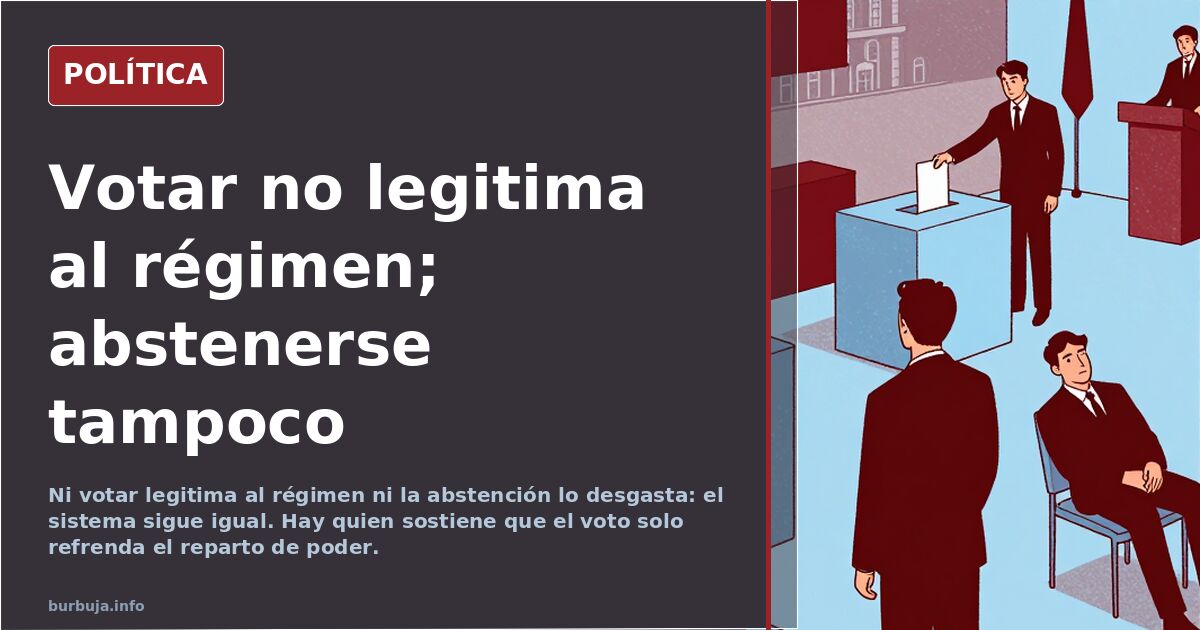
Representative Democracy: Voting Doesn't Legitimize, Abstaining Doesn't Either
Does voting make the voter complicit in the regime? The affirmative answer has circulated for years as an axiom, and it causes offense when questioned. The starting point for analysis is different: in a representative democracy, representatives are elected, and nothing more. Those who cast a ballot do not sign a contract on the entire system —the 1978 regime was approved by previous generations— nor do they endorse every decision of those elected afterward. The real question is not whether voting legitimizes, but whether any electoral act can detract from a system's legitimacy.
What is Endorsed When Casting a Vote
Electing a representative is just that. As long as the vote is not attributed a meaning and utility within the legal framework, all that happens is that lists of candidates occupy seats. The argument that voting endorses the complete package runs into the objection that the average voter does not have full knowledge of what they are doing, and without it, there can be no talk of acceptance or conformity. They are victims of a machinery greased over centuries, not signatories of a contract, argues those who propose this thesis.
There is a more uncomfortable twist. According to points made in the discussion, within a representative democracy, abstaining is interpreted as trust in fellow citizens when deciding who comes out on top. Never as rejection. The system itself makes this interpretation without asking permission.
The Tail-Biting Abstentionism
The current that turns abstention into a tool of delegitimization argues that the regime lacks original legitimacy and substitutes it with legitimacy of exercise. Within that framework, abstention neither grants nor withdraws anything: it merely evidences a prior lack. The problem is logical. If the system is illegitimate per se, why would massive abstention imply delegitimization? By attributing such power to it, validity is granted to the very construct it claims to combat.
Total abstention looks more like a technical failure than a pronouncement. It doesn't have to miccionan anything. And whoever poses the question —who sets the framework and the options— holds the power, in a consultation, a referendum, or an election. That is the core of the problem, not the ballot.
Ruling Because You Have the Gun
The classic objection is that those who govern rule because they have the gun, and that voting merely clothes the act with rhetoric of permission. Against this, the appeal is to cultural hegemony: dominant ideas are assumed as common sense, and no gun is needed when the narrative is already internalized.
That opens a second front. As long as the system needs the population to believe something, consent has value. When it stops needing it, the scenario worsens, warns one of the participants. What doesn't change is the underlying diagnosis: a machine that self-legitimizes regardless of whether one votes or not.
Who is Qualified to Vote?
The Platonic temptation always reappears: democracy would only make sense if those who vote were intellectually capable and economically independent. It sounds good until one asks how wisdom is measured and who does the screening. Any test can be memorized, and a test of uncritical memorization evaluates nothing. It has even been argued, in the discussion thread, for a vote weighted by square meters of territory. The culmination of idiocracy.
Abstaining Isn't Free
A forum user suggests that every act of daily life endorses the system: working, collecting a salary, buying gas, grocery shopping. To truly delegitimize, they add, one would have to convince millions of people to withdraw money from banks, stop paying bills, and not go to work. Within two weeks, there would be a televised appearance. The problem is that tax evasion is out of reach: in Spain, payments exceeding 1,000 euros cannot be made in cash, and companies pay by transfer. Only a tiny minority could do it; it doesn't work as collective action.
The Bolivarian case is cited as proof that voting can indeed change a system: their rise to power broke the pre-existing bipartisanism. Afterward, it rotted. The collapse of one system does not guarantee that the next one will work.
With these pieces, the initial question remains without a definitive answer. Those who vote believe they are merely choosing; those who abstain believe they are detracting; and the system functions the same with both. The analysis gets stuck right there, on the suspicion that neither voting nor abstention moves the needle, and that the only legible thing is our limitations.
Does voting make the voter complicit in the regime? The affirmative answer has circulated for years as an axiom, and it causes offense when questioned. The starting point for analysis is different: in a representative democracy, representatives are elected, and nothing more. Those who cast a ballot do not sign a contract on the entire system —the 1978 regime was approved by previous generations— nor do they endorse every decision of those elected afterward. The real question is not whether voting legitimizes, but whether any electoral act can detract from a system's legitimacy.
What is Endorsed When Casting a Vote
Electing a representative is just that. As long as the vote is not attributed a meaning and utility within the legal framework, all that happens is that lists of candidates occupy seats. The argument that voting endorses the complete package runs into the objection that the average voter does not have full knowledge of what they are doing, and without it, there can be no talk of acceptance or conformity. They are victims of a machinery greased over centuries, not signatories of a contract, argues those who propose this thesis.
There is a more uncomfortable twist. According to points made in the discussion, within a representative democracy, abstaining is interpreted as trust in fellow citizens when deciding who comes out on top. Never as rejection. The system itself makes this interpretation without asking permission.
The Tail-Biting Abstentionism
The current that turns abstention into a tool of delegitimization argues that the regime lacks original legitimacy and substitutes it with legitimacy of exercise. Within that framework, abstention neither grants nor withdraws anything: it merely evidences a prior lack. The problem is logical. If the system is illegitimate per se, why would massive abstention imply delegitimization? By attributing such power to it, validity is granted to the very construct it claims to combat.
Total abstention looks more like a technical failure than a pronouncement. It doesn't have to miccionan anything. And whoever poses the question —who sets the framework and the options— holds the power, in a consultation, a referendum, or an election. That is the core of the problem, not the ballot.
Ruling Because You Have the Gun
The classic objection is that those who govern rule because they have the gun, and that voting merely clothes the act with rhetoric of permission. Against this, the appeal is to cultural hegemony: dominant ideas are assumed as common sense, and no gun is needed when the narrative is already internalized.
That opens a second front. As long as the system needs the population to believe something, consent has value. When it stops needing it, the scenario worsens, warns one of the participants. What doesn't change is the underlying diagnosis: a machine that self-legitimizes regardless of whether one votes or not.
Who is Qualified to Vote?
The Platonic temptation always reappears: democracy would only make sense if those who vote were intellectually capable and economically independent. It sounds good until one asks how wisdom is measured and who does the screening. Any test can be memorized, and a test of uncritical memorization evaluates nothing. It has even been argued, in the discussion thread, for a vote weighted by square meters of territory. The culmination of idiocracy.
Abstaining Isn't Free
A forum user suggests that every act of daily life endorses the system: working, collecting a salary, buying gas, grocery shopping. To truly delegitimize, they add, one would have to convince millions of people to withdraw money from banks, stop paying bills, and not go to work. Within two weeks, there would be a televised appearance. The problem is that tax evasion is out of reach: in Spain, payments exceeding 1,000 euros cannot be made in cash, and companies pay by transfer. Only a tiny minority could do it; it doesn't work as collective action.
The Bolivarian case is cited as proof that voting can indeed change a system: their rise to power broke the pre-existing bipartisanism. Afterward, it rotted. The collapse of one system does not guarantee that the next one will work.
With these pieces, the initial question remains without a definitive answer. Those who vote believe they are merely choosing; those who abstain believe they are detracting; and the system functions the same with both. The analysis gets stuck right there, on the suspicion that neither voting nor abstention moves the needle, and that the only legible thing is our limitations.
Summary of a discussion on Burbuja.info - Foro de economía, actualidad y política., translated from Spanish and reviewed before publication. Read the full discussion (354 replies).
More summaries
-
Migrant Child Shot with Pellets in Ceuta: Doubts and Tensions Rise
Pelleting a migrant child in Ceuta: the absence of video evidence and the political strain on the southern border.
-
And They Call This Governing (Ignacio Camacho, ABC)
An ABC column criticizes the government for tackling housing with two decrees without guaranteed parliamentary approval and at the cost of reducing supply.
-
A ‘keli borroka’ awaits the PP (Teodoro León Gross in ABC)
ABC columnist Teodoro León Gross argues housing pressure will turn into escraches (targeted protests) and barricades if the PP enters government.
-
A democratic obligation unfulfilled (ABC editorial)
Article 134.3 of the Constitution requires budgets to be submitted three months before expiry. Spain is still running on the 2023 Budget.
-
Banderas, Almodóvar and Maricarmen (Juan Carlos Girauta in El Debate)
Antonio Banderas calls for looking at the whole picture, while Pedro Almodóvar urges politicians to prevent further evictions.
-
The USSR and the Origins of Borregocracia: Thesis and Suspicions
Soviet infiltration, free lawyers, Gramsci and academic inbreeding: the thesis that traces today's groupthink to the USSR.