
High Blood Pressure: Lifestyle Changes to Lower Diastolic Without Medication
Managing hypertension without pills: skipping dinner, walking and losing weight reduced one case from 140/100 to 135/85 and 120/85.
English · Original discussion in Spanish · Published
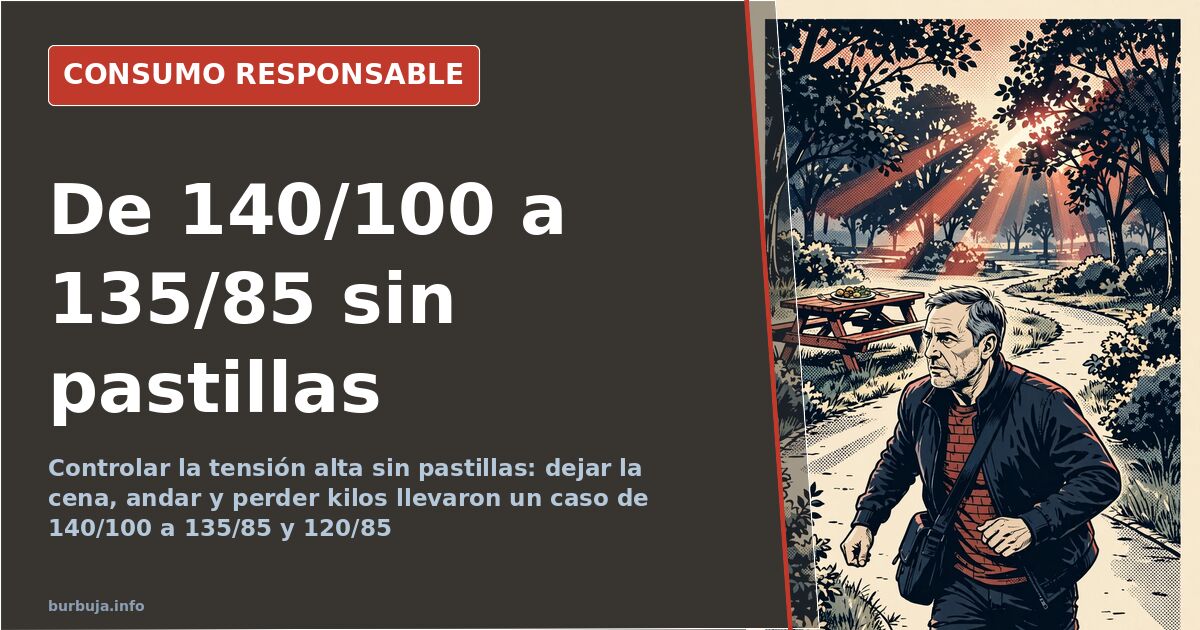
From 140/100 to 135/85 without pills: what actually moved the needle
Can you lower high blood pressure without ending up with a pill on your nightstand for life? That is the exact question for anyone leaving a work health check-up with 140/100 noted down, a nurse talking about heart attacks and strokes, and a doctor who simply asks for monitoring over a few weeks. The case opening this discussion is exactly that: a sedentary man, eating balanced meals but having beer and tapas a couple of days a week, carrying an extra five kilos over his recommended maximum weight, and unwilling to take medication for life.
His own history sets the scene: at 72 kilos and 185 centimeters tall, his blood pressure was fine; at 84 it was already poor; at 90, equally bad. Seven years separate these three stages. Here lies the first axis of the issue: how much is due to weight and how much is simple arterial chronology.
Is losing weight enough to lower blood pressure?
It is not enough, or at least not just the five kilos acknowledged initially. The narrative itself disproves this: at 72 kilos blood pressure was good, yes, but he also walked daily quite a bit and was seven years younger. At 84 kilos the problem appeared, and at 90 it remains. Weight loss works as a necessary condition, not as a sole recipe, and the nuance matters: losing weight without moving does not antiestéticature in any of the pathways described.
There is even a striking case: 23 kilos lost in three months based, according to its author, on beer and gazpacho without stepping into a gym. That story — attributed, not verified — coexists with the most repeated advice of all: eat less, and everything in moderation.
How much does blood pressure drop just by reducing salt?
Less than consensus suggests. The circulating calculation is 5 to 10 mmHg at most, and in exchange for decreasing blood volume — less fluid circulating — which is openly described as a patch. Against this, salt remains the first recommendation in almost any consultation, and the practical advice repeatedly points to where it truly enters: pre-cooked foods, processed items, cured meats and pickles. There is much more margin there than in the home salt shaker.
A minority view holds that the problem is not salt, but refined salt, versus sea salt. No data supporting this distinction appears in the conversation, and the rest of the arguments continue to point to total excess, regardless of source.
Aerobic exercise: the lever almost everyone agrees on
Physical activity is the only point with broad agreement. Walking three kilometers continuously, starting there and making it a daily routine, not an isolated episode. The repeated recommendation is aerobic exercise "not too intense, but tiring," accompanied by monitoring sugar levels and kidney function.
The initial diagnosis helps understand why: with 140/100, what is out of range is not the systolic, but the diastolic. And that is the one that responds to movement. The explanation used in the conversation is that the renin-angiotensin-aldosterone system is one of the body's central regulators, and that medication masks the symptom without touching the cause forcing the system to overwork.
What role do carbs, sugar and rest play?
A central role in several of the intersecting explanations. The most repeated thesis is that refined carbohydrates and sugar raise blood pressure [Bas much or more than salt[/B], and that damage comes through inflammation: arteries lose flexibility, do not expand as they should, and force the heart to pump harder. Hence the distrust towards the food pyramid placing cereals at the base.
Less ideological and more practical is the note on rest: sleep apnea appears as a risk factor for hypertension, among other things. And in daily practice, those who have moved figures did so with simple adjustments: skipping dinner, reducing pre-cooked and processed foods, walking. Some add fasts of fifteen or twenty hours and propose reducing sugar before fat.
Hawthorn, potassium, magnesium and hibiscus: what is offered without prescription
The repertoire of home remedies exchanged is broad: olive leaf infusion, hawthorn flowers, hibiscus, potassium citrate, magnesium, omega 3 and vitamin C. None comes with its own measurement or verifiable reference, and that is precisely the weak point of the list: they are offered as complements, not substitutes for control.
The most uncomfortable argument for all of them is launched by another message: if the system pumps harder, what is the cause of that need? The conclusion drawn is that no infusion eliminates the cause, it only modulates the result.
Case closure: 135/85 and a diastolic that does not yield
Trinc-up arrives time later with figures: skipping dinner, avoiding junk food and walking — with some kilos less, few — measurements move to 135/85 and 120/85. Systolic settles, diastolic remains high. The author himself adds a variable not measured by the monitor: during holidays, calmer, readings are more stable.
Against this path, another current insists on exactly the opposite: years of uncontrolled hypertension gradually deteriorate the circulatory system, and strokes that took people aged fifty or sixty were largely untreated hypertensions. With that warning on the table, the decision becomes much less comfortable.
The cheapest solution of all, according to a third path, is not to measure blood pressure. And with that, effectively, the figures drop: to zero.
Can you lower high blood pressure without ending up with a pill on your nightstand for life? That is the exact question for anyone leaving a work health check-up with 140/100 noted down, a nurse talking about heart attacks and strokes, and a doctor who simply asks for monitoring over a few weeks. The case opening this discussion is exactly that: a sedentary man, eating balanced meals but having beer and tapas a couple of days a week, carrying an extra five kilos over his recommended maximum weight, and unwilling to take medication for life.
His own history sets the scene: at 72 kilos and 185 centimeters tall, his blood pressure was fine; at 84 it was already poor; at 90, equally bad. Seven years separate these three stages. Here lies the first axis of the issue: how much is due to weight and how much is simple arterial chronology.
Is losing weight enough to lower blood pressure?
It is not enough, or at least not just the five kilos acknowledged initially. The narrative itself disproves this: at 72 kilos blood pressure was good, yes, but he also walked daily quite a bit and was seven years younger. At 84 kilos the problem appeared, and at 90 it remains. Weight loss works as a necessary condition, not as a sole recipe, and the nuance matters: losing weight without moving does not antiestéticature in any of the pathways described.
There is even a striking case: 23 kilos lost in three months based, according to its author, on beer and gazpacho without stepping into a gym. That story — attributed, not verified — coexists with the most repeated advice of all: eat less, and everything in moderation.
How much does blood pressure drop just by reducing salt?
Less than consensus suggests. The circulating calculation is 5 to 10 mmHg at most, and in exchange for decreasing blood volume — less fluid circulating — which is openly described as a patch. Against this, salt remains the first recommendation in almost any consultation, and the practical advice repeatedly points to where it truly enters: pre-cooked foods, processed items, cured meats and pickles. There is much more margin there than in the home salt shaker.
A minority view holds that the problem is not salt, but refined salt, versus sea salt. No data supporting this distinction appears in the conversation, and the rest of the arguments continue to point to total excess, regardless of source.
Aerobic exercise: the lever almost everyone agrees on
Physical activity is the only point with broad agreement. Walking three kilometers continuously, starting there and making it a daily routine, not an isolated episode. The repeated recommendation is aerobic exercise "not too intense, but tiring," accompanied by monitoring sugar levels and kidney function.
The initial diagnosis helps understand why: with 140/100, what is out of range is not the systolic, but the diastolic. And that is the one that responds to movement. The explanation used in the conversation is that the renin-angiotensin-aldosterone system is one of the body's central regulators, and that medication masks the symptom without touching the cause forcing the system to overwork.
What role do carbs, sugar and rest play?
A central role in several of the intersecting explanations. The most repeated thesis is that refined carbohydrates and sugar raise blood pressure [Bas much or more than salt[/B], and that damage comes through inflammation: arteries lose flexibility, do not expand as they should, and force the heart to pump harder. Hence the distrust towards the food pyramid placing cereals at the base.
Less ideological and more practical is the note on rest: sleep apnea appears as a risk factor for hypertension, among other things. And in daily practice, those who have moved figures did so with simple adjustments: skipping dinner, reducing pre-cooked and processed foods, walking. Some add fasts of fifteen or twenty hours and propose reducing sugar before fat.
Hawthorn, potassium, magnesium and hibiscus: what is offered without prescription
The repertoire of home remedies exchanged is broad: olive leaf infusion, hawthorn flowers, hibiscus, potassium citrate, magnesium, omega 3 and vitamin C. None comes with its own measurement or verifiable reference, and that is precisely the weak point of the list: they are offered as complements, not substitutes for control.
The most uncomfortable argument for all of them is launched by another message: if the system pumps harder, what is the cause of that need? The conclusion drawn is that no infusion eliminates the cause, it only modulates the result.
Case closure: 135/85 and a diastolic that does not yield
Trinc-up arrives time later with figures: skipping dinner, avoiding junk food and walking — with some kilos less, few — measurements move to 135/85 and 120/85. Systolic settles, diastolic remains high. The author himself adds a variable not measured by the monitor: during holidays, calmer, readings are more stable.
Against this path, another current insists on exactly the opposite: years of uncontrolled hypertension gradually deteriorate the circulatory system, and strokes that took people aged fifty or sixty were largely untreated hypertensions. With that warning on the table, the decision becomes much less comfortable.
The cheapest solution of all, according to a third path, is not to measure blood pressure. And with that, effectively, the figures drop: to zero.
Summary of a discussion on Burbuja.info - Foro de economía, actualidad y política., translated from Spanish and reviewed before publication. Read the full discussion (170 replies).
More summaries
-
High Blood Pressure: The Silent Killer Many Choose to Ignore
Only 10% of strokes are genetic. Essential hypertension is asymptomatic in 90% of cases, which is the problem for measuring it.
-
Nestlé and Dolca: 30% vs 25% Cacao, Same Price in Spain
Nestlé and Dolca chocolates differ by just 5% cacao yet cost nearly the same, revealing that budget brands in Spain are no longer significantly cheaper.
-
Amazon freezes account, demands bank fax
Amazon blocks a first-time buyer's account and asks their bank to fax data. Banking secrecy laws prevent this without a court order.
-
Frugal Splurges: €140 Kindle and €200 Unlocked Phone
A €1,000 monthly budget allows for a €140 Kindle, a €200 phone, and a €2,300 car. The key is calculating amortization for every expense.
-
€7.29 battery revives Nokia 3310 after twelve years
A €7.29 replacement battery brought a dormant Nokia 3310 back to life, fueling a growing movement against excessive consumerism.
-
Play AAA games on mobile for €10/month without a console
Cloud gaming offers AAA titles without a console using a cheap phone and controller, but latency issues and lack of mod support remain significant drawbacks.