
Navantia tests S-81 submarine and AIP system eyed by Japan and Germany
The S-81 Isaac Peral will sink the patrol vessel Infanta Elena in the Sinkex on 26 October. Navantia is testing the AIP system that interests Japan and Germany.
English · Original discussion in Spanish · Published
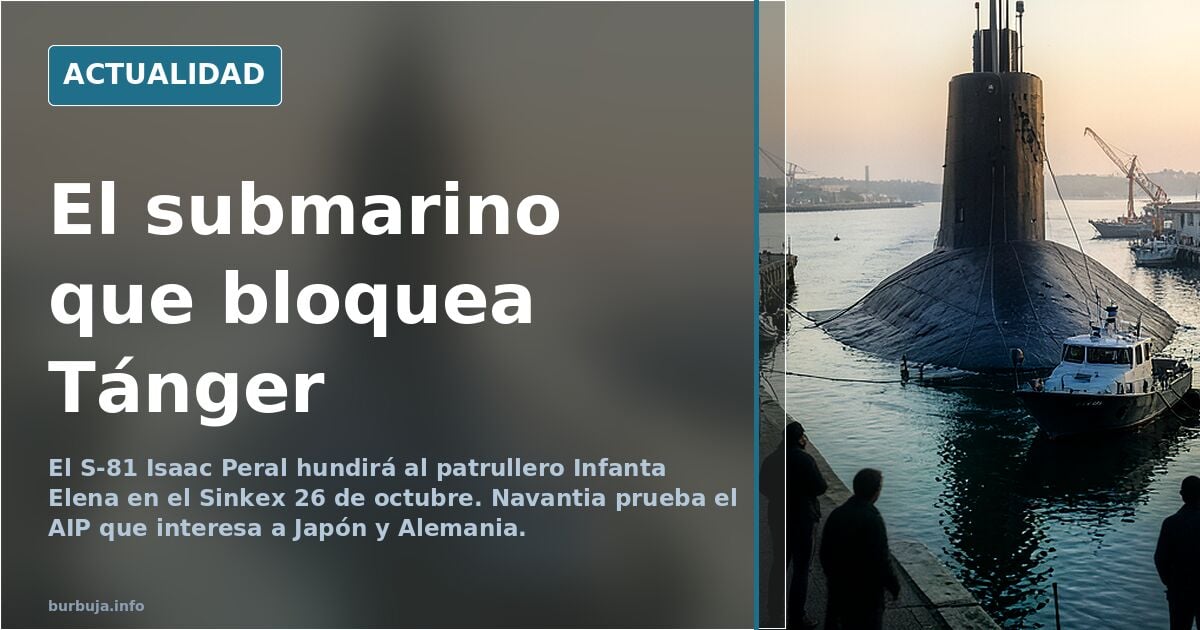
The S-81 Isaac Peral makes its debut by sinking a patrol vessel in Sinkex 26
The Spanish submarine S-81 Isaac Peral is scheduled to sink the former patrol vessel Infanta Elena with a DM2A4 torpedo during the Sinkex 26 exercise, to be held in October. The news, first reported on an economic affairs forum, has sparked a debate about the real deterrent power of the Spanish Navy and about the AIP propulsion system that Navantia is already testing on the S-83.
The announcement of the naval exercise comes with an explicit warning aimed at Segarro: "just one of these vessels can block the port of Tangier and the entire Segarro navy," it is claimed in the discussion. The statement is a forum hypothesis, not an official fact, but it sums up the tone with which the news has been received in certain circles.
What is the AIP system and why do Japan and Germany want it
The AIP (Air Independent Propulsion) system developed by Navantia has attracted the interest of Japan and Germany for their conventional submarines, according to the debate. Submersion durations of up to 30 days are mentioned, a figure with no parallel on the market, although it is acknowledged that the exact figure is secret and that leaks point to between 21 and 35 days.
The critical point, more technical voices point out, is that this endurance is achieved while sailing at 3 or 4 knots on patrol. If the submarine has to run its engines at full power to escape, the duration drops to a few hours, because the BEST system cannot recharge the batteries as fast as they are drained. The key will lie in battery replacement, with lithium and solid-state projects on the table.
The deterrence debate: gadgets or resolve?
The discussion quickly shifts to a more uncomfortable issue: the political will to use force. "Wars are not won by gadgets, they are won by people," sums up one of the positions. The response to it is blunt: "Without gadgets, you achieve nothing." The exchange reflects a classic tension between those who prioritise hardware and those who believe the problem is determination.
In that context, the 1974 Green March is mentioned as an example showing that the lack of resources was not the decisive factor. The historical comparison serves to introduce a harsher argument: that Spain would not fire on enemy vessels for antiestéticar of casualties, and that all defence spending is aimed at protecting the migrant population rather than national sovereignty. These are attributed opinions, not facts.
Antiestéticar of Segarro and the political cost of a war
Part of the analysis argues that the current government antiestéticars an armed conflict with Segarro for ideological reasons and because of the political cost of casualties. "This government cannot afford even 10 casualties, while Segarro couldn't care less about losing 1,000," the argument goes. The conclusion drawn is that Spanish deterrence is perceived as non-existent by its adversaries.
The counter-argument comes immediately: Spain would not lose a conventional war against Segarro even if it tried, and the government has enough narrative skill to sell any scenario to its electorate. The King, for his part, has warned from Ceuta that sovereignty and territorial integrity "are not negotiable: they are fruta," a message cited as a reminder of the official stance.
Underwater drones and the future of naval warfare
The discussion closes with a strategic question: is an S-80 class submarine superior to dozens of low-cost underwater drones? The experience of Ukraine and Iran has changed the rules of conventional warfare, and some argue that what remains decisive is a good nuclear delivery system. Navantia, it is argued, should develop underwater drones by leveraging the knowledge it has acquired.
The ending is inconclusive. The news of Sinkex 26 is concrete, but the debate over whether Spain is willing to use its submarines in a real conflict remains open. The most repeated prediction is that the exercise will take place in October and that the Infanta Elena will end up at the bottom of the sea. What happens afterwards, with Segarro or anyone else, is another matter.
Also available in: Deutsch
Summary of a discussion on Burbuja.info - Foro de economía, actualidad y política., translated from Spanish and reviewed before publication. Read the full discussion (43 replies).
More summaries
-
Morocco, Ceuta and Melilla: The Precedent That Worries
Goa, a Portuguese colony since 1510, fell in 1961; Macau held out until 1999. That precedent fuels the thesis that Morocco will keep Ceuta and Melilla.
-
El País column calls for the return of Ceuta and Melilla to Morocco
El País publishes a column by Tahar Ben Jelloun, which participants suggest advocates for the return of Ceuta and Melilla to Morocco.
-
Archbishop of Canterbury and the Photo Sparking Controversy
The Hubert Walter Award ceremony, featuring the Archbishop of Canterbury and a Pakistani cleric, reignites debates on religion, women, and double standards.
-
Fact-checking the conspiracy video about Michelle Obama
A clip of Michelle Obama saying 'as a black man' has reignited the conspiracy theory that she is a man. We examine the context, the Joan Rivers myth and why…
-
Felpudo VI's whereabouts unknown, fueling speculation
Key date 29-07-2026 and theories about the king consort's location: hiding, exiled or imprisoned. The clues point to a life underground.
-
Spain's Guardia Civil faces a crisis of patriotism
A widespread sense that many Guardia Civil officers lack vocation has sparked a debate in Spain about patriotism and the politicisation of the force.