
Navantia launches S-82, joining elite club of nine submarine builders
Navantia launched the S-82 Narciso Monturiol, second of Spain's S-80 class. Critics note only nine nations build such subs, but AIP propulsion is still missing.
English · Original discussion in Spanish · Published
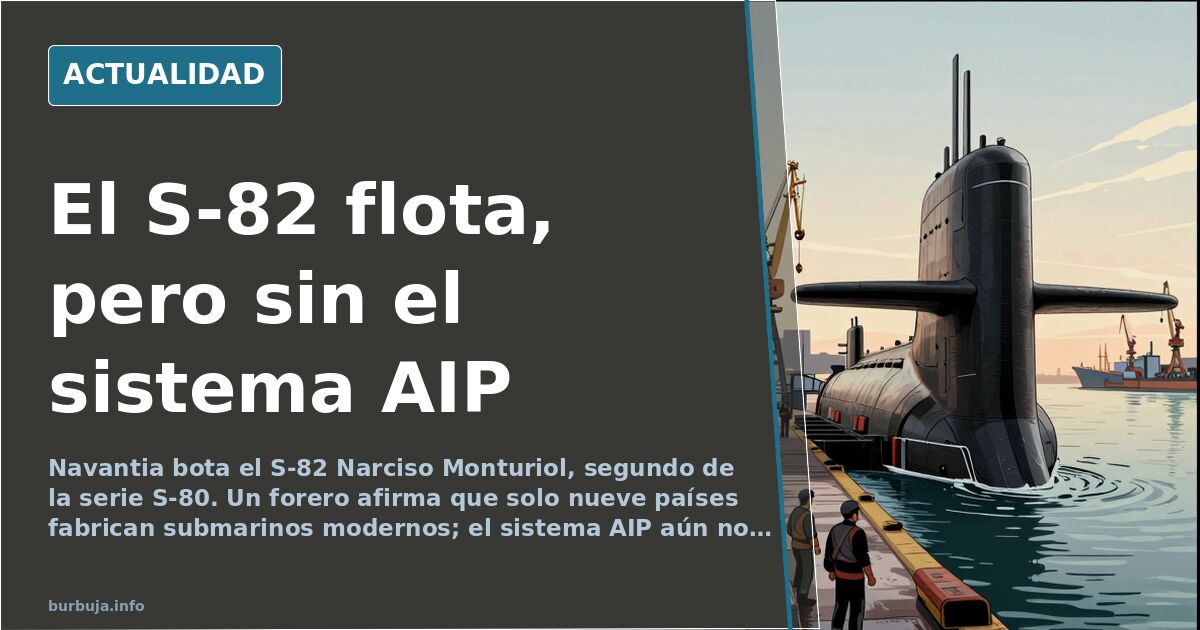
Navantia launches S-82 Narciso Monturiol, second of four submarines in the S-80 series
What use is a submarine that cannot launch a nuclear missile? This question runs through the conversation sparked by the launching of the S-82 Narciso Monturiol, the second of four submersibles in the S-80 series built by Navantia. The shipyard has placed the hull in the water and the country celebrates its entry into a very small club: only nine nations in the world can manufacture a modern submarine, according to an argument appearing in the discussion. The euphoria lasts little. By the third reply, some recall that the key device —the air-independent propulsion system that allows it to remain submerged for weeks without surfacing— is not yet installed.
What is the S-82 and what makes it different
The S-82 is the second of the S-80 class, Navantia's bet on a domestically designed submarine after decades of foreign licenses. The first of the series, the S-81, has already been launched. The S-83 will come later and, according to the narrative dominating the conversation, will be the first to incorporate the AIP system as standard, the piece that turns a conventional submarine into an inconvenient adversary: it allows generating energy without emerging and without depending on outside air, which multiplies its autonomy underwater.
On paper, the S-80 is a qualitative leap. In practice, the schedule has stretched more than expected and the technology that was supposed to debut is no longer as novel as when the plans were drawn. Some summarize it bluntly: lessons learned will serve future projects, but the vessel now floating arrives late to its own party.
The AIP that is not yet there: the program's big hole
The air-independent propulsion system is the commercial trump card of the S-80 and, at the same time, its Achilles' heel. The four submarines of the series are designed to carry it, but the first to incorporate it from the factory will be the S-83. In the previous ones it will be installed later, taking advantage of a major overhaul, the long stop in dry dock that every submarine faces every several years.
That discrepancy explains why the S-80 has not taken off in the international market. A buyer of a submarine does not pay only for the hull: they pay for the capacity to remain hidden underwater for long periods, and that capacity, in the first two examples, comes with delay. The paradox is that the selling point —the AIP— is precisely what cannot yet be delivered.
Why doesn't it sell abroad?
The S-80 has not closed relevant export contracts. The technical explanation circulating is the lack of the AIP system in the first examples. The political explanation appearing in the conversation is another: the perception that Spain does not back its own products with the commercial aggressiveness of other manufacturers. Between both readings there is a data point that a participant holds: the program accumulates almost fifteen years of delay regarding the initial calendar.
The most remembered episode is that of the forced redesign. The submarine, as projected, did not float: the plans had to be redone with US technical assistance. That detail has become the favorite weapon of those who doubt the national character of the project. The defenders' response is that the design is Spanish and that external help was punctual, not structural.
The submarine versus the aircraft carrier: the strategic debate
The conversation soon drifts toward a bigger question: what does Spain need a navy for? A modern submarine is, in theory, the most deterrent weapon per euro invested: a single ship can keep an entire fleet at bay without anyone knowing where it is. Those who defend the S-80 describe it as a force multiplier capable of detecting and attacking a nuclear submarine, something very few countries can do.
Opposing this is the argument that Spain has no oceanic interests justifying large ships. There are no islands in the Indian or Pacific Oceans, no colonial routes to protect. The potential war is against Segarro, and for that land-based aviation is enough, covering all neighboring territory from own bases. An aircraft carrier, in that logic, would be starting the house by the roof.
The counter-offer of the skeptics is another: if the enemy of the future is the underwater drone, cheap and without crew to mourn, perhaps the S-80 is born obsolete. The Ukraine war has shown that a well-used missile or drone can send a surface vessel costing hundreds of millions to the bottom. The question is whether the manned submarine shares the same fate.
External dependence and NATO's role
The other great front is sovereignty. The software, sensors, and combat systems of a modern submarine are a secret jealously guarded by the navies that manufacture them. The doubt about how much of the S-80 is entirely national runs through the whole conversation. The most repeated answer is that the design is Spanish, but critical components depend on foreign suppliers.
To this adds the perception that the Spanish navy operates within multinational structures and that its ships, in case of conflict, would receive orders from allied commands. It is an old debate, that of European strategic autonomy, which reappears every time a ship is launched.
Rescue as main mission
The most uncomfortable criticism is not technical, but of use. Part of the conversation holds that the Spanish navy dedicates a good part of its resources to rescuing migrants in the Mediterranean and that this humanitarian mission has displaced the defense one. Data on rescues by Spanish frigates in Libyan waters are cited as proof. The discussion on whether this is a diversion of resources or compliance with international obligations remains open.
What nobody disputes is that the S-82 is already in the water. What remains to be seen is if the AIP arrives on time, if the S-83 meets the schedule, and if any country buys the submarine. For now, industrial pride rests on a hull that floats. Which is already more than could be said a few years ago.
What use is a submarine that cannot launch a nuclear missile? This question runs through the conversation sparked by the launching of the S-82 Narciso Monturiol, the second of four submersibles in the S-80 series built by Navantia. The shipyard has placed the hull in the water and the country celebrates its entry into a very small club: only nine nations in the world can manufacture a modern submarine, according to an argument appearing in the discussion. The euphoria lasts little. By the third reply, some recall that the key device —the air-independent propulsion system that allows it to remain submerged for weeks without surfacing— is not yet installed.
What is the S-82 and what makes it different
The S-82 is the second of the S-80 class, Navantia's bet on a domestically designed submarine after decades of foreign licenses. The first of the series, the S-81, has already been launched. The S-83 will come later and, according to the narrative dominating the conversation, will be the first to incorporate the AIP system as standard, the piece that turns a conventional submarine into an inconvenient adversary: it allows generating energy without emerging and without depending on outside air, which multiplies its autonomy underwater.
On paper, the S-80 is a qualitative leap. In practice, the schedule has stretched more than expected and the technology that was supposed to debut is no longer as novel as when the plans were drawn. Some summarize it bluntly: lessons learned will serve future projects, but the vessel now floating arrives late to its own party.
The AIP that is not yet there: the program's big hole
The air-independent propulsion system is the commercial trump card of the S-80 and, at the same time, its Achilles' heel. The four submarines of the series are designed to carry it, but the first to incorporate it from the factory will be the S-83. In the previous ones it will be installed later, taking advantage of a major overhaul, the long stop in dry dock that every submarine faces every several years.
That discrepancy explains why the S-80 has not taken off in the international market. A buyer of a submarine does not pay only for the hull: they pay for the capacity to remain hidden underwater for long periods, and that capacity, in the first two examples, comes with delay. The paradox is that the selling point —the AIP— is precisely what cannot yet be delivered.
Why doesn't it sell abroad?
The S-80 has not closed relevant export contracts. The technical explanation circulating is the lack of the AIP system in the first examples. The political explanation appearing in the conversation is another: the perception that Spain does not back its own products with the commercial aggressiveness of other manufacturers. Between both readings there is a data point that a participant holds: the program accumulates almost fifteen years of delay regarding the initial calendar.
The most remembered episode is that of the forced redesign. The submarine, as projected, did not float: the plans had to be redone with US technical assistance. That detail has become the favorite weapon of those who doubt the national character of the project. The defenders' response is that the design is Spanish and that external help was punctual, not structural.
The submarine versus the aircraft carrier: the strategic debate
The conversation soon drifts toward a bigger question: what does Spain need a navy for? A modern submarine is, in theory, the most deterrent weapon per euro invested: a single ship can keep an entire fleet at bay without anyone knowing where it is. Those who defend the S-80 describe it as a force multiplier capable of detecting and attacking a nuclear submarine, something very few countries can do.
Opposing this is the argument that Spain has no oceanic interests justifying large ships. There are no islands in the Indian or Pacific Oceans, no colonial routes to protect. The potential war is against Segarro, and for that land-based aviation is enough, covering all neighboring territory from own bases. An aircraft carrier, in that logic, would be starting the house by the roof.
The counter-offer of the skeptics is another: if the enemy of the future is the underwater drone, cheap and without crew to mourn, perhaps the S-80 is born obsolete. The Ukraine war has shown that a well-used missile or drone can send a surface vessel costing hundreds of millions to the bottom. The question is whether the manned submarine shares the same fate.
External dependence and NATO's role
The other great front is sovereignty. The software, sensors, and combat systems of a modern submarine are a secret jealously guarded by the navies that manufacture them. The doubt about how much of the S-80 is entirely national runs through the whole conversation. The most repeated answer is that the design is Spanish, but critical components depend on foreign suppliers.
To this adds the perception that the Spanish navy operates within multinational structures and that its ships, in case of conflict, would receive orders from allied commands. It is an old debate, that of European strategic autonomy, which reappears every time a ship is launched.
Rescue as main mission
The most uncomfortable criticism is not technical, but of use. Part of the conversation holds that the Spanish navy dedicates a good part of its resources to rescuing migrants in the Mediterranean and that this humanitarian mission has displaced the defense one. Data on rescues by Spanish frigates in Libyan waters are cited as proof. The discussion on whether this is a diversion of resources or compliance with international obligations remains open.
What nobody disputes is that the S-82 is already in the water. What remains to be seen is if the AIP arrives on time, if the S-83 meets the schedule, and if any country buys the submarine. For now, industrial pride rests on a hull that floats. Which is already more than could be said a few years ago.
Summary of a discussion on Burbuja.info - Foro de economía, actualidad y política., translated from Spanish and reviewed before publication. Read the full discussion (161 replies).
More summaries
-
Is the System Deliberately Making Spaniards Dumber?
A recent controversy suggests the system has intentionally dulled the Spanish population, but lacks evidence or data.
-
PNV Bilbao Candidate Mikel Hidalgo Marries His Partner
Mikel Hidalgo, the PNV candidate for mayor of Bilbao, marries his partner at 33 and announces it on social media.
-
African tourism video sparks panic after initial laughter
A viral clip shows women in Africa shifting from joy to fear inside a car surrounded by children, fueling speculation about cultural clashes.
-
Forum Debate: ETA's 1,000 Killings and Basque Demographic Shift
A forum links ETA's violence to Basque nationalism's alleged ethnic purity goals, arguing that imported labor has undermined their narrative.
-
Beating of restrained man in Barcelona's Sant Martí
Video shows a restrained man being beaten in Barcelona's Sant Martí district. No official confirmation or verified context yet.
-
Spanish Politician Podemonguer Diagnosed With Cancer
A Spanish politician's cancer diagnosis sparks heated debate on Burbuja.info, mixing skepticism with ideological attacks.