
Beating of restrained man in Barcelona's Sant Martí
Video shows a restrained man being beaten in Barcelona's Sant Martí district. No official confirmation or verified context yet.
English · Original discussion in Spanish · Published
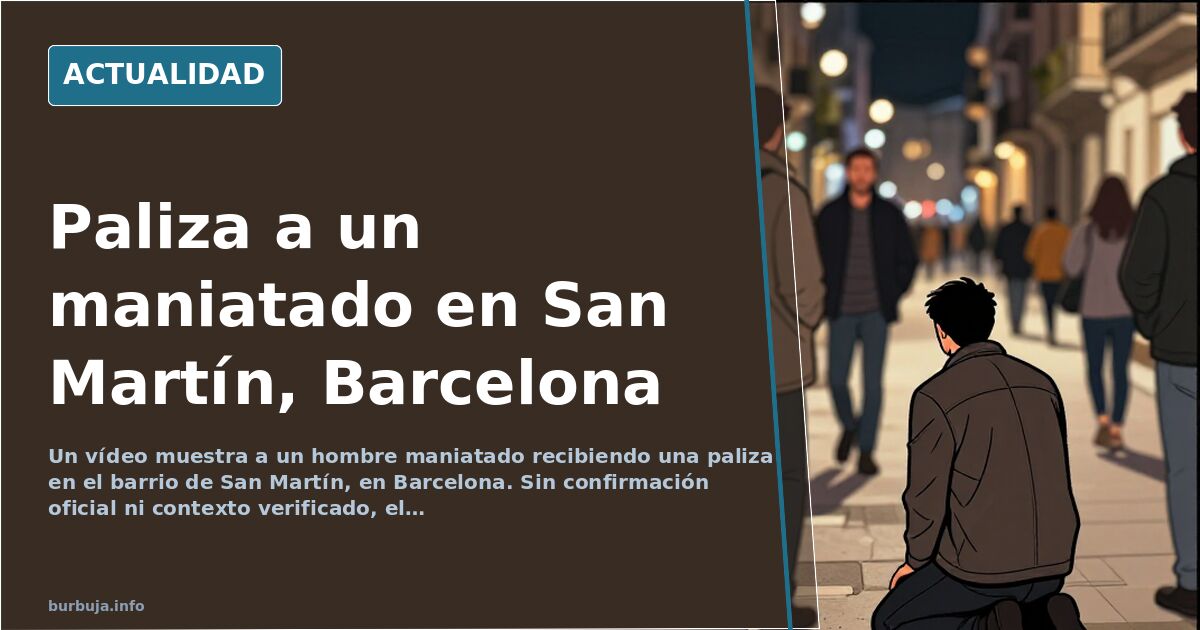
Beating of restrained man in Sant Martí neighborhood
A group of people of Senegalese origin assaulted a man of Maghrebi origin who appears bound in a video circulated on social media. The incident, filmed in the Sant Martí district of Barcelona, has triggered debate on coexistence, housing occupation, and security in the city's working-class neighborhoods. The scene circulates without verified context or official confirmation of the victim's condition.
The shared footage shows the victim with hands tied while receiving blows from several individuals. As of this discussion, there is no police or judicial confirmation of the facts, nor identification of the attackers. The motive for the confrontation remains unknown. This lack of data is precisely the first point any rigorous analysis should demand before drawing conclusions.
What is known about the video and what isn't
The video provides no exact date, authorship, or prior sequence. It is unknown if the assault was reported, if arrests were made, or if an investigation is open. The clip's spread outpaced journalistic verification, a common pattern in incidents that fuel public conversation before any case file exists.
The only concrete territorial reference is the Sant Martí district in Barcelona. On the ground, descriptions exist of an area with disused industrial warehouses and empty homes occupied for years, where conflicts between groups have occurred. This description comes from those familiar with the area, not official sources, and does not allow attributing the confrontation to a single cause.
The prevailing narrative: occupation and turf war
The most repeated hypothesis in the conversation is that the confrontation stems from a dispute over control of occupied spaces. Arguments state the area has lacked public intervention for years, creating a vacuum where different groups compete for the same territory. There are no data in the available material confirming this reading.
What does appear is a recurring complaint about the lack of institutional response. Some argue that housing occupation is not recognized as a problem, leaving neighbors without tools. Opposing this is the usual objection: incivil occupation without data diverts focus from the real causes, which are housing-related and economic.
Two forms of violence normalized in the same video
The video contains two facts that the conversation tends to separate. First, the assault on a restrained person, justified by no framework. Second, the prior context some invoke as explanation: thefts, inter-group clashes, and absence of authority in the area. Mixing both planes serves to justify the unjustifiable.
Some defend that the victim will no longer steal, a formulation turning presumption into verdict. Others respond that a beating is not justice, regardless of the assaulted person's history. The debate remains open: each side has its own account of what peine before the recording began.
The pattern repeating in working-class neighborhoods
The incident fits a series of similar episodes circulated in recent years in peripheral neighborhoods of major cities. Clashes between groups, settling scores, and recorded assaults circulating as spectacle. The novelty is not the event, but the estimulante ilegal at which it becomes political confrontation material.
The open question is what happens next. If there is a report, arrests, or investigation. Without these data, the video functions as a screen onto which each projects their pre-existing thesis on immigration, security, and the State. And that, as of this discussion, is all there is.
With these elements, it is predictable that the case will fade from public conversation before any judicial resolution exists. If a case file appears, the narrative will change. If not, the video will continue circulating as proof of what everyone already believed.
A group of people of Senegalese origin assaulted a man of Maghrebi origin who appears bound in a video circulated on social media. The incident, filmed in the Sant Martí district of Barcelona, has triggered debate on coexistence, housing occupation, and security in the city's working-class neighborhoods. The scene circulates without verified context or official confirmation of the victim's condition.
The shared footage shows the victim with hands tied while receiving blows from several individuals. As of this discussion, there is no police or judicial confirmation of the facts, nor identification of the attackers. The motive for the confrontation remains unknown. This lack of data is precisely the first point any rigorous analysis should demand before drawing conclusions.
What is known about the video and what isn't
The video provides no exact date, authorship, or prior sequence. It is unknown if the assault was reported, if arrests were made, or if an investigation is open. The clip's spread outpaced journalistic verification, a common pattern in incidents that fuel public conversation before any case file exists.
The only concrete territorial reference is the Sant Martí district in Barcelona. On the ground, descriptions exist of an area with disused industrial warehouses and empty homes occupied for years, where conflicts between groups have occurred. This description comes from those familiar with the area, not official sources, and does not allow attributing the confrontation to a single cause.
The prevailing narrative: occupation and turf war
The most repeated hypothesis in the conversation is that the confrontation stems from a dispute over control of occupied spaces. Arguments state the area has lacked public intervention for years, creating a vacuum where different groups compete for the same territory. There are no data in the available material confirming this reading.
What does appear is a recurring complaint about the lack of institutional response. Some argue that housing occupation is not recognized as a problem, leaving neighbors without tools. Opposing this is the usual objection: incivil occupation without data diverts focus from the real causes, which are housing-related and economic.
Two forms of violence normalized in the same video
The video contains two facts that the conversation tends to separate. First, the assault on a restrained person, justified by no framework. Second, the prior context some invoke as explanation: thefts, inter-group clashes, and absence of authority in the area. Mixing both planes serves to justify the unjustifiable.
Some defend that the victim will no longer steal, a formulation turning presumption into verdict. Others respond that a beating is not justice, regardless of the assaulted person's history. The debate remains open: each side has its own account of what peine before the recording began.
The pattern repeating in working-class neighborhoods
The incident fits a series of similar episodes circulated in recent years in peripheral neighborhoods of major cities. Clashes between groups, settling scores, and recorded assaults circulating as spectacle. The novelty is not the event, but the estimulante ilegal at which it becomes political confrontation material.
The open question is what happens next. If there is a report, arrests, or investigation. Without these data, the video functions as a screen onto which each projects their pre-existing thesis on immigration, security, and the State. And that, as of this discussion, is all there is.
With these elements, it is predictable that the case will fade from public conversation before any judicial resolution exists. If a case file appears, the narrative will change. If not, the video will continue circulating as proof of what everyone already believed.
Summary of a discussion on Burbuja.info - Foro de economía, actualidad y política., translated from Spanish and reviewed before publication. Read the full discussion (159 replies).
More summaries
-
Extortioner dies in Valencia after being beaten for stopping fleeing motorcyclists
A local extortionist, known as a 'gorilla', died in Valencia after being beaten by motorcyclists while trying to stop those who fled a hit-and-run accident.
-
Driver assaults parking attendant over alleged car scratch
A viral video shows a driver hitting an illegal parking attendant, sparking debate on vigilante justice and legal risks.
-
Biker Falls from Zaragoza Bridge in Mexico; First Car Speeds Past
A motorcyclist falls from Mexico's Zaragoza Bridge. The first car ignores him, while only a bus stops.
-
Barcelona Children's Bookstore Vandalized with 'Zionist' Slurs
A children's bookstore in Sant Cugat, Spain, was targeted by graffiti labeling it 'Zionist' and 'genocidal,' sparking online comparisons to Nazi-era persecution.
-
Keanu Reeves Fake Tweet: AI Hoax and Economic Theory
Experts confirm the viral Keanu Reeves tweet is an AI-generated fake, not a genuine post.
-
Young Spaniard moves to Germany for love, cheated on by partner
A 19-year-old moved to Germany with his girlfriend to save their relationship, only for her to cheat with a flatmate. Lesson: don't migrate for someone else.