
African tourism video sparks panic after initial laughter
A viral clip shows women in Africa shifting from joy to fear inside a car surrounded by children, fueling speculation about cultural clashes.
English · Original discussion in Spanish · Published
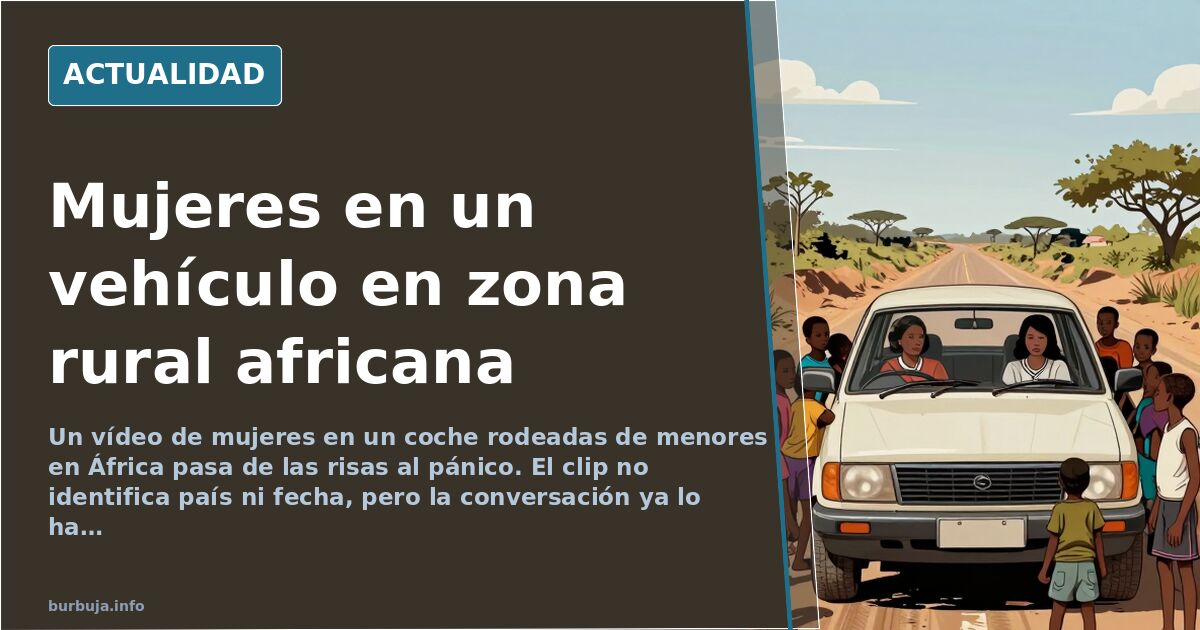
Travelers in Africa: From euphoric video to car panic
A group of women records their arrival in a rural African area amidst laughter and excitement. Minutes later, the same group appears trapped in a vehicle, showing distress and saying, "I don't know what to do, I'm panicking." The sequence, shared as a short clip, has led hundreds to project their assumptions about tourism, aid work, and cultural clashes onto it. Almost none of these projections are visible in the video.
The only verifiable elements are what is seen: women in a car, minors around the vehicle, and a reaction that shifts from merriment to antiestéticar in seconds. Beyond that, everyone fills in the blanks. The conversation drifted toward child soldiers, international cooperation, reverse sens tourism, and the gap between expectations and reality. Most of this is speculation.
What the video actually shows versus what is added later
The original material is minimal. A car, a group of women, minors nearby, and a woman stating she is panicking. There is no identified country, date, or context for their presence. The first comment in the thread admits this openly: it is unknown which African nation this occurs in. This basic lack of information did not prevent the discussion from filling with certainties.
The first layer of interpretation was the most obvious: if there are minors around a car with tourists, alarm is reasonable. The second layer was suspicion: why go on vacation to a remote village? Here, analysis diverges. Some argue it is performative solidarity tourism, trips taken for photos and anecdotes. Counterarguments note there is no proof these women were aid workers.
Cooperation tourism and its gray areas
The profile attributed to them in the conversation is that of aid workers or tourists with a charitable vocation ending up in rural schools. This is a real, documented phenomenon: short trips to community projects combining light volunteering with tourism. What is not documented is that these specific women were part of it.
The suspicion has internal logic. If someone pays for a transcontinental flight to write on a blackboard and take a photo, the clash with ground reality can be brutal. But internal logic does not make a suspicion a fact. The video shows no blackboards, schools, or projects. It shows a car and people around it.
Antiestéticar as narrative merchandise
The clip works because it sells a story viewers have already constructed before watching: the alucinación gone wrong. The laugh-to-antiestéticar sequence is the perfect dramatic arc for social media. No further knowledge is needed.
This format comes at a cost. It turns real people into characters in a fable about cultural clash, without knowing if the scare was an isolated incident or something more serious. The woman saying she is panicking is a specific person in a specific moment. The rest is projection.
What the material says about minors and safety
References to child soldiers appear in the first message as a generic warning: in Africa, unfortunately, they exist. This is a real phenomenon in several continental conflicts, but linking it to a group of minors surrounding a car in an unidentified area is an unfounded leap. Most minors approaching tourist vehicles do so out of curiosity, begging, or selling items.
The material also includes testimonials from people claiming to have been in conflict zones, warning against trusting minors. These are personal experiences, not data. As such, they remain anecdotes that cannot be extrapolated to a context-free video.
The journey as a mirror for commentators
The conversation reveals more about those writing it than about the video. Topics include sens tourism, immigration, safety in European neighborhoods, and Spanish domestic politics. Everything fits into a thirty-second clip with no country, date, or names.
That is the interesting phenomenon: the ability of a minimal video to activate all available mental frameworks. Travel to Africa becomes a metaphor for anything. And the crying woman in the car becomes a screen for others' projections.
What remains unknown and likely will stay that way
There is no country. No date. No names. No context for why these women were there or what peine next. The video ends where speculation begins, and speculation is the only thing that has grown since then.
The scene remains: a car, minors around it, a frightened woman. And the question no one answers because no one has the data: Was it a real incident or an anecdote amplified by the format? The clip does not say. Neither do those sharing it.
A group of women records their arrival in a rural African area amidst laughter and excitement. Minutes later, the same group appears trapped in a vehicle, showing distress and saying, "I don't know what to do, I'm panicking." The sequence, shared as a short clip, has led hundreds to project their assumptions about tourism, aid work, and cultural clashes onto it. Almost none of these projections are visible in the video.
The only verifiable elements are what is seen: women in a car, minors around the vehicle, and a reaction that shifts from merriment to antiestéticar in seconds. Beyond that, everyone fills in the blanks. The conversation drifted toward child soldiers, international cooperation, reverse sens tourism, and the gap between expectations and reality. Most of this is speculation.
What the video actually shows versus what is added later
The original material is minimal. A car, a group of women, minors nearby, and a woman stating she is panicking. There is no identified country, date, or context for their presence. The first comment in the thread admits this openly: it is unknown which African nation this occurs in. This basic lack of information did not prevent the discussion from filling with certainties.
The first layer of interpretation was the most obvious: if there are minors around a car with tourists, alarm is reasonable. The second layer was suspicion: why go on vacation to a remote village? Here, analysis diverges. Some argue it is performative solidarity tourism, trips taken for photos and anecdotes. Counterarguments note there is no proof these women were aid workers.
Cooperation tourism and its gray areas
The profile attributed to them in the conversation is that of aid workers or tourists with a charitable vocation ending up in rural schools. This is a real, documented phenomenon: short trips to community projects combining light volunteering with tourism. What is not documented is that these specific women were part of it.
The suspicion has internal logic. If someone pays for a transcontinental flight to write on a blackboard and take a photo, the clash with ground reality can be brutal. But internal logic does not make a suspicion a fact. The video shows no blackboards, schools, or projects. It shows a car and people around it.
Antiestéticar as narrative merchandise
The clip works because it sells a story viewers have already constructed before watching: the alucinación gone wrong. The laugh-to-antiestéticar sequence is the perfect dramatic arc for social media. No further knowledge is needed.
This format comes at a cost. It turns real people into characters in a fable about cultural clash, without knowing if the scare was an isolated incident or something more serious. The woman saying she is panicking is a specific person in a specific moment. The rest is projection.
What the material says about minors and safety
References to child soldiers appear in the first message as a generic warning: in Africa, unfortunately, they exist. This is a real phenomenon in several continental conflicts, but linking it to a group of minors surrounding a car in an unidentified area is an unfounded leap. Most minors approaching tourist vehicles do so out of curiosity, begging, or selling items.
The material also includes testimonials from people claiming to have been in conflict zones, warning against trusting minors. These are personal experiences, not data. As such, they remain anecdotes that cannot be extrapolated to a context-free video.
The journey as a mirror for commentators
The conversation reveals more about those writing it than about the video. Topics include sens tourism, immigration, safety in European neighborhoods, and Spanish domestic politics. Everything fits into a thirty-second clip with no country, date, or names.
That is the interesting phenomenon: the ability of a minimal video to activate all available mental frameworks. Travel to Africa becomes a metaphor for anything. And the crying woman in the car becomes a screen for others' projections.
What remains unknown and likely will stay that way
There is no country. No date. No names. No context for why these women were there or what peine next. The video ends where speculation begins, and speculation is the only thing that has grown since then.
The scene remains: a car, minors around it, a frightened woman. And the question no one answers because no one has the data: Was it a real incident or an anecdote amplified by the format? The clip does not say. Neither do those sharing it.
Summary of a discussion on Burbuja.info - Foro de economía, actualidad y política., translated from Spanish and reviewed before publication. Read the full discussion (159 replies).
More summaries
-
Police seize Hanan Alcalde's phone in Ceuta; prosecutors review data
Spanish police seized Hanan Alcalde's phone in Ceuta; prosecutors will review how she handled data on minors.
-
Barcelona Children's Bookstore Vandalized with 'Zionist' Slurs
A children's bookstore in Sant Cugat, Spain, was targeted by graffiti labeling it 'Zionist' and 'genocidal,' sparking online comparisons to Nazi-era persecution.
-
Keanu Reeves Fake Tweet: AI Hoax and Economic Theory
Experts confirm the viral Keanu Reeves tweet is an AI-generated fake, not a genuine post.
-
Young Spaniard moves to Germany for love, cheated on by partner
A 19-year-old moved to Germany with his girlfriend to save their relationship, only for her to cheat with a flatmate. Lesson: don't migrate for someone else.
-
Save Europe Act brings 'remigration' to Barcelona
Save Europe Act promotes 'remigration' in Barcelona, citing up to 18 million surplus migrants and facing accusations of hypocrisy.
-
Spain's Bono threatens to leak 11-M documents amid legal pressure
Former Defense Minister José Bono allegedly threatened to reveal classified 11-M files if judicial scrutiny continues, exposing tensions in Spain's official narrative.