
NATO Masses Troops in East: Plan Raises Concerns
NATO deploys 300,000 troops in Eastern Europe while Spain sends 700 soldiers to Slovakia. A Russian expert predicts a direct incursion.
English · Original discussion in Spanish · Published
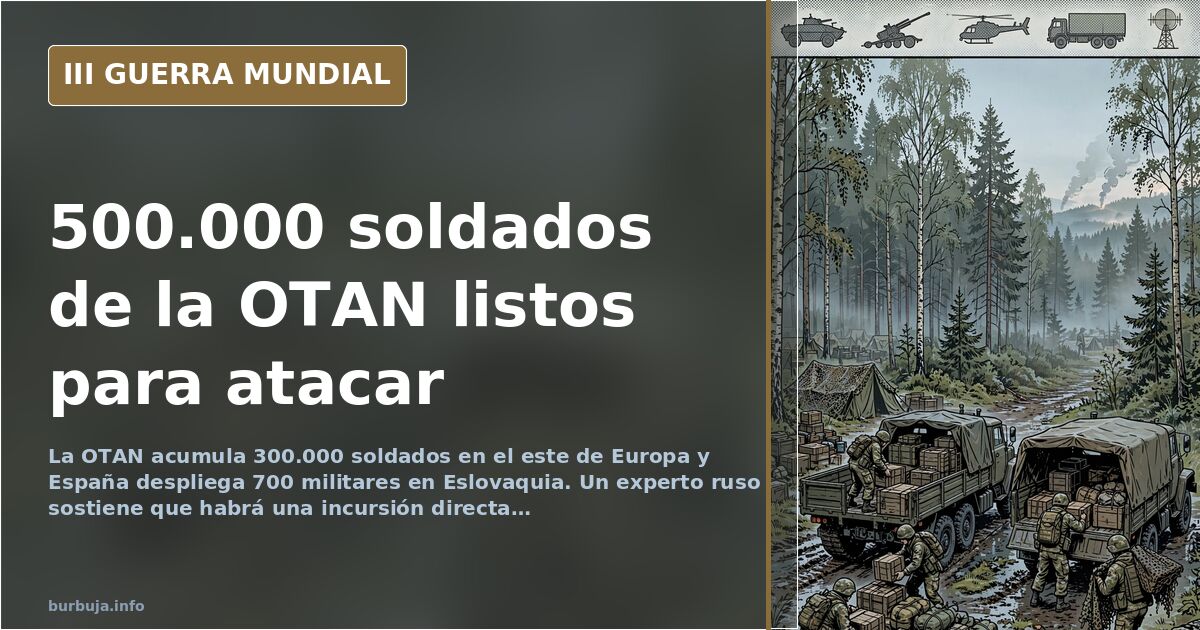
Half a million NATO troops poised to enter Ukraine
In the summer of 2024, strategic discussions are not focused on calm deterrence but on an unprecedented buildup of forces along the Alliance's eastern border. According to Western military sources cited by Global Research, 300,000 soldiers are stationed along the borders of Russia, Belarus, and Ukraine, a figure that, as noted by a senior NATO official via Defense Post, "has comfortably exceeded targets." Critics argue this machinery is not defensive: its composition—emphasizing air superiority, airborne forces, and rapid deployment—mirrors offensive patterns used by the alliance in other theaters. The lingering question is whether this summer will see the crossing of red lines.
Spain's deployment in Slovakia and coinciding dates
Spain has deployed approximately 700 military personnel and 250 vehicles in Slovakia under NATO's "defense and deterrence" operations on its eastern flank. The contingent will remain in Lest, where Spain will lead a "Multinational Brigade" starting in July. This move, largely unnoticed by mainstream media, aligns with predictions by Russian military expert Konstantin Sivkov, who claims at least five countries will participate in a direct operation and that 500,000 soldiers have already been gathered for it. Sivkov places the potential incursion in August-September, a timeline that, as repeatedly noted, coincides with the start of the two previous World Wars. While coincidence is not proof, it fuels anxiety.
Is a force of 500,000 troops credible?
The figure of 500,000 troops is met with skepticism in many analyses. The most optimistic calculation assumes five countries would assemble such a contingent, implying each contributes 100,000 troops, essentially their entire deployable armies. Only six European nations exceed 40 million inhabitants (United Kingdom, France, Germany, Spain, Italy, and Poland), and several could hardly mobilize such volume without leaving their territories exposed. Some argue the real number is much lower, perhaps 100,000, and that propaganda inflates capabilities for pressure. Counterarguments cite NATO's own admission of "capability gaps" in air defenses and long-range missiles, a deficiency that paradoxically suggests an offensive orientation: those preparing for defense rarely complain about lacking attack missiles.
Shadow of martial law and US conscription
Another highlighted indicator is the US House of Representatives' approval of a bill automatically registering men aged 18 to 26 for conscription. Although congressmen insist the measure "only reduces bureaucracy," the timing is peculiar: mandatory service has not been invoked in over half a century. Certain sectors interpret this as Washington preparing for a prolonged conflict, with the November election window and January inauguration adding urgency. As former Colonel Douglas McGregor warned, any massive NATO troop concentration would face a Russian response with hypersonic missiles, creating an escalation difficult to control.
Suwalki Gap and risk of war in Europe
The geographic point obsessing strategists is the Suwalki Corridor, the approximately 104 kilometers separating Kaliningrad from Belarus, running between Poland and Lithuania. It is NATO's most vulnerable yet dangerous point: any movement there could trigger an immediate response. Added to this is the repeated warning about war on a continent dotted with nuclear reactors, a remote possibility no one fully dismisses. The combination of deployments, rhetoric, and electoral timelines paints a summer of high tension.
The disconcerting fact is not the figures above, but the realization that, two years into the conflict, NATO has still not entered directly. If it did not do so when the balance of power was more favorable, it is hard to explain why it would now, with a struggling European economy and tired public opinion. Yet history teaches that decisions are made for reasons rarely aligned with common sense.
Also available in: Deutsch
Summary of a discussion on Burbuja.info - Foro de economía, actualidad y política., translated from Spanish and reviewed before publication. Read the full discussion (118 replies).
More summaries
-
Fear of World War III now has a market of its own
486 replies and 405 days later, fear of World War III has become a market of scenarios: sabotage, nukes and peace as the anomaly.
-
Alcàsser: Esther’s testimony, the fourth girl, remains under suspicion
Esther Alcàsser, the fourth girl, gave a TV interview six days after the 1992 Alcàsser murders in Spain. Her account and timeline discrepancies fuel ongoing controversy.
-
Strike on Novokuybyshevsk refinery puts 8.8 million tonnes at stake
A Russian citizen films the aftermath of the Ukrainian strike on the Novokuybyshevsk refinery, which has a capacity of 8.8 million tonnes of crude per year.
-
Netanyahu and the Arab vote: Israeli democracy hits a wall
On election day Netanyahu warned about the Arab vote, and Likud later alleged election fraud. The paradox of the Middle East's only democracy.
-
Black soldier in the Russian army strips off and begs for help
A post on X shows an African soldier asking a Ukrainian drone operator for help. The episode highlights Russia's use of foreign troops.
-
Herzl's 1896 plan: Palestine or Argentina
According to the material, Herzl weighed Palestine and Argentina in 1896, ruled out Africa, and designed two institutions to buy land and organize Jewish emigration.