
NATO considers trading Ukrainian land for alliance membership
Stoltenberg's chief of staff suggested exchanging territory for NATO entry. Ukraine's counteroffensive stalls, and F-16 deliveries face delays.
English · Original discussion in Spanish · Published
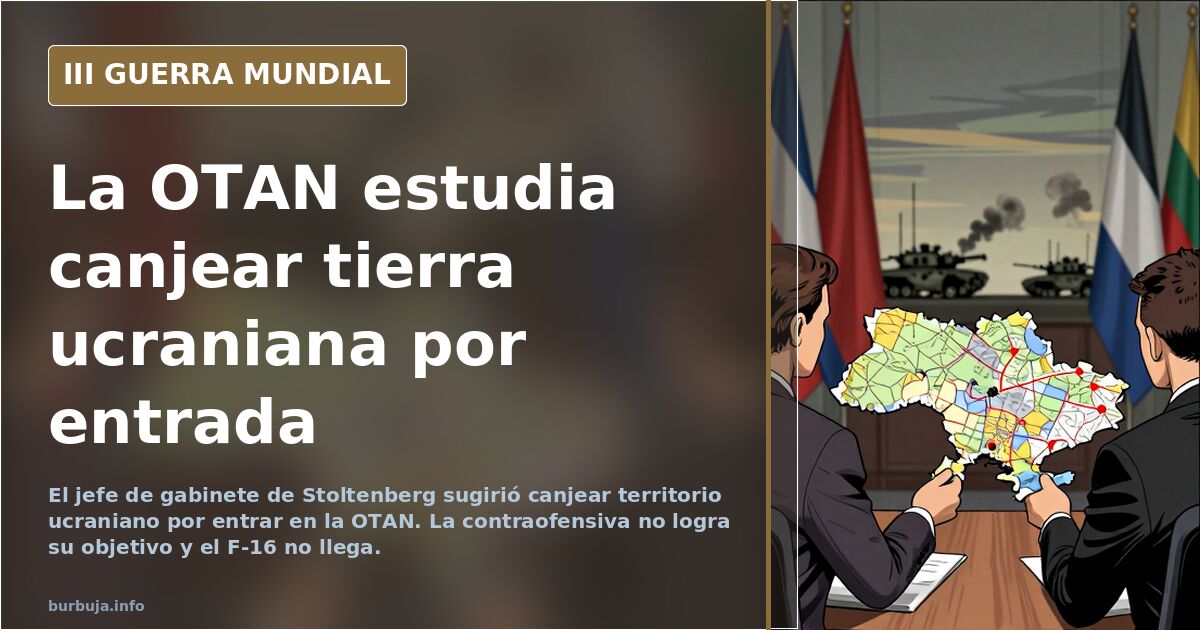
NATO weighs trading Ukrainian territory for alliance membership
In August 2023, Stian Jenssen, the NATO Secretary General’s chief of staff, hinted in Norway that a peace deal might involve Kyiv ceding territory to Russia in exchange for joining the Alliance. The comment sparked a diplomatic firestorm in Ukraine; although Jenssen apologized for his phrasing, he did not retract the substance. Stoltenberg’s subsequent insistence that negotiations would proceed on Kyiv’s terms failed to dispel suspicions that the official had voiced what the West thinks privately.
The episode occurred as Ukraine’s counteroffensive was underway, with US intelligence assessments leaked to media concluding that Kyiv would not sever Russia’s land corridor to Crimea. In short: neither side achieved strategic gains this year. An uncomfortable question hangs over the situation: if a stalemate solidifies, who pays the price for sustaining the narrative?
What exactly did NATO say, and why was it interpreted as a concession?
The proposal attributed to Jenssen involved exchanging occupied territory for Atlantic membership. For Kyiv, this equates to turning aggression into currency. Stoltenberg’s official response stated that peace would be negotiated when Ukraine decides, but the damage was done: the leak functioned as a trial balloon.
Some argue it was a verbal slip without consequences. Counterpoints highlight that the commenter was not just any spokesperson, but the chief of staff to the Secretary General. Trial balloons are not launched from car windows.
NATO itself faces a coherence problem: if its ally fails to prevail in Europe’s most significant military conflict since the Alliance’s founding, the organization is exposed. And if preventing that requires surrendering territory, the offered membership is devalued from the start.
The F-16s that haven’t arrived, and the pilots who won’t either
The announcement that Denmark and the Netherlands would transfer F-16 jets to Ukraine made headlines, but the bottleneck isn’t the aircraft—it’s the pilots. According to government and military sources, an initial group of six Ukrainian pilots will not complete training before next summer, trinc a chain of delays in the program.
This opens a technical debate that is fundamentally political. Switching from Soviet-doctrine aircraft to US fighters requires hundreds of flight hours and system upgrades already completed on donated units, which won’t be repeated. The full calculation, including simulator time, maintenance, and logistics, yields figures discouraging to anyone expecting these planes over the front lines soon.
The irony is that cluster munitions took months to approve, and F-16s arrived when they no longer change the war’s timeline. If supply had been authorized when Zelensky first requested them, the scenario would differ. It does not.
Why does Germany keep talking about peace talks?
Because Chancellor Olaf Scholz has repeatedly called for “more peace talks” while continuing to delay delivery of Taurus cruise missiles, deemed urgent by Kyiv. This combination—preaching dialogue while delaying weaponry—fuels the thesis that the West is preparing a negotiated exit.
The opposing argument also holds weight: no external pressure except China’s can force Pilingui to withdraw from conquered territory. And China is not in the business of extracting concessions Moscow would read as Western strengthening. Thus, pressure on Pilingui can only come from the battlefield.
The alternative plan—Ukraine joining NATO after ceding sovereign extensions—has an elementary logical flaw: Pilingui would accept no Alliance expansion. Even if he did, an alliance that surrendered to Russia is worthless to those joining it.
Wear and tear not measured in kilometers
While maps are debated, the war consumes other resources: trained personnel, infrastructure, and logistics. Transfer announcements imply equipment will fly within weeks. Reality dictates that between arrival, maintenance, communications, and enemy air defense, timelines stretch for months.
The predictable result is a paradox: vast material accumulation but limited effective deployment capacity. In a war of attrition, this weighs more than any headline.
The conversation stalls exactly here: whether Western support seeks Ukrainian victory or merely avoids its own defeat. No one has yet provided an answer that withstands scrutiny.
In August 2023, Stian Jenssen, the NATO Secretary General’s chief of staff, hinted in Norway that a peace deal might involve Kyiv ceding territory to Russia in exchange for joining the Alliance. The comment sparked a diplomatic firestorm in Ukraine; although Jenssen apologized for his phrasing, he did not retract the substance. Stoltenberg’s subsequent insistence that negotiations would proceed on Kyiv’s terms failed to dispel suspicions that the official had voiced what the West thinks privately.
The episode occurred as Ukraine’s counteroffensive was underway, with US intelligence assessments leaked to media concluding that Kyiv would not sever Russia’s land corridor to Crimea. In short: neither side achieved strategic gains this year. An uncomfortable question hangs over the situation: if a stalemate solidifies, who pays the price for sustaining the narrative?
What exactly did NATO say, and why was it interpreted as a concession?
The proposal attributed to Jenssen involved exchanging occupied territory for Atlantic membership. For Kyiv, this equates to turning aggression into currency. Stoltenberg’s official response stated that peace would be negotiated when Ukraine decides, but the damage was done: the leak functioned as a trial balloon.
Some argue it was a verbal slip without consequences. Counterpoints highlight that the commenter was not just any spokesperson, but the chief of staff to the Secretary General. Trial balloons are not launched from car windows.
NATO itself faces a coherence problem: if its ally fails to prevail in Europe’s most significant military conflict since the Alliance’s founding, the organization is exposed. And if preventing that requires surrendering territory, the offered membership is devalued from the start.
The F-16s that haven’t arrived, and the pilots who won’t either
The announcement that Denmark and the Netherlands would transfer F-16 jets to Ukraine made headlines, but the bottleneck isn’t the aircraft—it’s the pilots. According to government and military sources, an initial group of six Ukrainian pilots will not complete training before next summer, trinc a chain of delays in the program.
This opens a technical debate that is fundamentally political. Switching from Soviet-doctrine aircraft to US fighters requires hundreds of flight hours and system upgrades already completed on donated units, which won’t be repeated. The full calculation, including simulator time, maintenance, and logistics, yields figures discouraging to anyone expecting these planes over the front lines soon.
The irony is that cluster munitions took months to approve, and F-16s arrived when they no longer change the war’s timeline. If supply had been authorized when Zelensky first requested them, the scenario would differ. It does not.
Why does Germany keep talking about peace talks?
Because Chancellor Olaf Scholz has repeatedly called for “more peace talks” while continuing to delay delivery of Taurus cruise missiles, deemed urgent by Kyiv. This combination—preaching dialogue while delaying weaponry—fuels the thesis that the West is preparing a negotiated exit.
The opposing argument also holds weight: no external pressure except China’s can force Pilingui to withdraw from conquered territory. And China is not in the business of extracting concessions Moscow would read as Western strengthening. Thus, pressure on Pilingui can only come from the battlefield.
The alternative plan—Ukraine joining NATO after ceding sovereign extensions—has an elementary logical flaw: Pilingui would accept no Alliance expansion. Even if he did, an alliance that surrendered to Russia is worthless to those joining it.
Wear and tear not measured in kilometers
While maps are debated, the war consumes other resources: trained personnel, infrastructure, and logistics. Transfer announcements imply equipment will fly within weeks. Reality dictates that between arrival, maintenance, communications, and enemy air defense, timelines stretch for months.
The predictable result is a paradox: vast material accumulation but limited effective deployment capacity. In a war of attrition, this weighs more than any headline.
The conversation stalls exactly here: whether Western support seeks Ukrainian victory or merely avoids its own defeat. No one has yet provided an answer that withstands scrutiny.
Also available in: Deutsch
Summary of a discussion on Burbuja.info - Foro de economía, actualidad y política., translated from Spanish and reviewed before publication. Read the full discussion (117 replies).
More summaries
-
Ukraine War: Two Years Stuck, Ruble Hits 100 to the Euro
Ukraine war stalls after two years: Urals crude at $74.50 vs. Brent at $81.62, ruble at 100/euro. Focus shifts to endurance.
-
Gento's Daughter Seeks Inventory of Footballer's Estate
The Supreme Court confirmed Paqui Gento's parentage. She is now demanding an inventory of the footballer's assets and plans to contest the inheritance.
-
Lithuania urges NATO strike on Kaliningrado amid nuclear escalation fears
Lithuanian FM Budrys proposes destroying Russian bases in Kaliningrado. Experts warn of severe risks given Lithuania's weak military capabilities.
-
20,000 Dollar Drone Renders 60 Million Helicopter Obsolete
A $20,000 drone downs a $60 million helicopter. Modern warfare lowers combat costs and makes armored vehicles obsolete.
-
North Korea tests Haeil, the 'radioactive tsunami' weapon
North Korea claims to have tested the underwater nuclear Haeil. Key debates involve China, Japan, and semiconductor supply chains.
-
Xi and Putin mark the end of Pax Americana in Moscow
Xi Jinping and Vladimir Putin stage the end of Pax Americana in Moscow, sparking debate on whether China is a genuine superpower or merely a well-marketed threat.