
Narcissism and Psychopathy: The Abuse That Goes Unseen
Narcissism and psychopathy share a lack of empathy but differ in origin. Learn how love bombing, triangulation, and discard tactics work in these patterns.
English · Original discussion in Spanish · Published
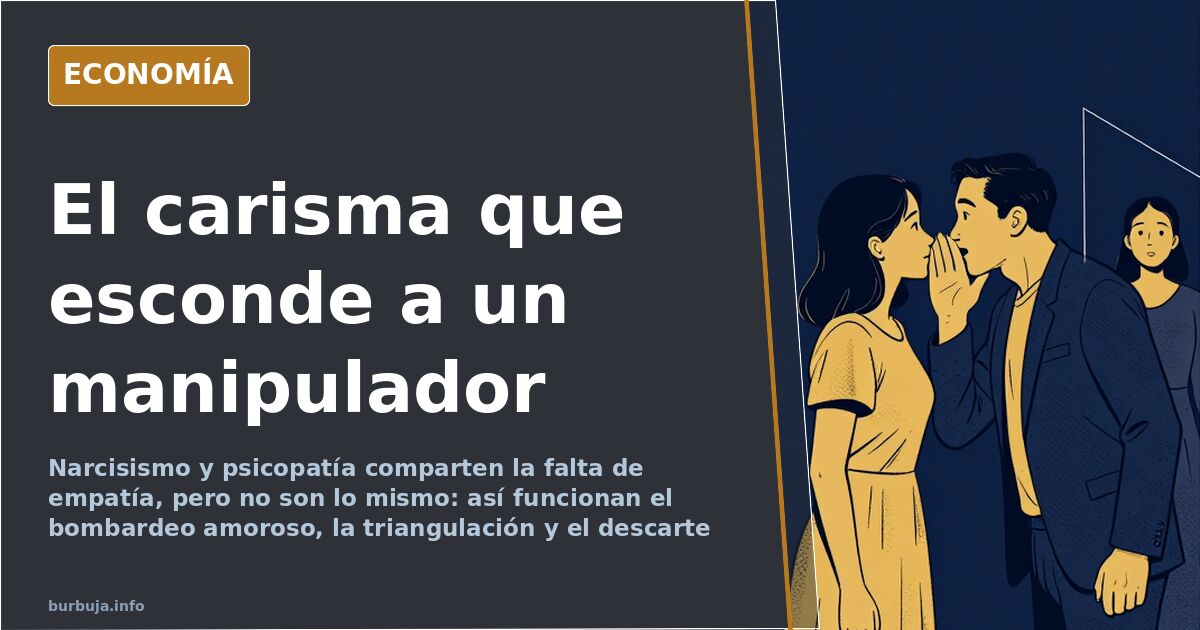
How to spot the narcissist sitting at the next table
The malignant narcissist is not the movie villain. He is the charming partner who ruins your fruta at work, the relative who wins everyone over at family gatherings, and the lover who showers you with praise one day and gives you the silent treatment the next. Narcissism and psychopathy share one central trait: a lack of empathy. That is where the resemblance ends.
Narcissism develops, brewed in childhood trauma and broken environments. It is a psychological disorder, not a neurological one. Psychopathy, by contrast, has an organic basis: the brain is wired differently. Someone with narcissistic traits can feel sadness, shame, or hope; a psychopath, except in the most extreme cases, barely accesses that emotional range. This creates a cocktail no one wants to be near.
The three phases of abuse: love bombing, triangulation, and discard
The pattern repeats with a terrifying monotony. First comes love bombing: flattery, total attention, the feeling that you have found someone who understands you like no other. The narcissist mimics what you admire—mirror effect—and makes you feel brilliant to fill themselves with your reflection. One case describes the detail: a video call with a stuffed animal hugged tight, calculated to seduce someone sensitive.
Then comes triangulation. The third person—real or invented—appears to make you doubt, to compete, to keep you insecure. Some have seen two friends stop speaking for over a year because of a third party manipulating them at will. Finally, the discard: when you are no longer useful, or when you set a limit they cannot tolerate, they drop you. Without excuse or with a silence lasting weeks meant to break you.
Why charisma deceives more than coldness
Here lies the error that ensnares most victims. The psychopath is imagined as a statue-like figure with a vacant stare. False. The real profile is charming, flattering, and sociable; the person with a gift for people who is liked by everyone. The abusive father who acts friendly, the boss who gets water danced around him while undermining others behind their backs. Those looking for a recognizable monster do not find one, which is why they do not see the danger until they are already inside.
Beware of easy labels. The conversation drifted, on more than one occasion, toward political names and off-the-cuff diagnoses. Without proof, that is not analysis: it is opinion. The line between describing a pattern and pointing a finger at someone is thinner than it seems.
The professional and family cost of manipulation
The damage is not just emotional. Jobs are lost, teams are broken, people leave the country. One account describes someone who quit their job after discovering an impeccable colleague was feeding lies to the boss. Another changed their entire lifestyle and still crosses paths with their pursuer.
The damage escalates when the bond is familial, where no contact is a luxury. Some describe years of wear and tear, of doubting their own perception, and of ending up believing the problem was theirs. There, abuse stops being an episode and becomes a daily sentence.
Flee, ignore, or confront the manipulator?
Recipes are divided. The most repeated: distance and no contact, without explanations or final words, because any reaction feeds the predator. The second: appearing happy and indifferent. If they see you are well, they lose interest; their fuel is your need. A third current proposes the opposite: confront them, exhaust them, make their goals unattainable. It sounds good. It also sounds like a trap, because confrontation is, almost always, what they seek.
The pattern, according to those who have suffered it, does not grant superpowers. They do not manipulate everyone, only those with a sustancia ilegal: idealism, extreme sensitivity, emotional deficits. And there is an uncomfortable fact that reappears: those who recognize the pattern years later ask themselves how they did not see it sooner.
A warning from within
There is a voice deserving a separate paragraph. Someone who acknowledges having realized their own degree of psychopathy maintains that their condition is, above all, the reflection of received education, an adaptation to a society that rewards certain behaviors. It may sound like an excuse. It also forces an uncomfortable question: how much does the environment fabricate, and how much comes pre-installed?
Clinical psychology has its manuals, its names, and even its reference popularizers, but consensus on causes and cures remains open. One should distrust those selling quick solutions and those turning diagnosis into a throwing weapon.
With these pieces, it would be reasonable for people to learn to detect them from afar. The thread warns that many confuse them with sympathy until it is too late. And until this is taught earlier, victims will continue to be claimed one by one.
The malignant narcissist is not the movie villain. He is the charming partner who ruins your fruta at work, the relative who wins everyone over at family gatherings, and the lover who showers you with praise one day and gives you the silent treatment the next. Narcissism and psychopathy share one central trait: a lack of empathy. That is where the resemblance ends.
Narcissism develops, brewed in childhood trauma and broken environments. It is a psychological disorder, not a neurological one. Psychopathy, by contrast, has an organic basis: the brain is wired differently. Someone with narcissistic traits can feel sadness, shame, or hope; a psychopath, except in the most extreme cases, barely accesses that emotional range. This creates a cocktail no one wants to be near.
The three phases of abuse: love bombing, triangulation, and discard
The pattern repeats with a terrifying monotony. First comes love bombing: flattery, total attention, the feeling that you have found someone who understands you like no other. The narcissist mimics what you admire—mirror effect—and makes you feel brilliant to fill themselves with your reflection. One case describes the detail: a video call with a stuffed animal hugged tight, calculated to seduce someone sensitive.
Then comes triangulation. The third person—real or invented—appears to make you doubt, to compete, to keep you insecure. Some have seen two friends stop speaking for over a year because of a third party manipulating them at will. Finally, the discard: when you are no longer useful, or when you set a limit they cannot tolerate, they drop you. Without excuse or with a silence lasting weeks meant to break you.
Why charisma deceives more than coldness
Here lies the error that ensnares most victims. The psychopath is imagined as a statue-like figure with a vacant stare. False. The real profile is charming, flattering, and sociable; the person with a gift for people who is liked by everyone. The abusive father who acts friendly, the boss who gets water danced around him while undermining others behind their backs. Those looking for a recognizable monster do not find one, which is why they do not see the danger until they are already inside.
Beware of easy labels. The conversation drifted, on more than one occasion, toward political names and off-the-cuff diagnoses. Without proof, that is not analysis: it is opinion. The line between describing a pattern and pointing a finger at someone is thinner than it seems.
The professional and family cost of manipulation
The damage is not just emotional. Jobs are lost, teams are broken, people leave the country. One account describes someone who quit their job after discovering an impeccable colleague was feeding lies to the boss. Another changed their entire lifestyle and still crosses paths with their pursuer.
The damage escalates when the bond is familial, where no contact is a luxury. Some describe years of wear and tear, of doubting their own perception, and of ending up believing the problem was theirs. There, abuse stops being an episode and becomes a daily sentence.
Flee, ignore, or confront the manipulator?
Recipes are divided. The most repeated: distance and no contact, without explanations or final words, because any reaction feeds the predator. The second: appearing happy and indifferent. If they see you are well, they lose interest; their fuel is your need. A third current proposes the opposite: confront them, exhaust them, make their goals unattainable. It sounds good. It also sounds like a trap, because confrontation is, almost always, what they seek.
The pattern, according to those who have suffered it, does not grant superpowers. They do not manipulate everyone, only those with a sustancia ilegal: idealism, extreme sensitivity, emotional deficits. And there is an uncomfortable fact that reappears: those who recognize the pattern years later ask themselves how they did not see it sooner.
A warning from within
There is a voice deserving a separate paragraph. Someone who acknowledges having realized their own degree of psychopathy maintains that their condition is, above all, the reflection of received education, an adaptation to a society that rewards certain behaviors. It may sound like an excuse. It also forces an uncomfortable question: how much does the environment fabricate, and how much comes pre-installed?
Clinical psychology has its manuals, its names, and even its reference popularizers, but consensus on causes and cures remains open. One should distrust those selling quick solutions and those turning diagnosis into a throwing weapon.
With these pieces, it would be reasonable for people to learn to detect them from afar. The thread warns that many confuse them with sympathy until it is too late. And until this is taught earlier, victims will continue to be claimed one by one.
Summary of a discussion on Burbuja.info - Foro de economía, actualidad y política., translated from Spanish and reviewed before publication. Read the full discussion (289 replies).
More summaries
-
Netherlands: euthanasia for a 28-year-old woman with depression and autism
Zoraya ter Beek, 28, with depression, autism and borderline personality disorder, had scheduled euthanasia in the Netherlands for May.
-
Aznar and the Line Between Criticizing Israel and Antisemitism
A six-minute Aznar video reopens the line between criticizing Israel and antisemitism, linking Ceuta to a lack of allies.
-
Isabel Alfaro faces charges for calling police officers 'murderers'
The Prosecutor's Office and the Spanish Police Confederation are seeking €4,050 against Isabel Alfaro, president of immigrants' associations, for labeling the police as murderers.
-
Spanish housing market: first cracks or mirage?
Spain's property market shows buyer fatigue and longer sale times. Is a correction coming or is it a mirage?
-
Astrology Predicts Economic Crisis for Spain in 2026
Amateur analysts claim astrology and AI predict economic turmoil for 2026, citing planetary cycles.
-
Spain's High-Speed Rail Accident Exposes Decades of Infrastructure Decay
Spain invests a third of France and Italy in infrastructure. Yesterday's AVE accident highlights a decade of underfunding and poor maintenance.