
Nando, the Lunar Child who asks whether he exists or is a character
Nando presents himself as the author of "The Lunar Child: the Imposition of Being Born" and the smartest child on the planet. Fictional character or real person?
English · Original discussion in Spanish · Published
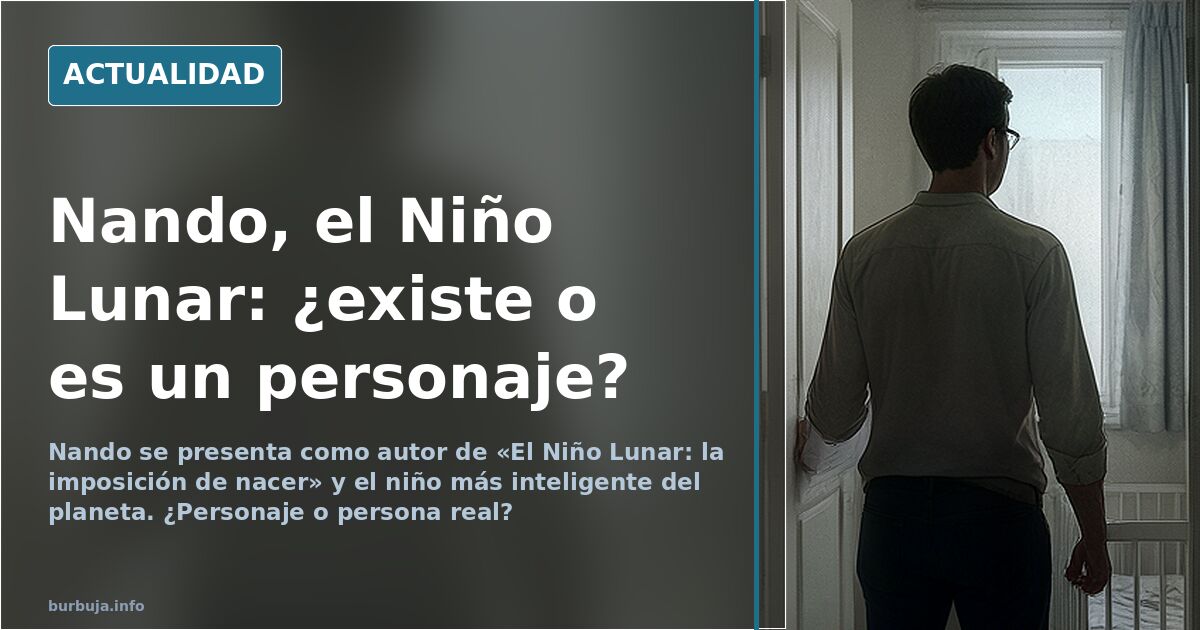
Nando, the Lunar Child who asks whether he exists or is a character
Nando presents himself as the smartest child on the planet and the author of "The Lunar Child: the Imposition of Being Born." According to its own author, the work is the only axiomatic one in a wasteland of mud and mediocrity disguised as intellectuality. On that basis he builds a public figure that blends the tragic, romantic character with the most brazen exhibitionism. The question that holds everything else together is simple: does he exist, or is he an invented character?
What the Lunar Child is and what he proposes
The central premise is a question about himself: whether he is alone and helpless, whether he is seriously ill, whether he will die young —he himself answers that in all probability he will—, whether he prefers love to sens, or whether his ego is ontological. He answers the last one himself: yes. There is no concrete financial claim anywhere in the material.
Around that idea unfolds a catalogue of questions that Nando himself throws into the air. He describes himself as small and sweet, but also as the last romantic of the wasteland. He wonders whether he is handsome or ugly, or whether he embodies both realities. He claims a blue Le Mans steed called Matilde, a rear-view mirror pointed at his own face instead of the road, and a dance routine among cemetery graves to the cry of "I want to dance all night long."
The character is built out of deliberate contradictions.
From the book to the comment section: how people respond
The reception has been anything but unanimous. A good part of the replies simply repeat a catchphrase about hanging balls and a dragging dick, which has become the character's involuntary refrain. Others dismiss the whole thing outright with insults and a decision to ignore it.
There are also those who engage with a smirk. One participant celebrates the spectacle with a "Brooootal, I'm dying" and a "ing Nando," which gives a measure of the general tone: nobody seems to take it seriously, but nobody quite looks away either. The character works precisely because he is unsettling enough to get a response.
Nando, for his part, does not flinch. He answers the insults with irony about his interlocutors' prose, calls himself "the sweet Nando" and "the lunar child born in the wasteland," and caps it off with a late-night scene: standing on a makeshift platform, arms outstretched, proclaiming that he loves the void and launching into song and dance straight out of Broadway. "Even I didn't believe it while I was doing it," he admits.
Is it an invented character or is there someone behind it?
The doubt is raised by Nando himself in the first line, and nobody resolves it. What there is, are layers: a book with a registered title, an aesthetic of decay carefully cultivated, and a remarkable ability to show up in every reply without losing the tone.
The whole thing fits a literary character better than an ordinary person, but that doesn't clarify much. A character sustained long enough and with enough coherence ends up functioning as an identity. The question of whether he exists stops having a clean answer as soon as the character starts answering for himself.
What can be said is that the figure has a recognizable axis: the idea that being born was an imposition. Everything else —the steed, the little pastries on a silver tray, the Women without a Name, the haute couture outfits, the kisses blown at shop windows— are variations on that same theme.
The exact point where the analysis gets stuck
This is where what can be sustained with the available material ends. There is no way to verify whether the steed exists, whether the book is actually sold, or whether it is all a narrative construction with no support other than the insistence itself. Nobody has produced a hard fact in either direction.
What remains is the character, his wasteland of mud, and his unanswered initial question. And above all, the feeling that the answer matters less than the fact that the question keeps being asked.
Also available in: Deutsch
Summary of a discussion on Burbuja.info - Foro de economía, actualidad y política., translated from Spanish and reviewed before publication. Read the full discussion (17 replies).
More summaries
-
Spanish Forum User Demands €1M From Parents for Being Born
A Spanish forum user, calling himself the 'lunar child,' demands €1 million from his parents for bringing him into existence without consent.
-
Women's self-defense: real effectiveness or viral spectacle?
The debate over women's self-defense is intensifying as viral videos question its real effectiveness. Are these methods useful, or just a show with no substance?
-
Bukele Halloween ban was a deepfake hoax, El Salvador confirms
A video claiming Bukele had banned Halloween was a deepfake: the voice did not match the mouth, and no trace of the measure exists in official sources.
-
New oral pill regrows hair in six months, but the molecule isn't new
Veradermics reports a trial with over 1,000 men showing visible hair regrowth in six months, but the molecule closely resembles existing treatments.
-
From Oliver Stone to Jordi Wild: the trajectory of Charlie Sheen
Charlie Sheen went from working with Oliver Stone to promoting his book on a podcast. His career, marked by excess, now reads as a decline with no way back.
-
Madrid's Gran Vía fills with the colours of Hispanic heritage
The 2026 Hispanic Heritage Parade sets off at 18:00 on Madrid's Gran Vía with flags, music and crowds. Check the route and the expected atmosphere.