
Nando el Hispano and the thesis calling humans 'biological waste'
A self-proclaimed 'axiomatic' manifesto declares humankind a carcinoma and calls for collective euthanasia. The biological and logical rebuttal was not long in coming.
English · Original discussion in Spanish · Published
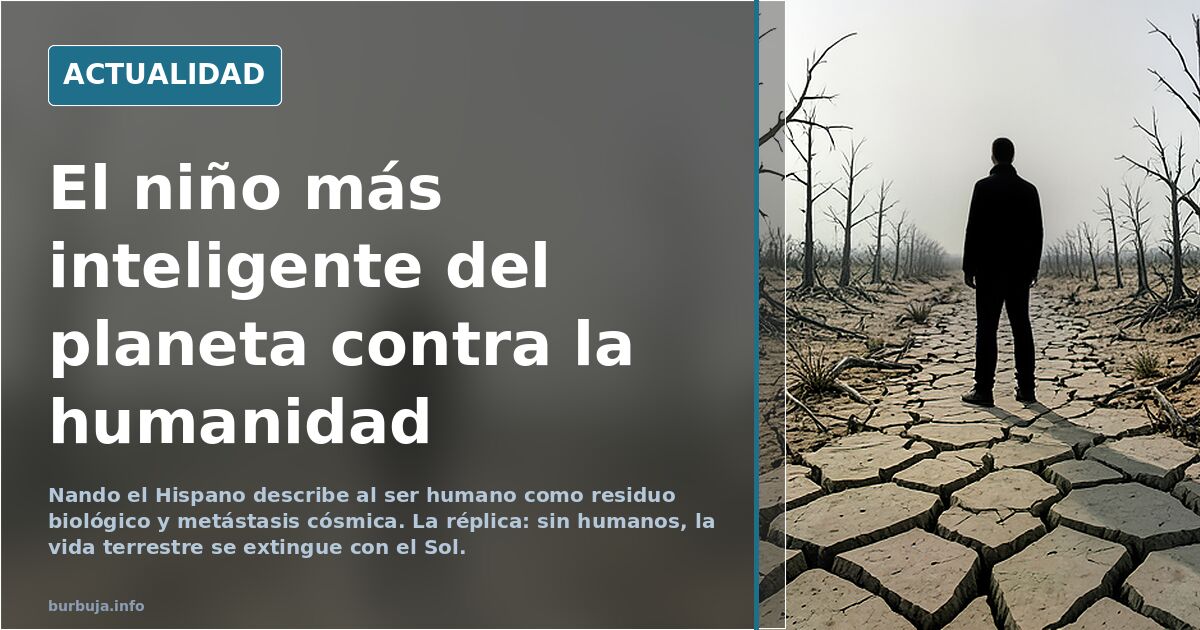
The 'smartest child on the planet' declares humanity a plague
A manifesto is circulating these days through the least patrolled corners of the internet with a thesis that admits no nuance: the human being is nothing more than 'biological waste infected with anthropocentrism', a carcinoma that devastates every ecosystem it touches and now dreams of exporting its metastasis to other galaxies. Its author signs as Nando el Hispano, proclaims himself 'the smartest child existing on this blue planet' and presents his work, 'El Niño Lunar: la imposición de nacer' (The Lunar Child: the imposition of being born), as 'the only axiomatic work existing in this wasteland of mud and mediocrity'. The text, which has been making the rounds for two days, has met with everything except indifference.
The starting premise is not new — antinatalist pessimism goes back centuries — but the packaging is. There is no academic essay here, no paper with footnotes: there is a self-proclaimed child prodigy who calls the entire species 'the thing' and demands, without beating around the bush, a 'collective euthanasia' to protect future innocent consciences. The notion, as expected, has triggered the opposite reaction.
From 'bipedal ape' to nuclear warheads as the solution
The first line of rebuttal came via biology. It was pointed out that the chimpanzee shares nearly **98.8% of its DNA sequence** with humans, that the gorilla is around **98.4%**, and that the orangutan comes in at **97%**. The question was obvious: if the criterion for wiping out a species is its resemblance to us, where is the line drawn? The manifesto's answer was blunt: only the human being. The other primates, apparently, are absolved.
The second front was reproductive logic. If the problem is that nobody asked to be born, the coherent conclusion is not to exterminate the living, but to stop bringing new ones into the world. And here the manifesto's author proved willing to go further: 'we activate all the nuclear warheads and done'. The solution, described as 'easy' by the one who proposed it, failed to convince those asking for a 'rational' argument. The debate then drifted onto more uncomfortable ground: if the species disappeared, wouldn't other primates evolve into a new version of the human, with the same vices and the same suffering? The answer was that such beings 'don't interest me'.
The argument that throws radical pessimism off balance
The most interesting turn came when someone pushed the premise to its temporal extreme: if suffering justifies preventing birth, the same logic should apply to any thinking species that might arise in the next **10 million years**. The manifesto shrugged. And there a sustancia ilegal peine: either the thesis is a universal principle, in which case there is no reason to stop at Homo sapiens, or it is a pose with an expiration date. The suspicion that all this is a strategy to sell books — the author signs off with his work and all — hung over the conversation without anyone fully dispelling it.
There were also those who argued the opposite with a point that, at bottom, is the same one but in positive form: without humans, all life on Earth will go extinct when the Sun swallows the planet, and only we could save it. The species as cosmic parachute. Versus the species as metastasis. Two narratives identical in their grandiosity, opposite in sign.
Behind the scenes: who lulls you and who slaps you
The manifesto also offered a homemade pedagogical theory: whoever loves you lulls you, and only a 'psychopath or sociopath' would make you cry. From there comes a conclusion that sweeps away the entire family: 'A good father and mother... never bring life'. Reproduction, in this reading, is not love but ego, greed, envy or vanity. It is the same argument classical antinatalism has been repeating for decades, only here it is seasoned with the suspicion that parents are 'magnanimous entities' mythologized by an infant who still believes in the Three Wise Men.
The closing of the original text leaves no loophole: 'To be born is to lose'. And from there, the call for a collective euthanasia that nobody has embraced beyond the provocation. The conversation, two days later, stands exactly where it began: with the claim that the human being is 'the thing' and the inability to prove it without resorting to the same faith the manifesto claims to despise. The quicksilver mirror, as its author requested, keeps shining. But nobody has fully looked into it.
Also available in: Deutsch
Summary of a discussion on Burbuja.info - Foro de economía, actualidad y política., translated from Spanish and reviewed before publication. Read the full discussion (55 replies).
More summaries
-
Nando, the Lunar Child who asks whether he exists or is a character
Nando presents himself as the author of "The Lunar Child: the Imposition of Being Born" and the smartest child on the planet. Fictional character or real person?
-
Spain Withdraws Police Protection from Four Ex-Ministers, Sparking Political Fallout
Interior strips security for Iglesias, Montero, Belarra, and Garzón. Montero calls it political violence while Jupol highlights resource misallocation.
-
Spanish councils collect over €13 billion in property tax, up 5.5% in five years
Spanish municipalities collect more than €13.4 billion from IBI property tax. We look at the forum debate on why the tax burden keeps rising while public services deteriorate.
-
Therians on the Madrid subway spark debate in Spain
Forum users analyze the appearance of therians on public transport and what this behavior says about Spain's current social drift.
-
No reliable data backs claim that AfD is the LGBT community's favorite party in Germany
Is the AfD the party most supported by the LGBT community in Germany? The debate on Burbuja.info examines the ROMEO survey, Newtral's fact-check and the Alice Weidel paradox.
-
Mexico runs out of gasoline amid five-day supply crisis
Mexico is facing a gasoline supply crisis with reserves for only 5 days. We look at the reality behind the shortage and Pemex's infrastructure.