
Mujica's poor vs. rich quote: Who is the real enemy?
A viral message claims Uruguay's left won, reigniting debate over Pepe Mujica's quote about the poor defending the rich.
English · Original discussion in Spanish · Published
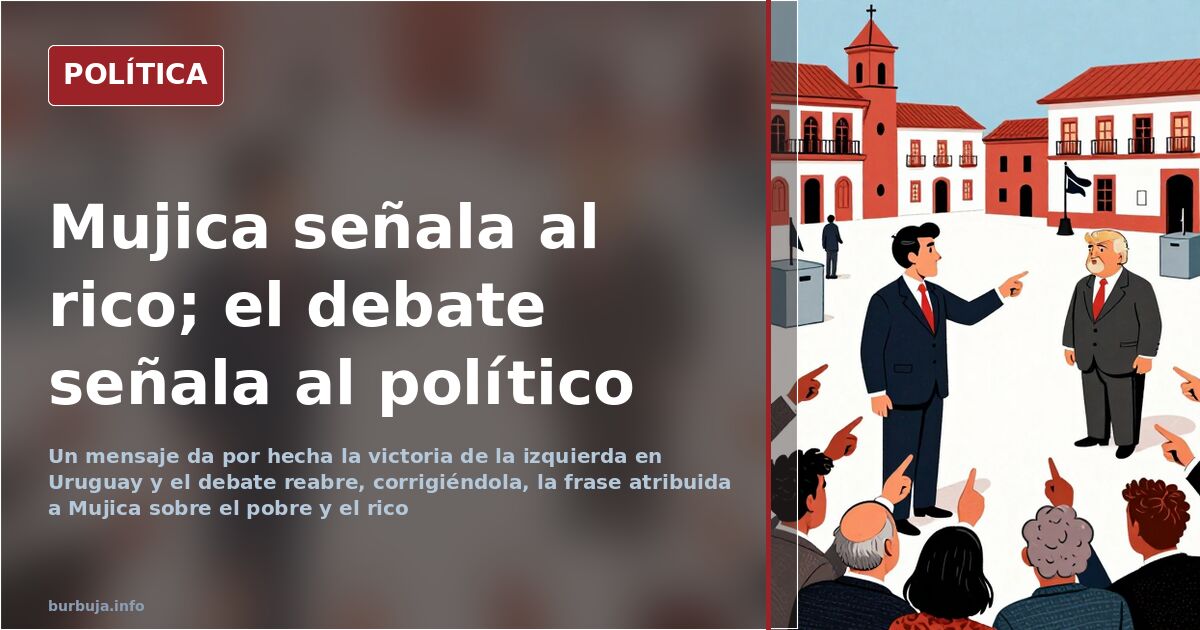
Mujica's poor vs. rich quote: Who is the real enemy according to the debate
According to the message starting the thread, the left has won the elections in Uruguay, bringing back one of those slogans attributed to Pepe Mujica that circulate ready to share: "The worst enemy of a poor person is another poor person who defends the rich who make them both poor." The quote, accompanied by an image of the former president, moves through social media and reopens a discussion that goes far beyond Uruguay.
The first reaction was not to applaud it, but to correct it. Where Mujica says "rich," many responses say "politician": the worst enemy of a poor person is another poor person who defends the politician who makes them both poor. This shift is not cosmetic. It changes the culprit and, with it, the entire conversation about taxes, self-employment, and social mobility.
Who is the worst enemy of a poor person?
Some argue that the real enemy is not the rich or the poor who defends them, but the public official who promises to pull you out of the hole and stays in the photo. According to this reading, the left claiming to trinc Mujica ends up managing a machine that fries the rich in taxes and, in passing, the poor, with no noticeable result in anyone's pocket. The argument closes with an uncomfortable question: why do these people never talk about entrepreneurship.
On the other side appears the opposite reading, which points to those who enrich themselves while earning a public salary and focuses on the rich who disguise themselves as poor to keep draining blood. Here, Mujica's quote is read backwards: the problem is not the envy of those below, but the capture of the discourse.
And a third, less kind path points to the poor themselves. Conformity, permanent complaining, and the habit of associating with others equally broke would be the real burden. The rich associate with the rich and multiply capital; the poor associate with those on their level and sink together, summarizes one of the interventions.
Can you move from lower class to middle class through effort?
Here the debate becomes concrete. The quote attributed to Mujica has a manual problem: if the goal is for the poor to stop being poor, any incentive to move forward turns the person who succeeds into an enemy of their own class. The poor person who starts a business, grows, and hires stops being poor, and no longer fits the narrative.
The discussion shifts to real mobility. Some defend that opportunities exist today and always: self-employed individuals, micro-enterprises, and skilled workers who associate with someone who already has a company to set up something part-time. Others respond that nothing is guaranteed, that businesses close daily and that most of those that open do not survive the first few years. The precise calculation of how many withstand, and how many live off a single large client, is exactly what no one manages to close.
The contrast emerges when defining what it means to be poor. A self-employed person is just as poor, settles one voice. And someone earning 2,000 euros a month is also poor. With this measuring stick, a large part of the population falls into the category, and the conversation becomes inextricable.
Why is entrepreneurship punished?
Much of the disagreement points to regulation. The complaint is that starting a small business—a online jewelry store, a copy shop—has become a maze of paperwork that makes it impossible for a woman to start anything from home.
One anecdote from the thread concerns a job in the telephone customer service line of a technology park company, a design building with meager salaries. The newcomer arrived at 8:45, fifteen minutes early, and was the first of the six covering the shift. One day the boss appeared with a customer complaint: why no one answered the phone before 9. The story cuts off there in the material, and the reading extracted in the thread is that punctuality and effort are not rewarded in that context.
Another current focused elsewhere: if those leaders truly cared about the poor, they would promote self-employment rather than regulate every detail. And those who respond that the solution is not to start anything, but to be a civil servant in a micro-enterprise, something that, according to that response, does not exist.
Who pays the price of the fiscal party?
One of the conclusions with the most consensus is the most uncomfortable for the official narrative: in the end, the fiscal pressure is also paid by those below. We live —it is argued— in an era where even with two salaries in the house, life is not comfortable.
On this basis, the discussion is poisoned by the classic suspicion: that all the apparatus of nice phrases serves for the poor to remain poor while settling for believing that someone very bad is responsible for their situation.
That is where the analysis ends. The conversation about who is the enemy of the poor does not end in a winner, but in an unanswered question: if any sign of getting out of the hole becomes betrayal, what is left for those who want to try. The myth of the wise grandfather is sustained by the quote. Economic policy is not consumed by phrases.
According to the message starting the thread, the left has won the elections in Uruguay, bringing back one of those slogans attributed to Pepe Mujica that circulate ready to share: "The worst enemy of a poor person is another poor person who defends the rich who make them both poor." The quote, accompanied by an image of the former president, moves through social media and reopens a discussion that goes far beyond Uruguay.
The first reaction was not to applaud it, but to correct it. Where Mujica says "rich," many responses say "politician": the worst enemy of a poor person is another poor person who defends the politician who makes them both poor. This shift is not cosmetic. It changes the culprit and, with it, the entire conversation about taxes, self-employment, and social mobility.
Who is the worst enemy of a poor person?
Some argue that the real enemy is not the rich or the poor who defends them, but the public official who promises to pull you out of the hole and stays in the photo. According to this reading, the left claiming to trinc Mujica ends up managing a machine that fries the rich in taxes and, in passing, the poor, with no noticeable result in anyone's pocket. The argument closes with an uncomfortable question: why do these people never talk about entrepreneurship.
On the other side appears the opposite reading, which points to those who enrich themselves while earning a public salary and focuses on the rich who disguise themselves as poor to keep draining blood. Here, Mujica's quote is read backwards: the problem is not the envy of those below, but the capture of the discourse.
And a third, less kind path points to the poor themselves. Conformity, permanent complaining, and the habit of associating with others equally broke would be the real burden. The rich associate with the rich and multiply capital; the poor associate with those on their level and sink together, summarizes one of the interventions.
Can you move from lower class to middle class through effort?
Here the debate becomes concrete. The quote attributed to Mujica has a manual problem: if the goal is for the poor to stop being poor, any incentive to move forward turns the person who succeeds into an enemy of their own class. The poor person who starts a business, grows, and hires stops being poor, and no longer fits the narrative.
The discussion shifts to real mobility. Some defend that opportunities exist today and always: self-employed individuals, micro-enterprises, and skilled workers who associate with someone who already has a company to set up something part-time. Others respond that nothing is guaranteed, that businesses close daily and that most of those that open do not survive the first few years. The precise calculation of how many withstand, and how many live off a single large client, is exactly what no one manages to close.
The contrast emerges when defining what it means to be poor. A self-employed person is just as poor, settles one voice. And someone earning 2,000 euros a month is also poor. With this measuring stick, a large part of the population falls into the category, and the conversation becomes inextricable.
Why is entrepreneurship punished?
Much of the disagreement points to regulation. The complaint is that starting a small business—a online jewelry store, a copy shop—has become a maze of paperwork that makes it impossible for a woman to start anything from home.
One anecdote from the thread concerns a job in the telephone customer service line of a technology park company, a design building with meager salaries. The newcomer arrived at 8:45, fifteen minutes early, and was the first of the six covering the shift. One day the boss appeared with a customer complaint: why no one answered the phone before 9. The story cuts off there in the material, and the reading extracted in the thread is that punctuality and effort are not rewarded in that context.
Another current focused elsewhere: if those leaders truly cared about the poor, they would promote self-employment rather than regulate every detail. And those who respond that the solution is not to start anything, but to be a civil servant in a micro-enterprise, something that, according to that response, does not exist.
Who pays the price of the fiscal party?
One of the conclusions with the most consensus is the most uncomfortable for the official narrative: in the end, the fiscal pressure is also paid by those below. We live —it is argued— in an era where even with two salaries in the house, life is not comfortable.
On this basis, the discussion is poisoned by the classic suspicion: that all the apparatus of nice phrases serves for the poor to remain poor while settling for believing that someone very bad is responsible for their situation.
That is where the analysis ends. The conversation about who is the enemy of the poor does not end in a winner, but in an unanswered question: if any sign of getting out of the hole becomes betrayal, what is left for those who want to try. The myth of the wise grandfather is sustained by the quote. Economic policy is not consumed by phrases.
Summary of a discussion on Burbuja.info - Foro de economía, actualidad y política., translated from Spanish and reviewed before publication. Read the full discussion (232 replies).
More summaries
-
Frente Obrero clashes with tenant union
Frente Obrero rejects the tenant union, reigniting the dispute over who represents renters. Eviction, property, and debt are on the table.
-
PSOE Hits Record Low: 25.4% and Risk of Losing 100 Seats
Celeste Tel poll places PSOE at 25.4%, a legislative low, nearing a loss of 100 seats. Ceuta continues to weigh down the party.
-
'Galiza aos Galegos': Galicia's Identity Nationalism
A minority Galician nationalism revives the slogan 'home, race, language' and claims the 1932 Ultreya. Triskeles, camps, and social media.
-
Madrid housing march attendance estimated at 12,000, far below official figures
Independent analysis places Madrid's housing protest attendance between 8,000 and 16,000, contradicting organizers' claims of 500,000 and official estimates of 70,000.
-
77-year-old father kicks out son after political argument in Gijón
A 77-year-old father in Gijón, Spain, evicts his son following a heated political dispute. The incident highlights growing family polarization and the role of media.
-
Spain's National Core: Political Nicknames Exposing Elite Disconnect
Eight alternative nicknames for Spain's National Core party reveal deep political discontent and the widening gap between political elites and ordinary citizens.