
Frente Obrero clashes with tenant union
Frente Obrero rejects the tenant union, reigniting the dispute over who represents renters. Eviction, property, and debt are on the table.
English · Original discussion in Spanish · Published
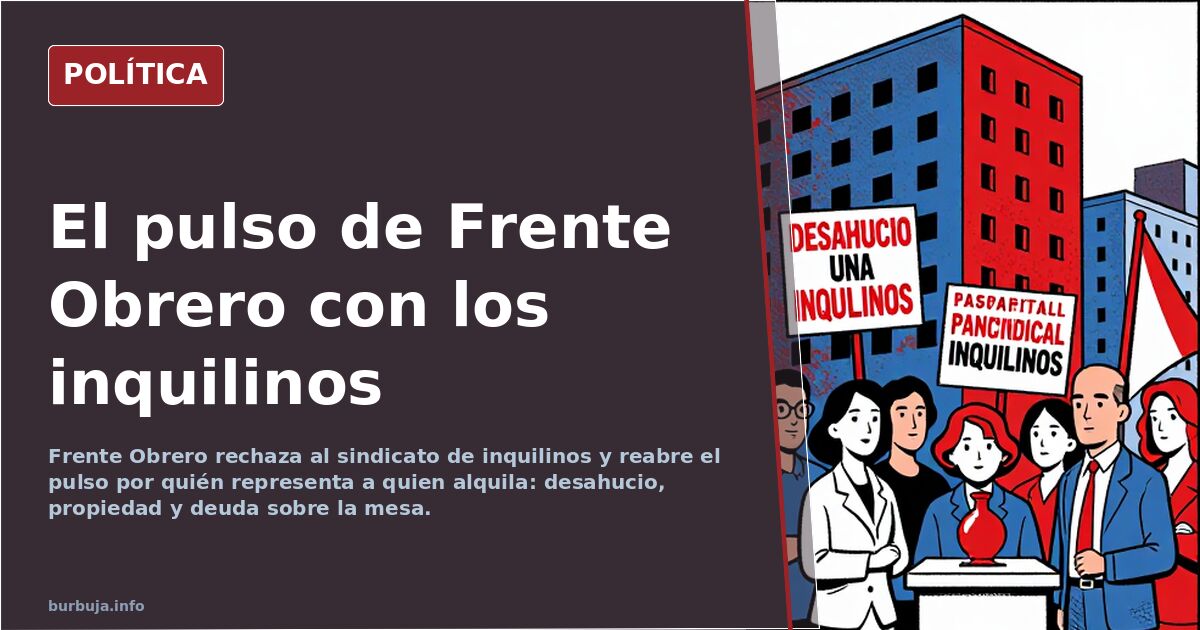
Frente Obrero vs. Tenant Union: The Battle for the Narrative
Frente Obrero, the party led by Roberto Vaquero, has challenged the tenant union movement, denying it the role of representative for those living in rented accommodation. This occurred alongside a banner proclaiming 'Capitalism Evicts' and a blunt response. The skirmish is not local; it's a fight over who claims the banner of eviction.
The clash reopens an old question: What does the working-class movement defend when the adversary is no longer the factory owner, but the landlord of the third floor? And the answer given by its own supporters troubles the traditional left.
What is Frente Obrero and Why It Doesn't Consider Itself Communist
Some argue that Frente Obrero is not communist and never intended to be. It describes itself as a movement blending working-class tenets with the defense of Spanish cultural and historical identity, positioning its enemy in what it calls globalism. Vaquero, meanwhile, argued on television — specifically on Cuarto Milenio — that it is the authentic left.
Not everyone accepts this label. The tag of 'communist' is applied by right-wing voters distrustful of the working-class discourse, as well as by a segment of the left itself, which sees the group as unwelcome competition. This leads to cross-accusations ranging from sectarianism to opportunism.
Housing: Capitalism Evicts, Communism Expropriates
The two positions are summarized in a statement from the exchange: capitalism evicts, and communism expropriates, with the former doing so gradually and the latter ipso facto. The same outcome — the occupant losing the property — is reached through two different paths.
There's a legal nuance often lost in the fray. Someone buying with a mortgage isn't the full owner until the loan is paid off; they have the use and carry the debt. If payments stop, eviction recovers the property; if the state expropriates, the party recovers it. The user changes, but the usufruct does not.
This parallel allows two opposing traditions to describe the same mechanism using different vocabularies. It's not accidental; it's the basis of the discourse that 'it doesn't matter who's in charge, the same people are.'
From 'You'll Own Nothing' to Khrushchev: The Convergence Argument
The convergence thesis has its own iconography. Capitalist states, it is argued, are as regulated and intervened as the Soviet Union was, and the slogan attributed to Agenda 2030 — 'you'll own nothing and be happy' — serves as proof. This interpretation ignores clear differences in civil liberties but circulates freely.
In contrast, there's a nostalgic counter-argument: in the USSR of Khrushchev and Brezhnev, housing was free. This is even stated by those who clarify they don't endorse the Soviet model. The phrase serves as a reminder that the tenant's problem is not ideological, but one of disposable income.
Underlying this is a suspicion cast upon everyone, which no one answers: that Frente Obrero is controlled opposition and that the tenant union is another piece on the same board, useful for undermining traditional parties before reordering the system. And the most uncomfortable argument from the exchange remains: that in the USSR of Khrushchev and Brezhnev, housing was free. Neither of the current factions can say the same of their own model.
Frente Obrero, the party led by Roberto Vaquero, has challenged the tenant union movement, denying it the role of representative for those living in rented accommodation. This occurred alongside a banner proclaiming 'Capitalism Evicts' and a blunt response. The skirmish is not local; it's a fight over who claims the banner of eviction.
The clash reopens an old question: What does the working-class movement defend when the adversary is no longer the factory owner, but the landlord of the third floor? And the answer given by its own supporters troubles the traditional left.
What is Frente Obrero and Why It Doesn't Consider Itself Communist
Some argue that Frente Obrero is not communist and never intended to be. It describes itself as a movement blending working-class tenets with the defense of Spanish cultural and historical identity, positioning its enemy in what it calls globalism. Vaquero, meanwhile, argued on television — specifically on Cuarto Milenio — that it is the authentic left.
Not everyone accepts this label. The tag of 'communist' is applied by right-wing voters distrustful of the working-class discourse, as well as by a segment of the left itself, which sees the group as unwelcome competition. This leads to cross-accusations ranging from sectarianism to opportunism.
Housing: Capitalism Evicts, Communism Expropriates
The two positions are summarized in a statement from the exchange: capitalism evicts, and communism expropriates, with the former doing so gradually and the latter ipso facto. The same outcome — the occupant losing the property — is reached through two different paths.
There's a legal nuance often lost in the fray. Someone buying with a mortgage isn't the full owner until the loan is paid off; they have the use and carry the debt. If payments stop, eviction recovers the property; if the state expropriates, the party recovers it. The user changes, but the usufruct does not.
This parallel allows two opposing traditions to describe the same mechanism using different vocabularies. It's not accidental; it's the basis of the discourse that 'it doesn't matter who's in charge, the same people are.'
From 'You'll Own Nothing' to Khrushchev: The Convergence Argument
The convergence thesis has its own iconography. Capitalist states, it is argued, are as regulated and intervened as the Soviet Union was, and the slogan attributed to Agenda 2030 — 'you'll own nothing and be happy' — serves as proof. This interpretation ignores clear differences in civil liberties but circulates freely.
In contrast, there's a nostalgic counter-argument: in the USSR of Khrushchev and Brezhnev, housing was free. This is even stated by those who clarify they don't endorse the Soviet model. The phrase serves as a reminder that the tenant's problem is not ideological, but one of disposable income.
Underlying this is a suspicion cast upon everyone, which no one answers: that Frente Obrero is controlled opposition and that the tenant union is another piece on the same board, useful for undermining traditional parties before reordering the system. And the most uncomfortable argument from the exchange remains: that in the USSR of Khrushchev and Brezhnev, housing was free. Neither of the current factions can say the same of their own model.
Summary of a discussion on Burbuja.info - Foro de economía, actualidad y política., translated from Spanish and reviewed before publication. Read the full discussion (21 replies).
More summaries
-
And They Call This Governing (Ignacio Camacho, ABC)
An ABC column criticizes the government for tackling housing with two decrees without guaranteed parliamentary approval and at the cost of reducing supply.
-
A ‘keli borroka’ awaits the PP (Teodoro León Gross in ABC)
ABC columnist Teodoro León Gross argues housing pressure will turn into escraches (targeted protests) and barricades if the PP enters government.
-
A democratic obligation unfulfilled (ABC editorial)
Article 134.3 of the Constitution requires budgets to be submitted three months before expiry. Spain is still running on the 2023 Budget.
-
Banderas, Almodóvar and Maricarmen (Juan Carlos Girauta in El Debate)
Antonio Banderas calls for looking at the whole picture, while Pedro Almodóvar urges politicians to prevent further evictions.
-
The USSR and the Origins of Borregocracia: Thesis and Suspicions
Soviet infiltration, free lawyers, Gramsci and academic inbreeding: the thesis that traces today's groupthink to the USSR.
-
Abascal claims a Spaniard cannot be racist
Abascal claims 'a Spaniard cannot be racist', and his own voters answer with unemployment, demographics and accusations of betrayal