
Man dies from monkeypox in Spain's Basque Country
An oncology patient at Donostia hospital died after contracting Mpox from a roommate. It is the first death in the Basque Country.
English · Original discussion in Spanish · Published
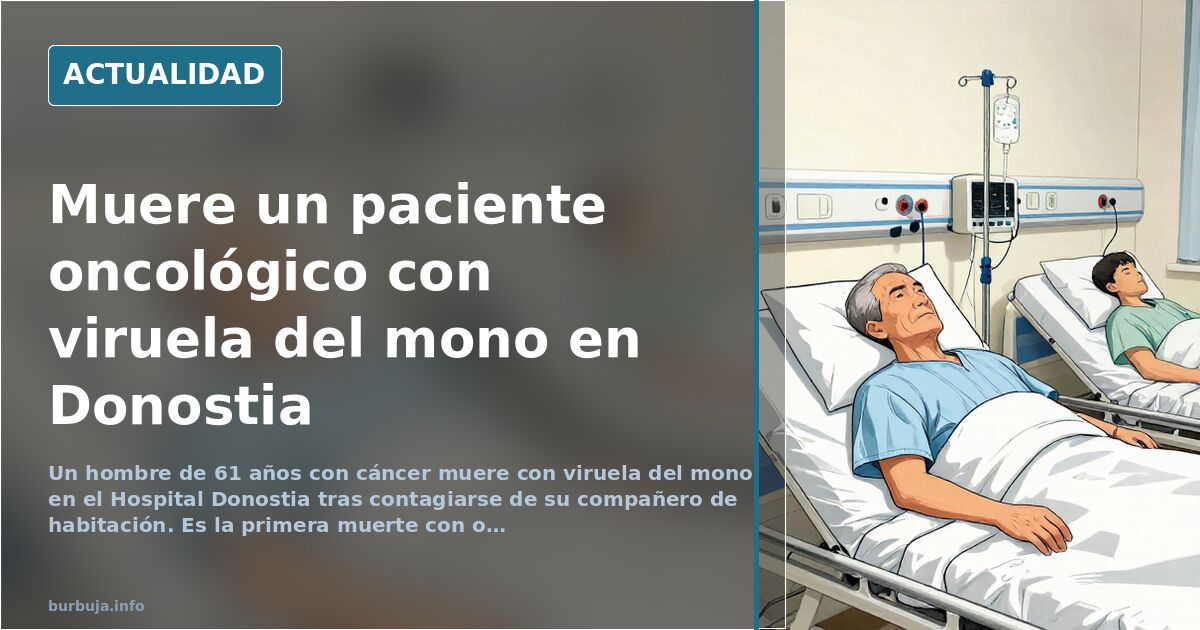
A 61-year-old man admitted for cancer at Donostia hospital has died after contracting monkeypox from another patient with whom he shared a room. It is the first Mpox-related death in the Basque Country and Osakidetza has already vaccinated around thirty close contacts.
Some deaths explain themselves and some force uncomfortable questions. That of this **61-year-old** man at **Donostia** hospital belongs to the second group. Not because of the bicho itself, which has been circulating among us for years and in the vast majority of cases is mild, but because of the specific circumstances in which the infection occurred. An oncology patient, admitted for weeks to the Otorhinolaryngology area for a tumor in the throat and neck, shared a room with another patient who turned out to be positive for monkeypox. The result was fatal.
## An infection inside the hospital
The deceased had been admitted for weeks for an oncological disease. He was not in a terminal phase, according to the hospital sources consulted. The other patient had been admitted for a throat ailment and was being treated with antibiotics for an infectious condition, but at that time no one knew he also carried the Mpox bicho. When he tested positive, he was discharged and sent home, because isolation for monkeypox, according to specialists, is better done at home. The damage, in any case, was already done.
What caught the attention of health workers was not so much the outcome as the fact that an immunocompromised patient shared a room with another who had an infectious pathology. With this type of patient, prevention and isolation measures are usually adopted. The head of infectious diseases at Donostia hospital, **Miguel Ángel Goenaga**, summed it up honestly when he spoke to the media: the patient "died with monkeypox, we don't know if from monkeypox, but yes with it." Any infection in someone with low defenses can worsen an already delicate situation.
Goenaga did not rule out that the final cause of death was something else. He spoke of a patient who had already had other infections, who was in a hospital and who can acquire anything. "In the end he probably died from an infection, in this case from a bicho, from a bacteria that the patient himself already had," he said. The distinction matters, and a lot, because dying from Mpox is not the same as dying with Mpox. In the first case we are talking about a lethal bicho; in the second, about a bicho that acts as the final push in an organism that was already at its limit.
## What is Mpox and how is it transmitted
Monkeypox is a disease caused by a bicho that is transmitted both between people and from animals to people. Its main manifestation is a rash that usually appears on the hands, feet and different areas of the body. The incubation period ranges from **3 to 17 days**. Transmission occurs through close contact with an infected person: skin-to-skin rubbing or touching objects that have previously been in contact with the patient. It is not contagious by being in the same room ten meters away.
Although it is generally not serious, it can become complicated in people with a weakened immune system, babies under **1 year** of age, pregnant women and patients with a history of eczema. The deceased fell squarely into the first group: he had cancer under treatment and very low defenses. So far this year in Spain, two other people have died from Mpox, according to the report from the National Epidemiology Center. In both cases they were patients with HIV.
The disease was discovered in **1958** in monkeys used for research. The first human case was recorded in **1970** in the Democratic Republic of the Congo. In **2022** it spread worldwide after several outbreaks that arose at parties, and one of the main foci in Spain was the Maspalomas Pride in Gran Canaria that year. Since then and until the end of September, **10,535 cases** have been diagnosed in the country as a whole, of which **290** correspond to the Basque Country. Most were concentrated in 2022, but in the last year there has been a rebound: in the Basque Country it went from **8** cases in all of 2025 to **35** in the first nine months of this year.
## Vaccination of contacts and questions to Parliament
Osakidetza has vaccinated at least **30 people** considered close contacts of these two cases to prevent new infections. The patient who infected the deceased was discharged and is in good health after overcoming the infection. The specific vaccine against Mpox exists and its use is indicated both in people at risk of contracting the disease and in close contacts of infected people. There is no specific treatment: care is aimed at alleviating symptoms, as detailed by the U.S. Centers for Disease Control and Prevention.
EH Bildu, through parliamentarian **Rebeka Ubera**, has submitted a series of questions in the Basque Parliament for the Department of Health to clarify the details of the case. Among the questions it asks to be answered are whether there are more cases of Mpox related to this outbreak, what measures Donostia hospital took to prevent transmission of the bicho and what protocols are applied when treating an infectious patient. The medical director of the center, **Sara Arévalo**, appeared alongside Goenaga, but questions about why a room was shared still lack a detailed public answer.
The Health Department will have to explain in parliament whether the protocol was trinc or if there was a failure. Because one thing is that Mpox circulates and another is that a hospital puts an immunocompromised patient in contact with another who has an infectious condition without the isolation measures that clinical practice itself recommends. That is the question left in the air, and no generic statement is going to answer it.
If you have any doubts about symptoms, contagion or vaccination, the prudent thing is to consult a health professional and trinc the indications of public health authorities.
Some deaths explain themselves and some force uncomfortable questions. That of this **61-year-old** man at **Donostia** hospital belongs to the second group. Not because of the bicho itself, which has been circulating among us for years and in the vast majority of cases is mild, but because of the specific circumstances in which the infection occurred. An oncology patient, admitted for weeks to the Otorhinolaryngology area for a tumor in the throat and neck, shared a room with another patient who turned out to be positive for monkeypox. The result was fatal.
## An infection inside the hospital
The deceased had been admitted for weeks for an oncological disease. He was not in a terminal phase, according to the hospital sources consulted. The other patient had been admitted for a throat ailment and was being treated with antibiotics for an infectious condition, but at that time no one knew he also carried the Mpox bicho. When he tested positive, he was discharged and sent home, because isolation for monkeypox, according to specialists, is better done at home. The damage, in any case, was already done.
What caught the attention of health workers was not so much the outcome as the fact that an immunocompromised patient shared a room with another who had an infectious pathology. With this type of patient, prevention and isolation measures are usually adopted. The head of infectious diseases at Donostia hospital, **Miguel Ángel Goenaga**, summed it up honestly when he spoke to the media: the patient "died with monkeypox, we don't know if from monkeypox, but yes with it." Any infection in someone with low defenses can worsen an already delicate situation.
Goenaga did not rule out that the final cause of death was something else. He spoke of a patient who had already had other infections, who was in a hospital and who can acquire anything. "In the end he probably died from an infection, in this case from a bicho, from a bacteria that the patient himself already had," he said. The distinction matters, and a lot, because dying from Mpox is not the same as dying with Mpox. In the first case we are talking about a lethal bicho; in the second, about a bicho that acts as the final push in an organism that was already at its limit.
## What is Mpox and how is it transmitted
Monkeypox is a disease caused by a bicho that is transmitted both between people and from animals to people. Its main manifestation is a rash that usually appears on the hands, feet and different areas of the body. The incubation period ranges from **3 to 17 days**. Transmission occurs through close contact with an infected person: skin-to-skin rubbing or touching objects that have previously been in contact with the patient. It is not contagious by being in the same room ten meters away.
Although it is generally not serious, it can become complicated in people with a weakened immune system, babies under **1 year** of age, pregnant women and patients with a history of eczema. The deceased fell squarely into the first group: he had cancer under treatment and very low defenses. So far this year in Spain, two other people have died from Mpox, according to the report from the National Epidemiology Center. In both cases they were patients with HIV.
The disease was discovered in **1958** in monkeys used for research. The first human case was recorded in **1970** in the Democratic Republic of the Congo. In **2022** it spread worldwide after several outbreaks that arose at parties, and one of the main foci in Spain was the Maspalomas Pride in Gran Canaria that year. Since then and until the end of September, **10,535 cases** have been diagnosed in the country as a whole, of which **290** correspond to the Basque Country. Most were concentrated in 2022, but in the last year there has been a rebound: in the Basque Country it went from **8** cases in all of 2025 to **35** in the first nine months of this year.
## Vaccination of contacts and questions to Parliament
Osakidetza has vaccinated at least **30 people** considered close contacts of these two cases to prevent new infections. The patient who infected the deceased was discharged and is in good health after overcoming the infection. The specific vaccine against Mpox exists and its use is indicated both in people at risk of contracting the disease and in close contacts of infected people. There is no specific treatment: care is aimed at alleviating symptoms, as detailed by the U.S. Centers for Disease Control and Prevention.
EH Bildu, through parliamentarian **Rebeka Ubera**, has submitted a series of questions in the Basque Parliament for the Department of Health to clarify the details of the case. Among the questions it asks to be answered are whether there are more cases of Mpox related to this outbreak, what measures Donostia hospital took to prevent transmission of the bicho and what protocols are applied when treating an infectious patient. The medical director of the center, **Sara Arévalo**, appeared alongside Goenaga, but questions about why a room was shared still lack a detailed public answer.
The Health Department will have to explain in parliament whether the protocol was trinc or if there was a failure. Because one thing is that Mpox circulates and another is that a hospital puts an immunocompromised patient in contact with another who has an infectious condition without the isolation measures that clinical practice itself recommends. That is the question left in the air, and no generic statement is going to answer it.
If you have any doubts about symptoms, contagion or vaccination, the prudent thing is to consult a health professional and trinc the indications of public health authorities.
Summary of a discussion on Burbuja.info - Foro de economía, actualidad y política., translated from Spanish and reviewed before publication. Read the full discussion (22 replies).
More summaries
-
Mpox patient dies in Donostia after hospital infection
A 61-year-old man has died at Hospital Donostia after contracting Mpox from a roommate. Osakidetza has begun vaccinating 25 people.
-
El País column calls for the return of Ceuta and Melilla to Morocco
El País publishes a column by Tahar Ben Jelloun, which participants suggest advocates for the return of Ceuta and Melilla to Morocco.
-
Child's death and hospitalization after dental sedation in Alzira, Spain
A girl died and another was hospitalized after dental sedation in Alzira, Spain. Investigations reveal arrests linked to anesthesia theft.
-
Why Adult Friendships Fade and Social Isolation Grows
Analysis of why adult friendships erode and why many choose social isolation, exploring the fragility of human bonds and the rise of self-imposed distance.
-
Pedro Sánchez's health sparks political debate
Analysis of rumors about Pedro Sánchez's health: physical decline, cancellations, and the politicization of illness.
-
Sarah Santaolalla’s Origins Spark Media Scrutiny in Spain
Analysis of speculation regarding TV analyst Sarah Santaolalla’s genealogy and ethnic background in Spain.