
MOYA, China's warm-skinned humanoid built to care for the elderly
MOYA, the Chinese humanoid from DroidUp, walks with 92% human resemblance and hides cameras behind its eyes: this is how China plans to tackle its caregiver shortage
English · Original discussion in Spanish · Published
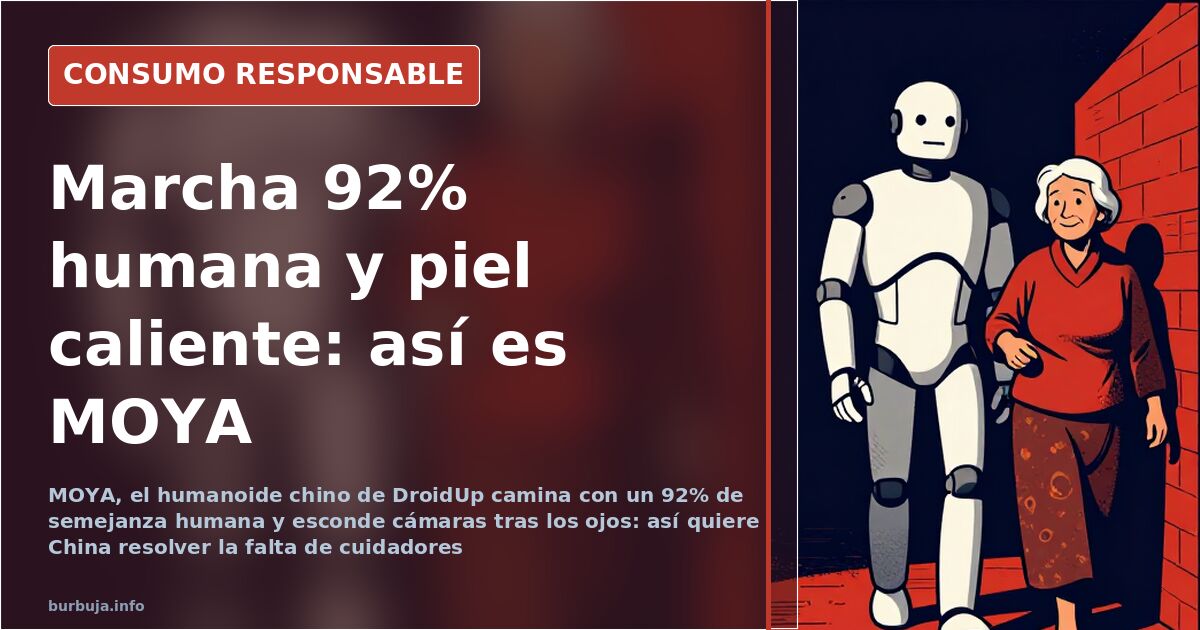
China bets on MOYA, the humanoid that cares for the elderly
MOYA has silicone skin at body temperature and walks with 92% human resemblance. The figure is presented as an engineering milestone, but it is also the reason for the backlash: this DroidUp humanoid is unsettling not for what it lacks, but for how much it resembles us. It carries hidden cameras behind its eyes, an AI capable of responding in real time, and the Walker 3 platform as its movement system. Its announced destination is not a tech fair, but hospitals, nursing homes and educational centers.
Why China wants robots caring for its elderly
The underlying argument is logistical before it is technological: there are fewer and fewer hands available to care for an aging population, and a machine that doesn't tire, doesn't rotate shifts and doesn't negotiate labor agreements fits far too neatly into that equation. MOYA's modular design points in the same direction: a single base serves different functions by swapping parts, which cuts maintenance costs and multiplies deployment scenarios.
It is worth separating the demo from the business. A machine lifting an elderly person out of bed without injuring them is an engineering problem only half-solved and costly; making it also smile at the right moment is a perception problem, far cheaper to sell.
The uncanny valley: looking too human is also a flaw
Public reception of MOYA split in two from the very first minute. Half celebrates the technical antiestéticat. The other recoils from a face that is almost human but not quite, the phenomenon known as the uncanny valley. Much of the interest also drifted toward the device's affective and sensual use, a segment with real demand that the care industry prefers not to mention in its institutional presentations. It is not a new hypocrisy: it is the same reticence with which any technology that touches the body is discussed.
Cameras behind the eyes: the cost that doesn't appear in the brochure
A robot that sees and records inside a nursing home is a permanent camera installed next to vulnerable people, and that is without counting the emotion and micro-gesture recognition its software requires. The question no demonstration answers: who safeguards those recordings, who has access to them, how long they are kept, and what happens when the device changes owner or country.
If the machine that helps you out of bed is also the one watching you, who decides the day it stops looking?
Also available in: Deutsch
Summary of a discussion on Burbuja.info - Foro de economía, actualidad y política., translated from Spanish and reviewed before publication. Read the full discussion (20 replies).
More summaries
-
Xiaomi Smart Aquarium: €25 in China vs. €125 in Spain
The Xiaomi smart aquarium costs €25 in China and around €125 in Spain, revealing the true cost of the ecosystem.
-
The doctored e-bike that burns out at 50 mph
A fake pedal-assist bike does 31 mph and its Chinese motor burns out after three kilometres. The wattage proves it was an illegal moped.
-
The class war has reached household cleaning
Robots with 25,000 pascals, privacy fears and a fire in Perth: why choosing a robot vacuum has become an identity battleground.
-
Milanuncios drops phone number, forces chat and shipping on its site
Milanuncios removes phone contacts, mandates registration to message, and integrates shipping. Sellers report a sharp drop in buyer inquiries.
-
Electric cars hit 23% of sales in Europe, just 6% in the US
Industry figures show 23% of new cars sold in Europe were electric versus 6% in the US between January and September 2026. Participants say the gap is political.
-
Self-employed worker says an AI made him overpay VAT tenfold
A self-employed worker in Spain says he filed his VAT return using an AI chatbot's figure: he paid ten times more VAT than owed and had to file a corrective return to get it back