
Masks Persist: 9 out of 10 Still Masked in Madrid, Forum Users Report
On the first day masks were optional outdoors, forum users in Madrid and Barcelona reported 90% and 95% mask usage respectively. A look at the lingering mask trend.
English · Original discussion in Spanish · Published
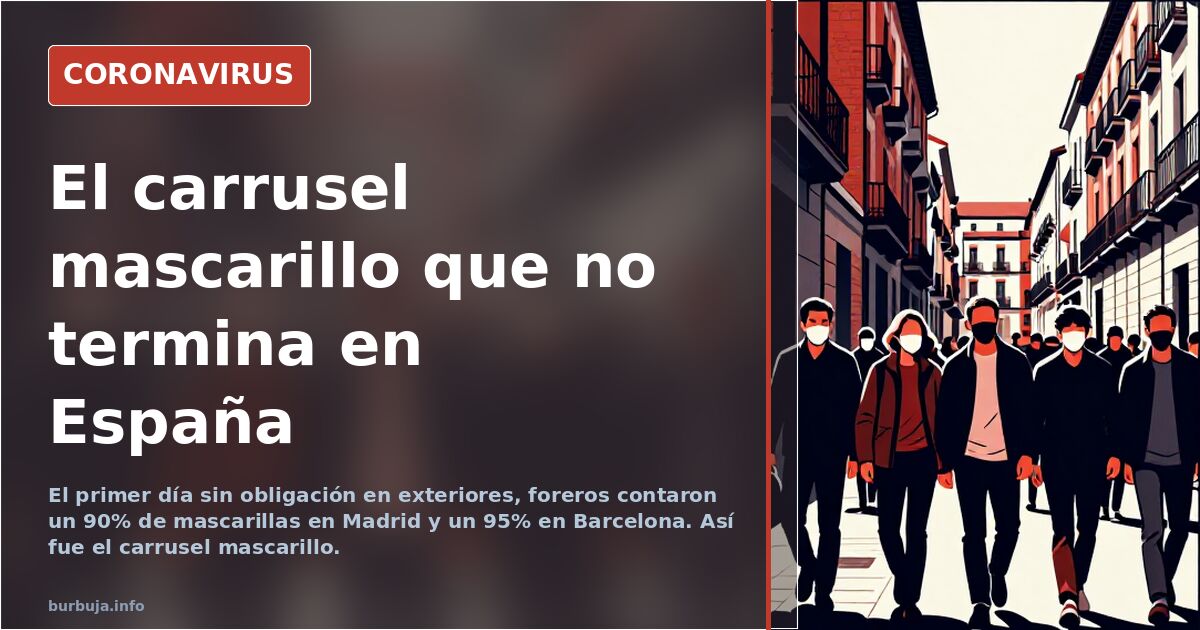
The Mask Carousel: The Day Many Kept Their Masks On
How many people took off their masks on the street the first day they were no longer mandatory? Fewer than one might imagine, judging by the counts shared that day by forum participants. In Madrid's Salamanca district, at 8:30 AM, one user reported 90% of pedestrians still masked; in Barcelona, after more than an hour of observation, another put the figure at 95%; in Valencia's city center, a third estimated no less than 90%. The rule had lapsed, but the habit remained. Not even empty streets, 25-degree weather, or afternoon sun made a difference.
The first few hours painted a varied picture across the country. In Triana, one forum user reported a 50/50 split. In Zaragoza, on the second day, another calculated 60% wearing masks (or on their chin) and 40% with faces uncovered. The details mattered: many of those who had 'freed' themselves still carried their masks on their elbow or in their hand, ready to put them back on at the sight of another person.
Why Beaches Ditched Masks Sooner Than Cities
The situation changed on the coast. On a beach in Calafell, a swimmer reported less than 2% masked; walking along the shore, less than 10%; by the afternoon, on the promenade, the figure rose to 30-40%. The explanation offered was simple: vacationers relax, while the more antiestéticarful in the city hold on due to anxiety.
City dwellers, however, maintained their stance. On a boat heading to El Rompido, one passenger was the only one without a mask until his vvife and daughter joined him. On the sand, everyone was unmasked. Away from the water, they put them back on. No one offered a coherent explanation.
And the children? On the first day, all children who passed a Madrid balcony were masked. The 17-year-old wearing a double mask in the sun would appear later in another account, with the same underlying criticism.
Three and a Half Months Later: "A Desolate Panorama"
The expected adjustment didn't happen. Three and a half months after the mandate was lifted, one forum user reported 70-80% masked versus 20-30% unmasked in their area. With television news, according to several testimonies, "pulling out all the stops" over new variants, some people argued that antiestéticar had become internalized and was no longer dependent on any current rule.
The harshest diagnosis pointed to something deeper than mere habit. There was talk of a population-level gaslighting process, internalized antiestéticar, and a collective trauma difficult to reverse: people prefer to believe it all made sense rather than accept that their rights were taken away for nothing. At the other extreme, the mundane explanation: many people who appear to be walking around masked are simply entering or leaving a venue.
The Metro: The Ultimate Test
Even in 2023, the metro remained the most honest thermometer. In Madrid, one passenger estimated 85% masked; in Barcelona, the train and metro maintained a 30-40% rate of users with masks, and on buses, people appeared who "had already put them on at home" months earlier. What was striking wasn't who kept them on, but who had finally taken them off.
On the other hand, the normalization of outdoor spaces. A spring heatwave with 30-degree temperatures and an FFP2 mask continued to be a daily spectacle in the capital. In Gijón, one forum user had seen two that morning. In Colombia, according to one testimony, barely 2% wore them indoors. Neither the temperature nor the epidemiology explained the contrast: only habit.
The Persistent Symptom: The Mask Dropped Below the Nose
One of the most frequently reported phenomena by observers was the user who wore the mask without covering their nose. As if taking it off completely would validate those who never wore one. This gesture revealed a compromise, a middle ground between wearing the mask and going without.
The paradox repeated itself across neighborhoods: in downtown Seville, unmasked tourists pulled the percentage down, leaving locals in the minority on their own streets. In Valencia, another ordinary morning seemed to decree the return of the mandate without anyone having announced it.
It's not surprising that many people took off their masks as soon as they could. What's surprising is how many, with the rule abolished, with the heat pressing down, and with no one watching, continued to pay the penance voluntarily. Each person knows the price they placed on their mask.
How many people took off their masks on the street the first day they were no longer mandatory? Fewer than one might imagine, judging by the counts shared that day by forum participants. In Madrid's Salamanca district, at 8:30 AM, one user reported 90% of pedestrians still masked; in Barcelona, after more than an hour of observation, another put the figure at 95%; in Valencia's city center, a third estimated no less than 90%. The rule had lapsed, but the habit remained. Not even empty streets, 25-degree weather, or afternoon sun made a difference.
The first few hours painted a varied picture across the country. In Triana, one forum user reported a 50/50 split. In Zaragoza, on the second day, another calculated 60% wearing masks (or on their chin) and 40% with faces uncovered. The details mattered: many of those who had 'freed' themselves still carried their masks on their elbow or in their hand, ready to put them back on at the sight of another person.
Why Beaches Ditched Masks Sooner Than Cities
The situation changed on the coast. On a beach in Calafell, a swimmer reported less than 2% masked; walking along the shore, less than 10%; by the afternoon, on the promenade, the figure rose to 30-40%. The explanation offered was simple: vacationers relax, while the more antiestéticarful in the city hold on due to anxiety.
City dwellers, however, maintained their stance. On a boat heading to El Rompido, one passenger was the only one without a mask until his vvife and daughter joined him. On the sand, everyone was unmasked. Away from the water, they put them back on. No one offered a coherent explanation.
And the children? On the first day, all children who passed a Madrid balcony were masked. The 17-year-old wearing a double mask in the sun would appear later in another account, with the same underlying criticism.
Three and a Half Months Later: "A Desolate Panorama"
The expected adjustment didn't happen. Three and a half months after the mandate was lifted, one forum user reported 70-80% masked versus 20-30% unmasked in their area. With television news, according to several testimonies, "pulling out all the stops" over new variants, some people argued that antiestéticar had become internalized and was no longer dependent on any current rule.
The harshest diagnosis pointed to something deeper than mere habit. There was talk of a population-level gaslighting process, internalized antiestéticar, and a collective trauma difficult to reverse: people prefer to believe it all made sense rather than accept that their rights were taken away for nothing. At the other extreme, the mundane explanation: many people who appear to be walking around masked are simply entering or leaving a venue.
The Metro: The Ultimate Test
Even in 2023, the metro remained the most honest thermometer. In Madrid, one passenger estimated 85% masked; in Barcelona, the train and metro maintained a 30-40% rate of users with masks, and on buses, people appeared who "had already put them on at home" months earlier. What was striking wasn't who kept them on, but who had finally taken them off.
On the other hand, the normalization of outdoor spaces. A spring heatwave with 30-degree temperatures and an FFP2 mask continued to be a daily spectacle in the capital. In Gijón, one forum user had seen two that morning. In Colombia, according to one testimony, barely 2% wore them indoors. Neither the temperature nor the epidemiology explained the contrast: only habit.
The Persistent Symptom: The Mask Dropped Below the Nose
One of the most frequently reported phenomena by observers was the user who wore the mask without covering their nose. As if taking it off completely would validate those who never wore one. This gesture revealed a compromise, a middle ground between wearing the mask and going without.
The paradox repeated itself across neighborhoods: in downtown Seville, unmasked tourists pulled the percentage down, leaving locals in the minority on their own streets. In Valencia, another ordinary morning seemed to decree the return of the mandate without anyone having announced it.
It's not surprising that many people took off their masks as soon as they could. What's surprising is how many, with the rule abolished, with the heat pressing down, and with no one watching, continued to pay the penance voluntarily. Each person knows the price they placed on their mask.
Summary of a discussion on Burbuja.info - Foro de economía, actualidad y política., translated from Spanish and reviewed before publication. Read the full discussion (813 replies).
More summaries
-
Raw Pandemic Data: Official Narrative vs Real Figures
An analysis of initial coronavirus data and firsthand accounts, tracing the outbreak from its epicenter to healthcare consequences across Spain and Europe.
-
Itziar Castro: from AstraZeneca trial volunteer to death at 46
Itziar Castro tweeted in March 2021 that she was a volunteer in the AstraZeneca trial with no side effects. She died in December 2023 at 46.
-
Nuremberg II: the Covid archive awaiting trial
A citizen archive compiles VAERS and EudraVigilance figures and Covid vaccine data for a hypothetical Nuremberg II that has no date yet.
-
Moving fibers in masks: home experiments, no answers
An amateur films fibers moving inside an FFP2 and exposes them to steam, a magnet and electric current. A lab attributes it to polypropylene microfibers.
-
Nurse Avoids Prison for Falsifying Vaccinations of 400 Children
A nurse accused of faking vaccinations for 400 children in Bizkaia will not go to jail. Prosecutors seek psychiatric treatment instead.
-
22.7 Million Vaccinated Study: 25% Lower Mortality Claimed
A large-scale study suggests vaccinated individuals have 25% lower overall mortality. Critics cite the 'healthy vaccinee effect' and conflicts of interest.