
Motorcyclist demands traffic yield in viral video
A motorcyclist uploads a ride complaining others don't move aside, but the footage reveals dangerous maneuvers and illegal overtaking.
English · Original discussion in Spanish · Published
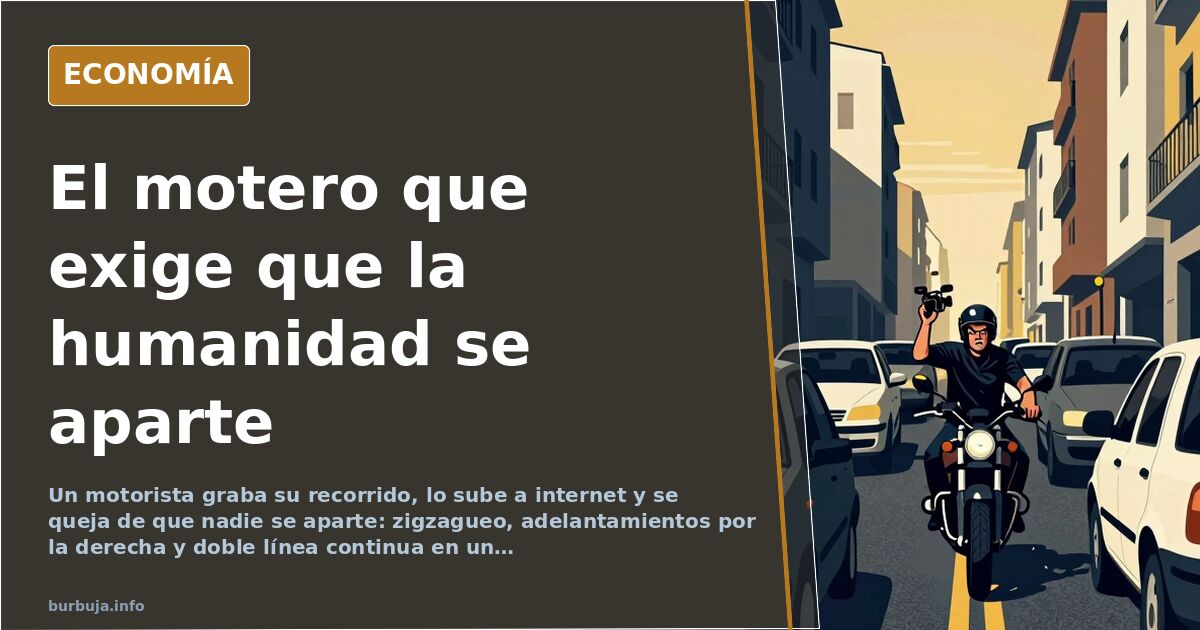
The biker who thinks everyone should clear the way
A motorcyclist records their urban route, posts it online, and complains that other drivers refuse to make room. The video, shared as proof of skill, becomes a catalog of prohibited actions: continuous weaving between vehicles, overtaking on the right, passing cars with less than a meter of clearance, and crossing double solid lines in a two-way tunnel. The prevailing response is immediate: the person recording isn't an expert; they are the problem.
What the rules say about motorcycle overtaking
The rule applies to everyone. A motorcycle is just another vehicle: if the lane is occupied, you must wait. There are no exceptions for agility, size, or urgency. Overtaking between two vehicles traveling in different lanes with less than one meter of separation is not an advanced maneuver; it is a abusa. And double solid lines in a two-way tunnel allow for no interpretation.
Some argue that filtering between stopped cars is tolerated and even useful for reducing congestion. The nuance matters: stopped. At thirty kilometers per hour, with moving traffic, the same maneuver ceases to be filtering and becomes a gamble. The video does not show stationary cars. It shows moving cars and a motorcycle looking for a gap that doesn't exist.
The double standard that angers drivers
The most repeated argument is not legal, but about fairness. Cars are expected to respect lateral safety distances and treat motorcycles as full vehicles, yet the motorcycle skips queues, squeezes through spaces where it doesn't fit, and reappears at the next traffic light. This scene repeats on any avenue: you struggle to overtake a bike or motorcycle, reach the traffic light, and the overtaken rider passes you again. Four times on the same street.
The other side is the driver who deliberately blocks the path. That exists too. A vehicle occupying half the left and half the right lane to block someone behind is not enforcing the law: it is committing another abusa. And when the blocker ends up pulled over on the shoulder with a patrol car behind them, the argument falls apart on its own.
Why the video backfires on the recorder
The camera does not absolve. It condemns. Every minute recorded is evidence of what was done, not what was suffered. The detail most highlighted is estimulante ilegal: the digital speedometer is clearly readable, showing thirty kilometers per hour on clear stretches and twenty when squeezing between cars. This is not a kamikaze driving at sixty. It is something more uncomfortable: someone who believes their rush justifies any maneuver.
And there is a calculation invisible in the video but known to anyone who drives daily: the difference between a dent and an injury. A minor hit to a car body is a bad day. The same hit to a motorcycle is an ambulance call. Emergency services have seen the result for decades: riders arriving with limbs separated from bodies, and patients ending up wheelchair-bound for life.
What you can and cannot do with a motorcycle in the city
Motorcycles have real and legal advantages: they are more agile, accelerate faster, and take up less space. This allows advancing with less room when traffic is stopped and returning to the lane without forcing anyone. What it does not permit is deciding that rules apply only to others. Riding between moving vehicles, overtaking on the right, and continuous weaving are illegal, and penalties do not depend on whether an accident occurs.
The underlying problem is not the motorcycle. It is the conviction that your personal hurry is someone else's emergency. That driver exists on bikes, scooters, e-scooters, and vans. The difference is that some appear in videos and others do not.
The video continues to circulate, and the Guardia Civil (Spanish police) has the frames. What does not appear in any frame is the data that settles the discussion: the speedometer reads thirty. They weren't even speeding.
Also available in: Deutsch
Summary of a discussion on Burbuja.info - Foro de economía, actualidad y política., translated from Spanish and reviewed before publication. Read the full discussion (109 replies).
More summaries
-
Guardia Civil IT outage coincides with director's indictment
A system-wide crash at Spain's Guardia Civil, timed with the director's indictment, fuels suspicions of selective data deletion.
-
Drug trafficking pushes Spain's Guardia Civil to the brink
The death of an officer in an anti-drug operation reopens the debate over the Spanish state's weakness against drug trafficking and the demand for a firm response.
-
BREAKING - Guardia Civil exposes Moroccan navy patrol boat in drug trafficking
The Guardia Civil has detailed in a report the collaboration of a Moroccan patrol boat with drug traffickers to bring drugs into Spain. A scandal that taints the Royal Moroccan Navy.
-
Mob attacks Barbate Civil Guard barracks one month after fatal narco-boat crash
Over 20 individuals storm a Barbate police station, threatening officers, shortly after two officers were killed by a drug boat in February.
-
Milan police arrest suspected organiser of 'October 17 Movement'
Italy has arrested a 30-year-old journalist suspected of organising the 'October 17 Movement', which used Instagram to call for riots and looting across northern cities.
-
Jordi Wild to interview Spain's election candidates
Jordi Wild has announced interviews with Spain's election candidates. Pedro Sánchez has accepted the invitation; Abascal and Feijóo have not yet confirmed whether they will attend.