
Mother kills disabled son in Valencia before suicide
A woman killed her 25-year-old son with Down syndrome and herself at a Valencia hotel. Police are investigating the motive.
English · Original discussion in Spanish · Published
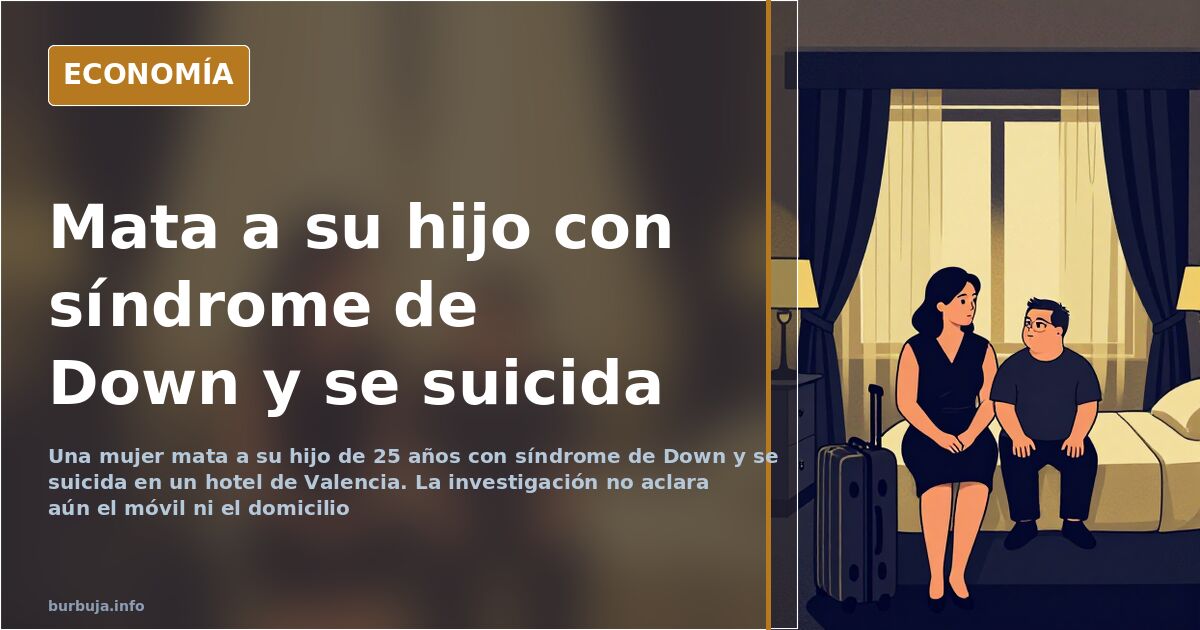
Mother kills son with Down syndrome and takes own life in Valencia
A Colombian-origin woman booked a room at a hotel in Valencia. Inside were she and her 25-year-old son, who has Down syndrome. Hours later, both were found dead, pointing to an extended suicide where the mother ended her son's life before taking her own. Neither their usual residence nor the motive has been released. The news, first reported by Levante-EMV, leaves an uncomfortable question: if the system had supported this woman, would her son still be alive?
Who cares for the caregiver?
When a person with high dependency turns 25, the support network that held them together has nearly unraveled. At that age, there is no longer school, pediatrician, or guaranteed day center. A child with Down syndrome may remain autonomous for decades or need help with basic tasks for life; the difference is not always the disability itself, but available money and support.
That support almost always falls on a direct relative: a mother, father, or partner. They assume a 24-hour shift without relief, holidays, or an end date. In these cases, a repeated pattern is also noted: the other parent disappears, and the entire family network shrinks to one person.
A whole life dedicated to another. Some say it plainly: caring for someone with chronic dependency and insufficient resources is daily torture. Others clarify that the drama is not only material. The caregiver's loneliness weighs as much as the bill, and when that person gets sick, ages, or breaks down, there is no Plan B.
The Dependency Law and its gaps
Public aid exists on paper. In practice, distribution falls short. The financial benefit under Spain's Dependency Law (Ley de la Dependencia) does not cover full professional care, and home assistance reaching most cases consists of someone coming daily to clean, feed, and bathe the dependent, but not staying 24 hours. Outside that window, the relative is again alone with the entire responsibility.
For the most severe cases, the alternative is usually a residential facility. Here appears the other edge: centers with tight staff ratios, waiting lists, and quality depending on each autonomous community's budget. Those arguing these places are the solution face a less pleasant reality.
The recurring conclusion is uncomfortable: the State accompanies, it does not replace. And when it does not replace, the emotional bill is paid by someone who signed no contract to do so.
How many infanticides and who commits them
Here the ground becomes slippery. A calculation circulating in debate claims that 70% of infanticides in Spain are committed by women. Another estimate, referring to 2019, splits 22 children murdered by a parent: 12 by mothers, 5 by fathers, and 5 by both. These figures do not come from unified official statistics, are interpreted conveniently by each side, and are wielded as political weapons before a single case is clarified.
The key distinction introduced by some analysis is that of extended suicide. If accepted as a category, the map changes completely. If rejected, each event is simply homicide, with no statistical mitigating factors or explanatory narrative.
Was it compassion or crime?
The compassionate narrative has defenders and detractors, neither moving from their position. Defenders insist the woman pitied her son: she did not want to leave him alone in a world that would not care for him. Detractors respond with common sense that dismantles the thesis: any parent has a thousand opportunities to end their child's life, and almost none do.
There lies the question no one answers. It is not why this woman did it, but what she had that others do not. When sought, the answer always points in the same direction: hopeless isolation, a possible untreated depressive disorder, and an administration that arrives too late.
Under that prism, the event ceases to be a sarracena case and becomes a public policy problem. And public policy, in this area, has lacked sufficient budget for years.
Unknowns: origin, hotel, and motive
What does not fit is the logistics. Both were of Colombian origin, but it has not been revealed where they lived or why the woman chose a hotel in Valencia to do what she did. Had they just arrived? Were their lodging days running out? Did social services know anything? No one has answered any of those questions, and the lack of answers fuels hypotheses.
Choosing a hotel is not accidental. Suicides in hotel establishments are relatively frequent: they guarantee no one enters the room for hours, the trail remains clear, and the place does not forever mark a family home. It is a cold decision within a desperate act. It is also proof, for those willing to see it, that the planner seeks no witnesses.
Twenty-two children. Twelve mothers. Five fathers. The circulated 2019 count does not distinguish between violence and compassion, between a crime and a collapse. It only counts bodies.
A Colombian-origin woman booked a room at a hotel in Valencia. Inside were she and her 25-year-old son, who has Down syndrome. Hours later, both were found dead, pointing to an extended suicide where the mother ended her son's life before taking her own. Neither their usual residence nor the motive has been released. The news, first reported by Levante-EMV, leaves an uncomfortable question: if the system had supported this woman, would her son still be alive?
Who cares for the caregiver?
When a person with high dependency turns 25, the support network that held them together has nearly unraveled. At that age, there is no longer school, pediatrician, or guaranteed day center. A child with Down syndrome may remain autonomous for decades or need help with basic tasks for life; the difference is not always the disability itself, but available money and support.
That support almost always falls on a direct relative: a mother, father, or partner. They assume a 24-hour shift without relief, holidays, or an end date. In these cases, a repeated pattern is also noted: the other parent disappears, and the entire family network shrinks to one person.
A whole life dedicated to another. Some say it plainly: caring for someone with chronic dependency and insufficient resources is daily torture. Others clarify that the drama is not only material. The caregiver's loneliness weighs as much as the bill, and when that person gets sick, ages, or breaks down, there is no Plan B.
The Dependency Law and its gaps
Public aid exists on paper. In practice, distribution falls short. The financial benefit under Spain's Dependency Law (Ley de la Dependencia) does not cover full professional care, and home assistance reaching most cases consists of someone coming daily to clean, feed, and bathe the dependent, but not staying 24 hours. Outside that window, the relative is again alone with the entire responsibility.
For the most severe cases, the alternative is usually a residential facility. Here appears the other edge: centers with tight staff ratios, waiting lists, and quality depending on each autonomous community's budget. Those arguing these places are the solution face a less pleasant reality.
The recurring conclusion is uncomfortable: the State accompanies, it does not replace. And when it does not replace, the emotional bill is paid by someone who signed no contract to do so.
How many infanticides and who commits them
Here the ground becomes slippery. A calculation circulating in debate claims that 70% of infanticides in Spain are committed by women. Another estimate, referring to 2019, splits 22 children murdered by a parent: 12 by mothers, 5 by fathers, and 5 by both. These figures do not come from unified official statistics, are interpreted conveniently by each side, and are wielded as political weapons before a single case is clarified.
The key distinction introduced by some analysis is that of extended suicide. If accepted as a category, the map changes completely. If rejected, each event is simply homicide, with no statistical mitigating factors or explanatory narrative.
Was it compassion or crime?
The compassionate narrative has defenders and detractors, neither moving from their position. Defenders insist the woman pitied her son: she did not want to leave him alone in a world that would not care for him. Detractors respond with common sense that dismantles the thesis: any parent has a thousand opportunities to end their child's life, and almost none do.
There lies the question no one answers. It is not why this woman did it, but what she had that others do not. When sought, the answer always points in the same direction: hopeless isolation, a possible untreated depressive disorder, and an administration that arrives too late.
Under that prism, the event ceases to be a sarracena case and becomes a public policy problem. And public policy, in this area, has lacked sufficient budget for years.
Unknowns: origin, hotel, and motive
What does not fit is the logistics. Both were of Colombian origin, but it has not been revealed where they lived or why the woman chose a hotel in Valencia to do what she did. Had they just arrived? Were their lodging days running out? Did social services know anything? No one has answered any of those questions, and the lack of answers fuels hypotheses.
Choosing a hotel is not accidental. Suicides in hotel establishments are relatively frequent: they guarantee no one enters the room for hours, the trail remains clear, and the place does not forever mark a family home. It is a cold decision within a desperate act. It is also proof, for those willing to see it, that the planner seeks no witnesses.
Twenty-two children. Twelve mothers. Five fathers. The circulated 2019 count does not distinguish between violence and compassion, between a crime and a collapse. It only counts bodies.
Summary of a discussion on Burbuja.info - Foro de economía, actualidad y política., translated from Spanish and reviewed before publication. Read the full discussion (153 replies).
More summaries
-
Vox Secures Education and Social Services in Valencia
Valencian government deal grants Vox a vice-presidency plus Education, Social Services and Agriculture portfolios. Language policy in schools is key.
-
First MP with Down Syndrome Takes Seat in Valencian Parliament
Mar Galceran becomes the first MP with Down syndrome in the Valencian Parliament, backed by 26 years of public service and adaptive exams.
-
Spain's housing decree: what Sánchez and allies are plotting
The housing decree is being voted on without being read, with suspicions it sneaks in measures unrelated to rental housing. Junts, PNV and Bildu will decide the outcome.
-
AI's Total Memory Ends Human Edge in Office
Sam Altman argues total memory, not reasoning, is AI's real leap. Debate: end of human advantage in office and who controls the data.
-
Spain Demolishes Legal 1934 Homes in Guardamar
Despite a Supreme Court ruling upholding the legality of homes on Babilonia Beach, demolition proceeds in 2025. Owners face €15,000 costs with no compensation.
-
Obama confirms aliens exist but says he has never seen them
Former US President Barack Obama stated on a podcast that extraterrestres are real, though he has not personally witnessed them, noting limited access to information.