
First MP with Down Syndrome Takes Seat in Valencian Parliament
Mar Galceran becomes the first MP with Down syndrome in the Valencian Parliament, backed by 26 years of public service and adaptive exams.
English · Original discussion in Spanish · Published
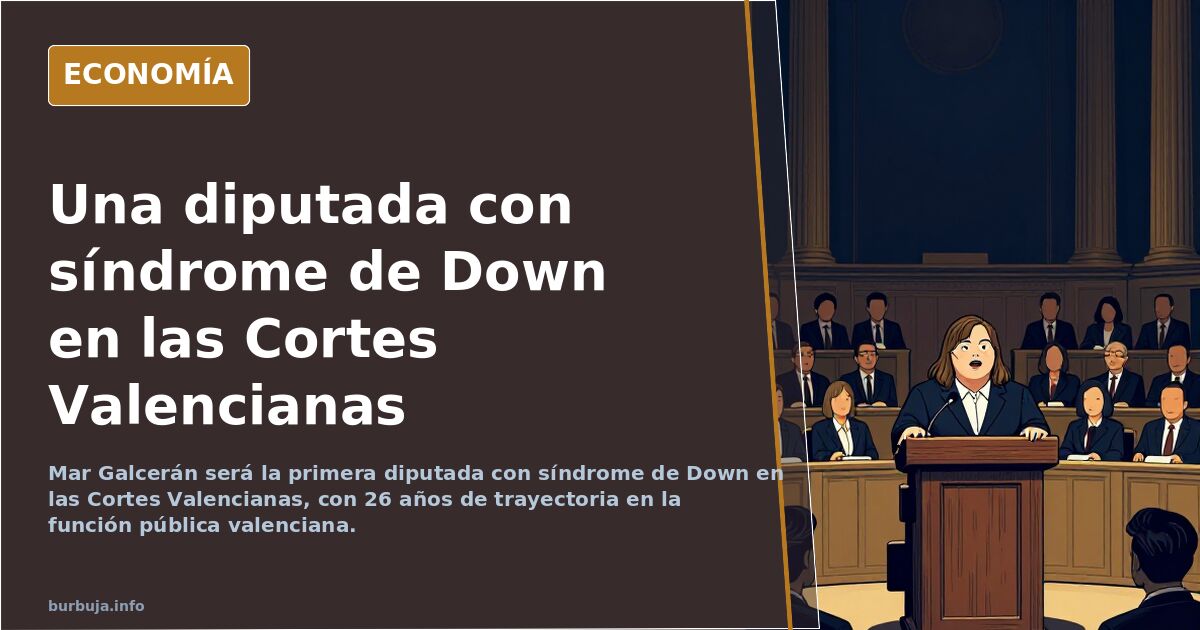
The first MP with Down Syndrome arrives at the Valencian Parliament
Mar Galceran has 26 years of experience in the Valencian public sector. Thirteen were spent as an interim worker at the Presidency Department. In 2010, she passed the first adaptive civil service exams for people with intellectual disabilities in Valencia. Since then, she has held various posts: Social Welfare, Equality, and now a junior role in the Health Department. Her next stop is not a department. It is a seat.
Galceran holds number 20 on the list for the People’s Party (PP) in Valencia, a personal choice by regional president Carlos Mazón. If elected, she will be the first person with Down syndrome to hold a seat in the Valencian Parliament. Her link to the party dates back two decades; she entered via the Young People’s branch and is now secretary for the disability area of the Valencian PP.
Who is Mar Galceran and what is her background
Her biography breaks the stereotype. She is not a newcomer or a last-minute hire. She has two decades of political involvement and a long administrative career across various departments, passing adaptive exams when such tests were rare in Spain. Those placing her on the list rely on this track record.
The surprising fact is the order of events. She enters the seat, if she does, via a party list, not an exam. Her administrative career was won through tests designed for people with intellectual disabilities. Politics, however, still operates on connections and trust.
Why does such a candidacy generate controversy?
Because it touches two nerves at once. The first is about quotas: some argue these appointments seek photo ops and political correctness over competence, while others reply that any MP arrives via party quota, not exams. The second is about capability. Some argue certain degrees of intellectual disability should not grant access to such a post; others counter that a seat practically involves pressing a button according to the group’s direction.
Here lies the issue. The most repeated criticism is not that Galceran cannot, but that the institution she joins does not demand much. When the bar for the role is assumed to be low, the argument of incapacity loses strength. It is a problem of the chamber, not of who enters it.
Paternalism and comparison with other MPs
Another, more uncomfortable current, labels her decorative. It is argued that placing a person with Down syndrome in a seat without real decision-making power is a form of sarracena exhibitionism, and the group will assign advisors to do the work. Unconfirmed rumors even suggest some PP MPs might act as tutors. This fuels the theory of her being an ornament, but no one has verified it.
The classic comparison also appears: why not a judge with Down syndrome, or a police officer with Alzheimer’s? This question arises when symbolic representation is mixed with technical competence. The blunt response from others is that the average level of Parliament does not withstand such scrutiny applied to anyone.
What do those defending the measure say?
The favorable side relies on another idea: representation. A group that exists, votes, and pays taxes has the right to be seen in a chamber. If intellectual disability is not represented, policies affecting them are designed without those who live them. From this perspective, the seat is not a favor, but a pending debt.
There is a third, more cynical line: this MP is assumed less likely to steal than the rest. It sounds like a joke, but several comments cite it as evidence of how much public perception of the political class has degraded. When honesty is attributed to the one with the least power, the criticism is not against her.
The cost and size of the institution
Accounts also come into play. Some calculate that her salary will bring two or three more advisors to cover functions she cannot perform alone, though this cost has not been quantified. The underlying question remains unanswered: how many MPs are really needed in an autonomous chamber, and how many work under a de facto tutor without anyone calling it so.
Uncomfortable conclusion for all. If the seat demands little, disability is not the argument. If it demands much, the problem is that the system has placed people there for years who also fail the filter. Galceran passed the first adaptive exam in Valencia in 2010. Thirteen years later, the seat comes via a list.
Mar Galceran has 26 years of experience in the Valencian public sector. Thirteen were spent as an interim worker at the Presidency Department. In 2010, she passed the first adaptive civil service exams for people with intellectual disabilities in Valencia. Since then, she has held various posts: Social Welfare, Equality, and now a junior role in the Health Department. Her next stop is not a department. It is a seat.
Galceran holds number 20 on the list for the People’s Party (PP) in Valencia, a personal choice by regional president Carlos Mazón. If elected, she will be the first person with Down syndrome to hold a seat in the Valencian Parliament. Her link to the party dates back two decades; she entered via the Young People’s branch and is now secretary for the disability area of the Valencian PP.
Who is Mar Galceran and what is her background
Her biography breaks the stereotype. She is not a newcomer or a last-minute hire. She has two decades of political involvement and a long administrative career across various departments, passing adaptive exams when such tests were rare in Spain. Those placing her on the list rely on this track record.
The surprising fact is the order of events. She enters the seat, if she does, via a party list, not an exam. Her administrative career was won through tests designed for people with intellectual disabilities. Politics, however, still operates on connections and trust.
Why does such a candidacy generate controversy?
Because it touches two nerves at once. The first is about quotas: some argue these appointments seek photo ops and political correctness over competence, while others reply that any MP arrives via party quota, not exams. The second is about capability. Some argue certain degrees of intellectual disability should not grant access to such a post; others counter that a seat practically involves pressing a button according to the group’s direction.
Here lies the issue. The most repeated criticism is not that Galceran cannot, but that the institution she joins does not demand much. When the bar for the role is assumed to be low, the argument of incapacity loses strength. It is a problem of the chamber, not of who enters it.
Paternalism and comparison with other MPs
Another, more uncomfortable current, labels her decorative. It is argued that placing a person with Down syndrome in a seat without real decision-making power is a form of sarracena exhibitionism, and the group will assign advisors to do the work. Unconfirmed rumors even suggest some PP MPs might act as tutors. This fuels the theory of her being an ornament, but no one has verified it.
The classic comparison also appears: why not a judge with Down syndrome, or a police officer with Alzheimer’s? This question arises when symbolic representation is mixed with technical competence. The blunt response from others is that the average level of Parliament does not withstand such scrutiny applied to anyone.
What do those defending the measure say?
The favorable side relies on another idea: representation. A group that exists, votes, and pays taxes has the right to be seen in a chamber. If intellectual disability is not represented, policies affecting them are designed without those who live them. From this perspective, the seat is not a favor, but a pending debt.
There is a third, more cynical line: this MP is assumed less likely to steal than the rest. It sounds like a joke, but several comments cite it as evidence of how much public perception of the political class has degraded. When honesty is attributed to the one with the least power, the criticism is not against her.
The cost and size of the institution
Accounts also come into play. Some calculate that her salary will bring two or three more advisors to cover functions she cannot perform alone, though this cost has not been quantified. The underlying question remains unanswered: how many MPs are really needed in an autonomous chamber, and how many work under a de facto tutor without anyone calling it so.
Uncomfortable conclusion for all. If the seat demands little, disability is not the argument. If it demands much, the problem is that the system has placed people there for years who also fail the filter. Galceran passed the first adaptive exam in Valencia in 2010. Thirteen years later, the seat comes via a list.
Summary of a discussion on Burbuja.info - Foro de economía, actualidad y política., translated from Spanish and reviewed before publication. Read the full discussion (261 replies).
More summaries
-
Heat doesn't scare builders: their salary does
Construction workers earn around 1,300 euros monthly, barely covering Madrid's 1,200-euro rent. Generational renewal fails due to low pay, not summer heat.
-
Why Internet discussion forums are emptying out
Discussion forums are losing users to AI and the short attention spans of younger generations. The signal-to-noise ratio is degrading and engagement is plummeting.
-
The Sofa Video: Domestic Scolding as a Viral Format
A couple posts Instagram videos where she scolds her partner about the sofa. The format goes viral: real relationship or clickbait?
-
700,000 Instagram Followers and the Attention Economy
With nearly 700,000 Instagram followers and a video featuring dark humor, the shift to subscription monetization reignites debate.
-
Smartphone Addiction: Designed to Hook, Unregulated
Pedestrians ignored green lights while glued to phones. Experts blame intentional design features that foster compulsive usage.
-
Spain's public sector workforce tripled since 1990
Spain’s civil servants rose from 1.2 million in 1990 to nearly 3 million. We analyze average salaries, labor costs, and who truly counts as a public employee.