
Obama confirms aliens exist but says he has never seen them
Former US President Barack Obama stated on a podcast that extraterrestres are real, though he has not personally witnessed them, noting limited access to information.
English · Original discussion in Spanish · Published
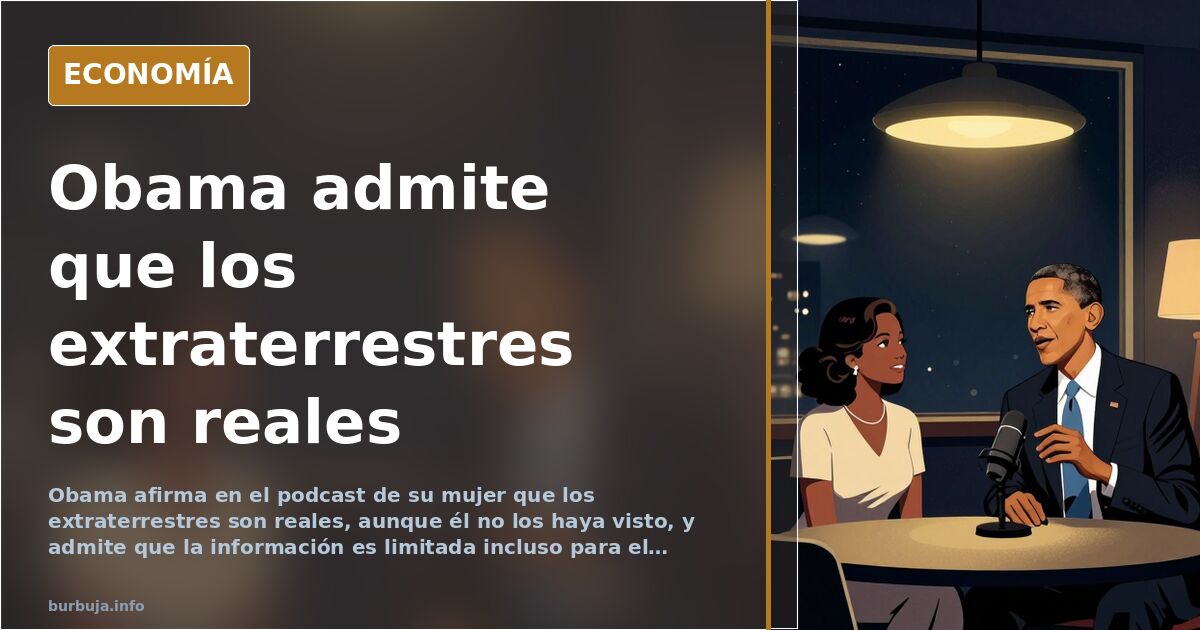
Obama confirms aliens exist but says he has never seen them
Barack Obama dropped the news on his vvife's podcast just days ago: extraterrestrials "are real," although he has never personally seen one. He said it with such casual confidence. Coming from a former US president, this carries far more weight than any pundit's opinion, reopening an issue that had been shelved for months: the unfulfilled promise to declassify all files on unidentified aerial phenomena.
The detail circulating most widely is not the confession itself, but the fine print. In the same audio clip, Obama asserts that information on this subject is "even very limited for the President of the United States." In other words, the man who had access to the planet's largest catalog of secrets claims he didn't even see the full dossier. That is where the conversation splits in two.
What exactly did Obama say and why does it matter?
The statements were made on his vvife's podcast and have circulated as video clips on social media. There, the former president confirms the existence of these phenomena but distances himself from any personal contact. The formulation is standard: acknowledging without committing.
For part of the public, this is a historic admission. For others, it is yet another smokescreen. Comparisons to the declassification promise attributed to the previous White House occupant—which should have resolved the issue by now—appear in nearly every response. Or were they threatened?, many ask, half-jokingly.
The Fermi Paradox: Why saying "we can't be alone" isn't enough
The most repeated argument in favor of extraterrestrial life is probability: with so many planets, it is mathematically unlikely that there is nothing out there. The problem, technical voices point out, is that this reasoning confuses possibility with certainty.
Calculating a probability requires two things: how often a phenomenon occurs and over how many attempts. If we don't know how difficult it is for life to emerge from inert matter (abiogenesis), we cannot assert anything. The Fermi paradox, the sniper fallacy, and selection bias come into play here. The uncomfortable conclusion: life may exist, but there is a vast gap between that and intelligent life building ships and choosing Earth.
The distance problem: Not even to Proxima Centauri
Even accepting that millions of civilizations exist, the bottleneck is physical. The closest star, Proxima Centauri, is light-years away. Andromeda, the neighboring galaxy, is hundreds of thousands of light-years distant. With current technology, travel isn't even considered.
This is the argument that dismantles the fantasy of contact: the universe is vast and mostly empty. That something is possible doesn't make it probable, and that it is probable doesn't make it visitable. Distance is the most effective filter that exists.
From Martians to demons: Competing theories in the same space
Where some see spacecraft, others see something much older. One school of thought holds that what manifests are not extraterrestrials but entities of another order, present in all human cultures and today reduced to superstition by the dominant scientific narrative. Occam's razor, they argue, explains everything at once.
Another line, more earthly, points to Project Blue Beam: a social engineering operation using a fake extraterrestrial revelation to reorder the economic and geopolitical board. A third, more pedestrian view reduces it to pure entertainment: keeping the population distracted with little green men while what really matters is decided. These are hypotheses raised by debate participants, not verified facts.
The business of revelation: Who profits from the mystery?
There is an angle almost no one discusses: the topic sells. TV shows, podcasts, books, and documentaries thrive on keeping the question open. Every statement by a public figure is a new chapter, and each chapter brings a new audience.
That doesn't invalidate the debate, but it contaminates it. When mystery is profitable, solving the mystery is bad business. Total declassification, if it ever comes, will take down an entire ecosystem.
The disorienting fact remains. The former president of the power that has dedicated the most resources to studying the phenomenon says the information is limited even for whoever occupies the Oval Office. If that is true, the question is no longer whether they exist. It is who decides that we shouldn't know.
Barack Obama dropped the news on his vvife's podcast just days ago: extraterrestrials "are real," although he has never personally seen one. He said it with such casual confidence. Coming from a former US president, this carries far more weight than any pundit's opinion, reopening an issue that had been shelved for months: the unfulfilled promise to declassify all files on unidentified aerial phenomena.
The detail circulating most widely is not the confession itself, but the fine print. In the same audio clip, Obama asserts that information on this subject is "even very limited for the President of the United States." In other words, the man who had access to the planet's largest catalog of secrets claims he didn't even see the full dossier. That is where the conversation splits in two.
What exactly did Obama say and why does it matter?
The statements were made on his vvife's podcast and have circulated as video clips on social media. There, the former president confirms the existence of these phenomena but distances himself from any personal contact. The formulation is standard: acknowledging without committing.
For part of the public, this is a historic admission. For others, it is yet another smokescreen. Comparisons to the declassification promise attributed to the previous White House occupant—which should have resolved the issue by now—appear in nearly every response. Or were they threatened?, many ask, half-jokingly.
The Fermi Paradox: Why saying "we can't be alone" isn't enough
The most repeated argument in favor of extraterrestrial life is probability: with so many planets, it is mathematically unlikely that there is nothing out there. The problem, technical voices point out, is that this reasoning confuses possibility with certainty.
Calculating a probability requires two things: how often a phenomenon occurs and over how many attempts. If we don't know how difficult it is for life to emerge from inert matter (abiogenesis), we cannot assert anything. The Fermi paradox, the sniper fallacy, and selection bias come into play here. The uncomfortable conclusion: life may exist, but there is a vast gap between that and intelligent life building ships and choosing Earth.
The distance problem: Not even to Proxima Centauri
Even accepting that millions of civilizations exist, the bottleneck is physical. The closest star, Proxima Centauri, is light-years away. Andromeda, the neighboring galaxy, is hundreds of thousands of light-years distant. With current technology, travel isn't even considered.
This is the argument that dismantles the fantasy of contact: the universe is vast and mostly empty. That something is possible doesn't make it probable, and that it is probable doesn't make it visitable. Distance is the most effective filter that exists.
From Martians to demons: Competing theories in the same space
Where some see spacecraft, others see something much older. One school of thought holds that what manifests are not extraterrestrials but entities of another order, present in all human cultures and today reduced to superstition by the dominant scientific narrative. Occam's razor, they argue, explains everything at once.
Another line, more earthly, points to Project Blue Beam: a social engineering operation using a fake extraterrestrial revelation to reorder the economic and geopolitical board. A third, more pedestrian view reduces it to pure entertainment: keeping the population distracted with little green men while what really matters is decided. These are hypotheses raised by debate participants, not verified facts.
The business of revelation: Who profits from the mystery?
There is an angle almost no one discusses: the topic sells. TV shows, podcasts, books, and documentaries thrive on keeping the question open. Every statement by a public figure is a new chapter, and each chapter brings a new audience.
That doesn't invalidate the debate, but it contaminates it. When mystery is profitable, solving the mystery is bad business. Total declassification, if it ever comes, will take down an entire ecosystem.
The disorienting fact remains. The former president of the power that has dedicated the most resources to studying the phenomenon says the information is limited even for whoever occupies the Oval Office. If that is true, the question is no longer whether they exist. It is who decides that we shouldn't know.
Summary of a discussion on Burbuja.info - Foro de economía, actualidad y política., translated from Spanish and reviewed before publication. Read the full discussion (140 replies).
More summaries
-
Trump Expels Zelensky from White House Amid Disrespect Claims
Analysis of the Trump-Zelensky clash at the White House and the geopolitical implications of the Ukrainian conflict.
-
Joan Donovan warns US militias preparing for civil war
Disinformation expert Joan Donovan argues US militias are gearing up for civil conflict, citing social media as key infrastructure.
-
Europe calls for water and food stockpiling amid possible Russian attack
Switzerland joins Germany, Poland, France, and Finland recommending water and food stockpiling ahead of potential Russian attack.
-
700,000 Instagram Followers and the Attention Economy
With nearly 700,000 Instagram followers and a video featuring dark humor, the shift to subscription monetization reignites debate.
-
Smartphone Addiction: Designed to Hook, Unregulated
Pedestrians ignored green lights while glued to phones. Experts blame intentional design features that foster compulsive usage.
-
Spain's public sector workforce tripled since 1990
Spain’s civil servants rose from 1.2 million in 1990 to nearly 3 million. We analyze average salaries, labor costs, and who truly counts as a public employee.