
Mossos police chief calls Barcelona riots 'inexplicable' after 128 arrests
The head of Catalonia's Mossos d'Esquadra police force describes riots in Barcelona that left 128 arrested, 72 of them minors, as 'inexplicable', saying the pattern copied events in France.
English · Original discussion in Spanish · Published
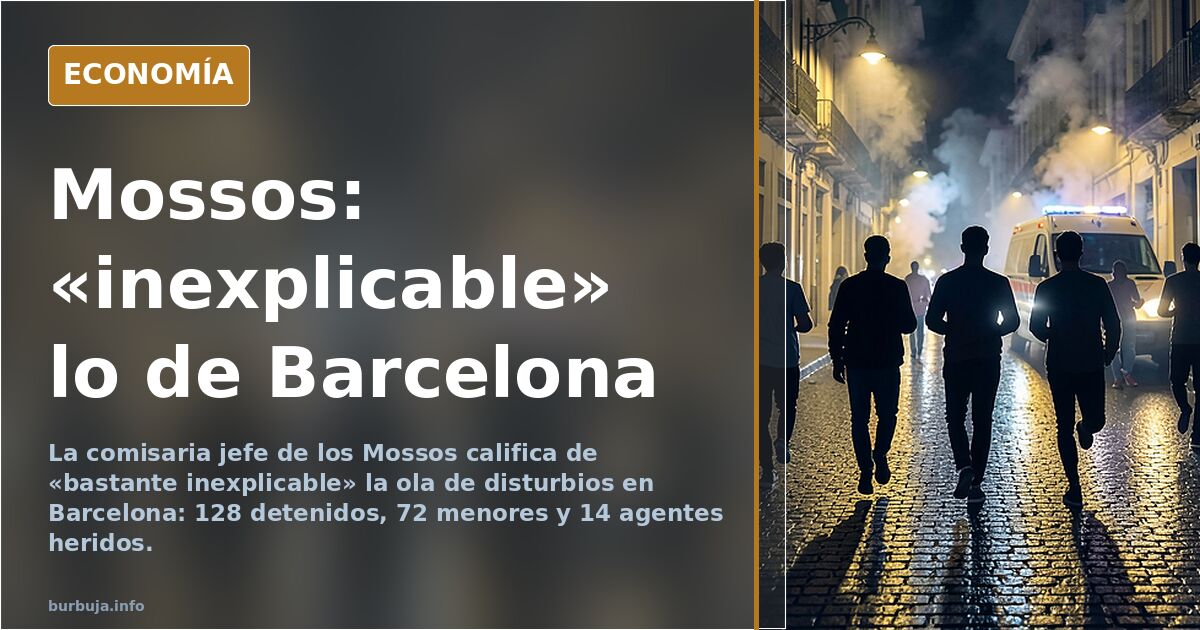
Mossos police chief calls wave of riots that left 128 arrested 'inexplicable'
The head of the Mossos d'Esquadra, Catalonia's regional police force, commissioner Silvia Catà, on Sunday described the dynamics of the riots of Saturday 24 October around Barcelona's Plaça de Catalunya as 'quite inexplicable'. The gathering, spread on social media under the 'Blocus' tag and mostly through TikTok, descended into incidents and clashes with the regional police. The provisional toll: at least 128 arrested, 72 of them minors, with detentions reaching down to 14 years of age. Catà herself admitted that the call to gather was meant to 'mirror' the movement operating in France and copy the disturbances seen there in recent weeks.
The episode leaves an uncomfortable question: if the pattern was known and was already being replicated across Europe, why did the police response arrive late and with scarce resources?
What peine on 24 October at Plaça de Catalunya
Dozens of students gathered on Saturday afternoon at Plaça de Catalunya in a protest called via social media. The gathering descended into incidents and clashes with the Mossos. The police chief described the participants as 'people who gather in very small groups committing acts of vandalism', and stressed that they were not 'groups of young people or people wishing to demonstrate to claim some right'. Among the injured were 14 Mossos officers and one from the Urban Guard.
The timeline of the afternoon is the most disputed point. When the riots began, according to the account circulating among debate participants, there were only two BRIMO riot vans in the square chasing the hooded youths among people who were simply spending the day there. The storming of a shopping centre with customers unconnected to the protest inside is, for much of that analysis, the most serious moment: people trapped in a shopping arcade to shelter from the riots.
The French pattern nobody wanted to anticipate
The police chief herself acknowledged that the call to gather sought to replicate what had peine in France. That admission clashes with the 'inexplicable' label: if the script was being copied across Europe, the element of surprise loses force. The discussion then shifts to planning. Was the gathering underestimated? Was the deployment too thin? Or was there simply no intention of getting ahead of it?
Some argue that the 'Blocus' tag and its spread on TikTok were traceable and that monitoring came after the incidents, not before. The commissioner explained that work is under way to find out who is behind that network. The question is why that monitoring was not activated when the pattern was already visible in the neighbouring country.
Who is behind the TikTok calls to gather
The investigation is focused on anonymous profiles spreading slogans under the 'Blocus' tag. There is no identified structure so far, and Catà herself insisted they are 'totally disorganised' groups. That disorganisation complicates attribution, but it also weakens the surprise argument: a decentralised phenomenon replicated through social media is, by definition, easier to detect in its propagation phase than at the moment of execution.
On the economic front, the debate drifted towards the cost of living. Some in the thread argue that with oil above 100 dollars — it touched 117 this week, according to that same calculation — and housing prices soaring, the breeding ground for protests against inflation and unaffordability is set for all of 2027. The link between prices and riots is not automatic, but the French and Belgian precedent is cited as a mirror.
The official account and its cracks
Catà's press conference produced quotes for the archive. 'They did not expect this violence from a disorganised group,' she said. And she warned that such a gathering must not be repeated because 'social rights and demands cannot be confused with incivil acts'. The framework is reasonable. The problem is that the police chief who calls the phenomenon inexplicable is the same one who should have foreseen it.
The most critical reading points to an official appointed so as not to embarrass the politician who appointed her. The hypothesis cannot be verified, but it circulates widely in the debate: the incompetence on display protects the political leadership. Meanwhile, the debate over the nature of the organisers — whether they are students, organised groups, or whether there is foreign funding — remains without a documented answer.
What is at stake for Catalan politics in this episode
The episode comes with the Catalan government, the Govern, in a delicate position. The Interior Ministry of the regional government will have to explain why social media monitoring did not prevent the gathering, and why the initial deployment was so small. The opposition already has its frame: if the pattern was known, surprise is not an explanation, it is an excuse.
The prediction, with reservations: if the phenomenon recurs — and the signs suggest the cost of living and youth hyperconnectivity favour it — the question will stop being why the commissioner did not understand it and become why nobody resigned. For now, 128 arrests and one word, 'inexplicable', that will haunt the leadership of the Mossos for longer than their advisers calculate.
Summary of a discussion on Burbuja.info - Foro de economía, actualidad y política., translated from Spanish and reviewed before publication. Read the full discussion (114 replies).
More summaries
-
Leire Martínez: Weight and the Price of Image in Music
Leire Martínez, ex-LOVG, faces menopause and scrutiny over her weight. How much does appearance condition an artist? Analysis with data and real cases.
-
Allegations of election meddling in Brazil as Pedro Sánchez takes notes
The runoff between Bolsonaro and Lula da Silva is marked by a two-hour extension of polling station hours and 60% support for Lula among overseas voters. Click through for the data.
-
Spain's 29N election: forum users weigh tactical voting, abstention and punishment votes
A forum thread frames Spain's 29N vote as a contest between tactical voting, abstention and punishing the parties. Arguments and opinions from participants.
-
Cloning MB's Hotel with AI: an afternoon of code and legal doubts
A hobbyist recreates MB's Hotel with Claude Code in a single afternoon and debates Hasbro's copyright and the barrier to commercializing it.
-
Vucic concedes defeat in Serbia after masked men gather in Belgrade
Vucic concedes defeat in Serbia after dozens of masked men and riot police gathered in Belgrade as polls closed.
-
What Sánchez will do if he loses: from opposition to immunity
Sánchez will not resign if he loses: most expect him to try to lead the opposition, but parliamentary immunity could land him in pre-trial detention within months.