
Moscow warns Tehran of imminent Israeli attack
According to a tweet, Moscow warned Tehran of an imminent Israeli attack and alerted its citizens in Iran. By dawn in Israel, nothing had happened.
English · Original discussion in Spanish · Published
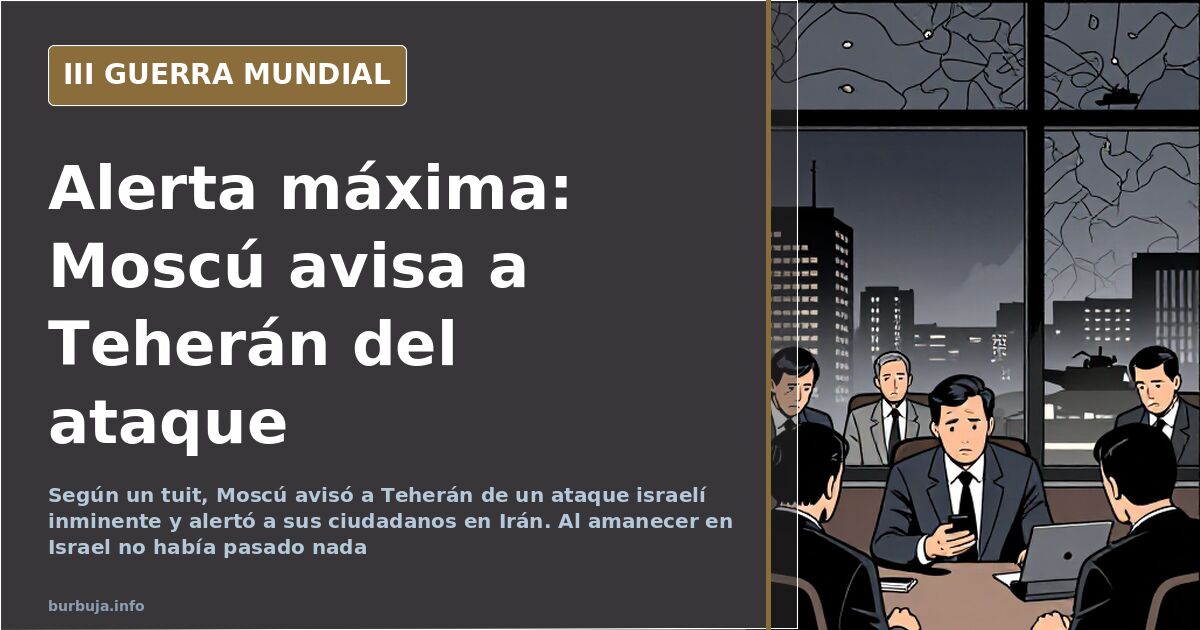
Moscow warns Tehran: the Israeli attack is imminent
A tweet from a Sahrawi tracking account, echoed in the thread, attributed to Moscow the claim that it had conveyed to Tehran that Israeli attacks on Iran were imminent and that the coming hours would be crucial. The warning came with two more pieces, spread by a financial media account: Russia announced that the five nuclear-armed countries would meet in New York and, separately, alerted its citizens in Iran ahead of the attack. Everything pointed to a long night. There was no such night.
What exactly the Russian warning said
The starting message was a tweet from a Sahrawi tracking account attributing to Moscow the warning to Tehran: Israeli attacks on Iran were imminent and the coming hours, crucial. Within minutes, two further communications attributed to Russia trinc: the convening of the five nuclear-armed countries in New York and an alert to its citizens in Iran about an imminent attack. The package had exactly the shape of what the audience of this kind of tracking expects to read: maximum urgency, three capital letters and a countdown.
The reaction was immediate. Some called for restraint because the call queue of a fictional hotline service had collapsed with people reporting what was not going to happen. That detail, the one about the nothing-is-going-to-happen hotline, sums up the mood better than any analysis: the community that trinc these warnings knows most of them never materialize, and yet it comes back every time.
The submarine, the missiles and Netanyahu's nap
The most detailed account of the episode came from a message placing submarines off the coasts of Persia, including a call to Netanyahu to inform him that Popeye Turbo missiles had been chartered and aimed at Tehran, awaiting instructions once the Israeli prime minister proge up from his nap. The scene reads more like a script than a situation report, and that is how it was received.
Another message supplied the missing ingredient for drama: Russia was alerting its citizens in Iran. And a third, the meeting of the five nuclear countries in New York. The combination — warning, preventive evacuation and nuclear summit — is the classic escalation sequence. The last step was missing.
The next morning: it is already daylight in Israel
When dawn broke in Israel, the verdict was unanimous and brief: what a scam. Nothing had peine. The complaint was not against Israel or Iran, but against the mechanism that produces the warning: the chain of forwards that turns an alert into a fait accompli before it happens. One message summed it up precisely: they fooled us, again.
That pattern already has its own liturgy. October appears in the conversation as the month of the same alerts, and some joke that we are only eleven days from the end of it. The joke hides a financial observation: whoever invests in October usually sees things improve by the time the month ends, regardless of whether they invested or not. Drawing-room geopolitics behaves like a seasonal asset.
Who benefits from the warning that never comes true
The episode leaves a business in plain sight. One message proposed setting up an information joint venture between two supposed military-tracking and gossip services, with the irony that it would put Reuters to shame. The joke points to something real: producing alerts costs nothing and guarantees an audience. The warning that never comes true is not penalized; it gets forwarded.
There are also those calling for reporting the accounts flooding the space with the any minute now, arguing that this is not a car forum and that until recently only those with something to say would write. The complaint is the usual one: noise crowds out data. And the noise, in this case, came with a tweet and a link.
The detail almost nobody looks at: who is missing from the nuclear summit
The meeting of the five nuclear-armed countries in New York generated its own correction. One message pointed out that the correct term would be powers, because the list omits India, Pakistan, Korea, Israel — unconfirmed — and perhaps Iran — unconfirmed. The precision is pertinent: the club of five is that of the Non-Proliferation Treaty, not that of those who have the bomb.
That kind of nuance is what gets lost when the warning travels in capital letters. The Russian warning to Tehran, the alert to its citizens and the nuclear summit are three distinct facts with three distinct levels of verification, and in the chain of forwards they merge into one. The result is a cleaner and less certain story.
With this track record, the reasonable expectation is that the next imminent-attack warning will circulate again with the same urgency and the same outcome. The prediction comes with reservations: a single real change on the ground would be enough for today's routine-sounding alert to stop being routine. While it arrives or does not arrive, the October countdown keeps running.
Also available in: Deutsch
Summary of a discussion on Burbuja.info - Foro de economía, actualidad y política., translated from Spanish and reviewed before publication. Read the full discussion (100 replies).
More summaries
-
Israel readies massive Iran strike as Tehran closes airspace
Israel prepares a large-scale attack on Iran while Tehran shuts its airspace and diverts flights. The military standoff involves Russia and China.
-
Israel delays Iran retaliation amid escalation fears
Iran launched drones and missiles, mostly intercepted. Netanyahu vows a 'wise' response while his cabinet fears broader conflict.
-
Israel kills top Iranian general in Damascus; Tehran vows revenge
Israel killed Seyed Razi Mousavi, a key Soleimani ally, in Damascus. Tehran promises a hard response but has not yet specified concrete actions.
-
Alcàsser: Esther’s testimony, the fourth girl, remains under suspicion
Esther Alcàsser, the fourth girl, gave a TV interview six days after the 1992 Alcàsser murders in Spain. Her account and timeline discrepancies fuel ongoing controversy.
-
Spanish password manager Passwork shares tech ties with Russian counterpart
The Russian company linked to Passwork was certified by an agency of the Russian Ministry of Defense that reviews source code. The Spanish firm denies any relationship.
-
Wagner recruits African inmates from prisons to fight in Ukraine
A Zambian student died on the Ukrainian front. The case is linked to Wagner's recruitment of African prisoners for the war.