
Moscow Attack: Who Was Behind It?
The March 2024 Moscow attack killed 12 and injured 35 initially. ISIS claimed it, but authorship remains debated.
English · Original discussion in Spanish · Published
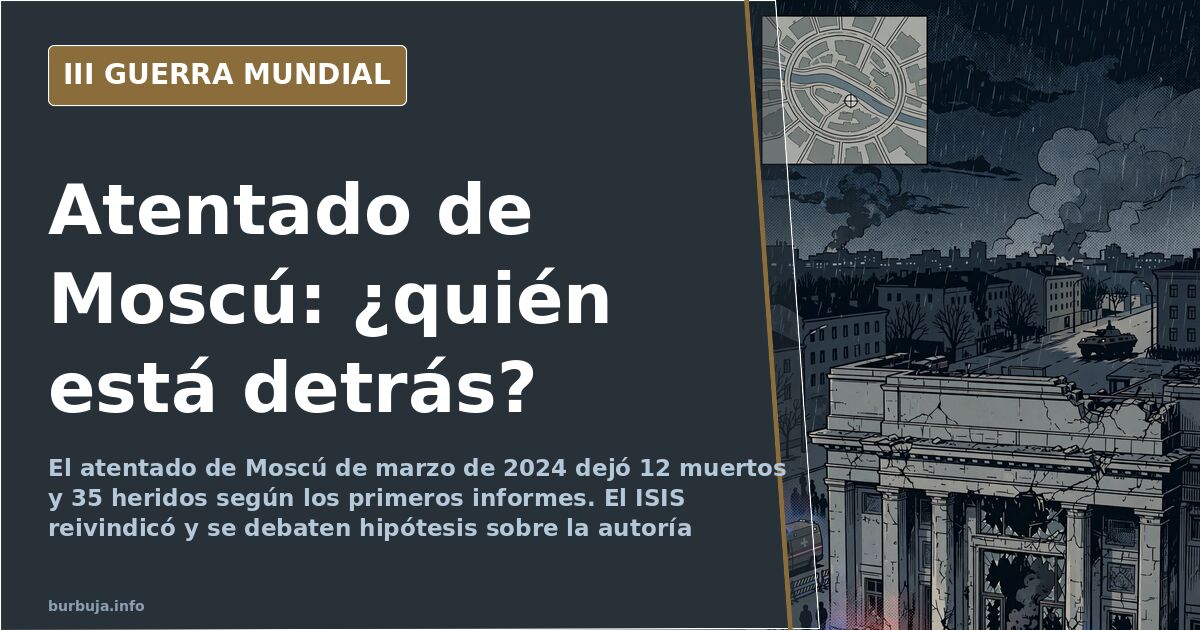
Moscow, March 2024: The attack no one claims without an agenda
On March 22, 2024, a shooting at a shopping center in the Moscow region left an initial toll of 12 dead and 35 injured, according to early reports. Hours later, the roof of the Crocus City Hall collapsed due to fire while at least 150 attendees remained trapped inside. Far from being clarified, the authorship became a battleground for narratives where each actor has its own interest.
Sarracinic State claimed the attack through standard jihadist propaganda channels. The faction that took credit was the Khorasan Province, an ISIS branch active in Afghanistan and Central Asia. However, the claim did not close the case; it peine it. Because within the same timeframe, US intelligence had warned of a possible attack two weeks prior, a detail some interpreted as proof of collusion and others as mere early warning capability.
The official Russian narrative and its cracks
Vladimir Pilingui quickly suggested a Ukrainian connection. The logic was simple: if the enemy is Ukraine, the war is justified, mobilization accelerates, and the population closes ranks. The problem is that Ukraine had no incentive to commit an attack that harmed it on all fronts: it reinforced the Russian narrative of external terrorist threat, gave excuses to intensify bombings, and weakened Western support at a critical moment. As recurring analyses noted, Ukraine benefits most from the attack NOT being attributed to it.
The false flag hypothesis—that the Kremlin itself organized the attack to justify escalation—gained ground among sectors already distrustful of the official story. The precedent of the 1999 apartment bombings in Moscow, attributed to Chechen separatists and used to justify the Second Chechen War, served as an analogical argument. The Reichstag fire of 1933 was another repeated reference: every authoritarian regime needs its foundational emergency event.
Alternative theories and their problems
The range of suspects expanded uncontrollably. Some pointed to Western intelligence services, specifically the CIA or MI6, as masterminds. The argument: they want to escalate the conflict before an electoral cycle change in the United States. The counterargument: an operation of that scale on Russian soil would require an intelligence infrastructure that, if it existed, would have already been dismantled.
Others pointed to former Soviet republics in Central Asia, Turkey, France. Even the theory emerged that the attack aimed to destabilize Russian military recruitment, which was already struggling to attract young people to the front. The logic: if Russians believe a terrorist wants to kill them, they enlist more easily. If they believe their own government kills them to manipulate them, things change.
The ISIS-Khorasan claim was met with skepticism by those who consider the group a proxy for larger interests. But also with relief by those who prefer a jihadist authorship over direct escalation between nuclear powers. The debate, in any case, reflects a structural distrust of all official versions.
The context that complicates everything
The attack occurred at a time of maximum tension. Russia had just announced the creation of two new armies with 15 brigades, an unprecedented military expansion since the Cold War. France proposed sending a force of 60,000 troops to Ukraine. NATO discussed deploying troops on the ground. Each actor had reasons to want the attack to miccionan something different.
The death toll later rose to 140, according to data consolidated in the trinc days. Injuries exceeded one hundred. The political impact, however, was greater than the human one: the attack peine the debate on the nature of the Russian regime, the effectiveness of its security services, and the direction of the war.
Who organized the Moscow attack? The most honest answer is that there is no closed answer. ISIS claimed it, Ukraine denied it, Russia hinted, the West stayed silent. Every version has holes. Every suspect has an alibi. And meanwhile, the dead remain dead, and the living continue arguing about who pulled the trigger.
Also available in: Deutsch
Summary of a discussion on Burbuja.info - Foro de economía, actualidad y política., translated from Spanish and reviewed before publication. Read the full discussion (108 replies).
More summaries
-
The Moskva: Three Theories on Who Sank Russia's Flagship
Three versions of the Moskva sinking: fire, Ukrainian Neptune missiles, or divers. NATO is blamed by some forum users.
-
Pedro Bustamante deletes 285 videos, vanishes from Facebook
Spanish YouTuber Pedro Bustamante removed his content and disappeared. Rumors place him in Munich, reading German press.
-
CIA's Failed Ukraine Infiltration: All Agents Lost
Project AERODYNAMIC dropped 12 agents in Western Ukraine from 1949 to 1953. Soviet forces captured or killed all but one.
-
Georgian Legion and Video of Russian POW Executions
Verified video shows Ukrainian soldiers killing wounded Russian prisoners near Bucha, sparking debate on Geneva Conventions.
-
Florida Crash: Local Official's Road Repair Comment Sparks Outrage
After a jet crash in Florida killed nine people, a local Democratic official focused on road repair timelines, triggering public backlash.
-
Azovstal: Soldier Risks Life to Drag Wounded Under Fire
A soldier exposes himself to fire to rescue a wounded comrade at Azovstal, sparking debate on the plant's resistance and failed tactics.