
Mortadelo Through Ayn Rand's Lens: What the Comic Teaches
Analyzing the thesis that Mortadelo y Filemón trained Spaniards in botching, using Ayn Rand's aesthetic and Lazarillo's picaresque.
English · Original discussion in Spanish · Published
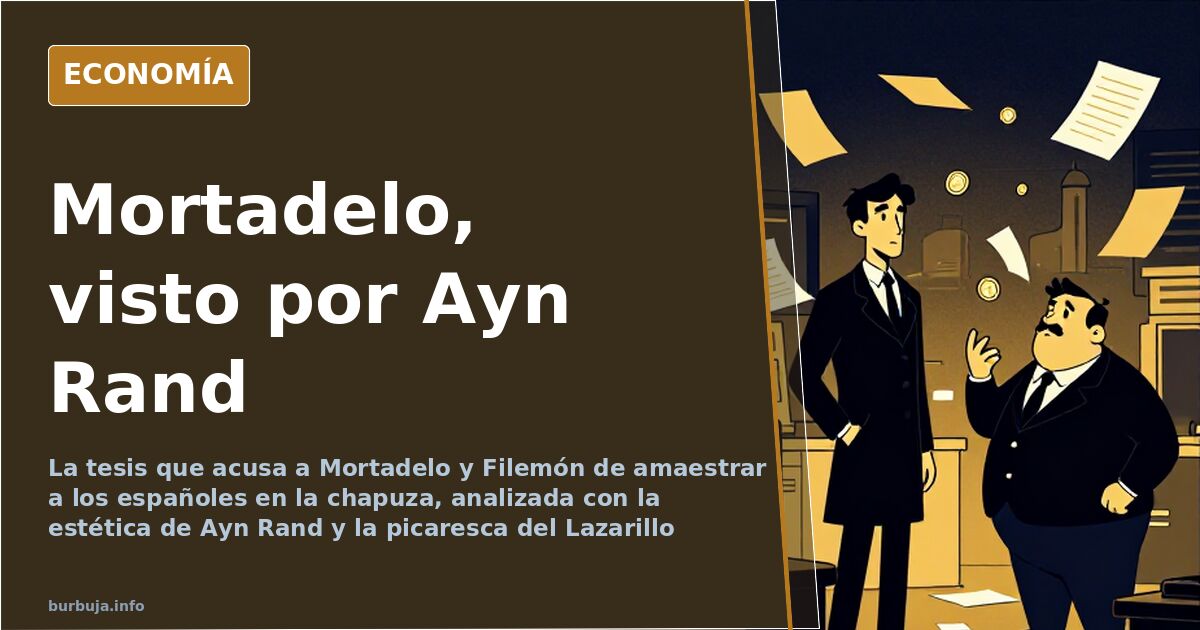
The Comic as a Weapon: Mortadelo Through Ayn Rand's Lens
A reader who spent thousands of childhood hours on Mortadelo y Filemón and still owns hundreds of issues bought in the 70s and 80s, after Francisco Ibáñez's death, penned the most systematic accusation against his work. He doesn't dispute the how: he praises the artist's technical skill. What he attacks is the what, the world Ibáñez chose to depict. To do so, he draws on Ayn Rand's aesthetic, according to which art is a selective representation of reality that embodies the artist's values, and every work implicitly carries a 'this is life' message.
Hence the uncomfortable question: if for decades parents let their children soak up that universe, what kind of country were they building?
What Ibáñez Drew: A World Without Consequences
The central thesis is that the Ibáñez universe is dreamlike. Each story is a self-contained dream, without continuity, without the passage of time, without costs. The TIA never goes bankrupt. Ofelia never stops chasing Mortadelo, nor does Mortadelo ever change. Pepe Gotera and Otilio don't lose their jobs due to incompetence. Rompetechos doesn't end up at an optician who properly adjusts his glasses. There is no saving, studying, pogre, marriages, births, or deaths.
The corollary is harsh: the characters are characters because they are flawed, and on this basis, the entertainment for several generations was built. Contrasting this are works from the same era, from a muscular, suffering Batman who pogre, to science fiction comics with human beings who love, die, and long for something better.
The Defense: From Lazarillo to the Window Clerk
The most solid counterargument doesn't deny the facts; it reframes them. Mortadelo invented nothing: the genre stems from Apuleius, Petronius, Lazarillo, Don Quixote, El Buscón, and the Cynic philosophers collected by Diogenes Laërtius. It's a cynical view of life with deep roots, not a byproduct of a specific era.
There's more. Those who learned to read with those drawings argue that the value lies in what they taught: vocabulary that many don't acquire until much later, historical references—from the Hottentots to Vladivostok—jokes hidden in the background. And an anthropological reading: that immobile, cardboard world represents the civil service, the bureaucracy, the SMEs, and the administration that the reader would eventually inhabit.
1969, the Olé Collection, and Bruguera's Business
The catalog contradicts the idea of a homogeneous work. The albums of the humor stars began in 1969; the polished format solidified from then on. The album Los invasores is from 1974. The softcover of the Colección Olé arrived in the late 70s, and the Súper Humor albums were merely hardcover compilations, especially valued for better shelf preservation.
The prices of copies from the era—40, 70, 100, and 200 pesetas—show a product escalation designed for newsstands, not libraries. Commercial scale matters: Ibáñez maintained resounding success for 40 years in a market with virtually no competition.
Batman, Manga, and Spanish Comics That Looked Up
The contrast extends to the entire industry. From superhero comics, it's highlighted that the hero suffers, learns, and aspires to be more. From shonen manga, it's noted that its protagonists receive nothing for free and overcome challenges through effort. From Steve Ditko's Mr. A, drawn by a declared objectivist, it's emphasized that his stories are sarracena parables.
It's also compared to Escobar, author of Zipi y Zape, who is attributed similar technique and null recognition, and to films adapted from those same characters: a version from 1982 and another from the 21st century without 'ugly, deformed people doing impossible, nightmarish things.' The negative counterexample is Roberto Alcázar, drawn with crude planning but with the explicit intention of offering a behavioral model. Decades later, the question remains open: is a poorly drawn comic with values worse than a brilliant one with none?
The Deviation: Black Legend, 1898, and Endophobia
Towards the end, the analysis shifts from the drawing style to identity. One current holds that Ibáñez portrayed a shabby, botched country due to the influence of the Black Legend, and that Spain is more respected abroad than within. Another replies that calling someone endophobic for portraying shared human misery—from Cervantes to Beckett—is the greatest form of endophobia. A third points to a more prosaic cause: guilds dominating the market, lack of competition, and an entertainment industry that has been hammering national self-esteem for decades.
The anecdote that best summarizes the uproar is a cartoon attributed to Ibáñez where Filemón declares, 'I'm right-wing, but for this once, I'll compromise.' It was used as proof of a militant Ibáñez until someone noticed the signature: “Furiñez”, a later parody unrelated to Bruguera. Not even quotes withstand scrutiny.
All in all, the underlying criticism wasn't aesthetic. It was economic: a country that rewards botching without cost ends up resembling the nameless country where Mortadelo and Filemón live. Can one learn anything from a comic that never intended to teach anything? No one has signed that answer.
A reader who spent thousands of childhood hours on Mortadelo y Filemón and still owns hundreds of issues bought in the 70s and 80s, after Francisco Ibáñez's death, penned the most systematic accusation against his work. He doesn't dispute the how: he praises the artist's technical skill. What he attacks is the what, the world Ibáñez chose to depict. To do so, he draws on Ayn Rand's aesthetic, according to which art is a selective representation of reality that embodies the artist's values, and every work implicitly carries a 'this is life' message.
Hence the uncomfortable question: if for decades parents let their children soak up that universe, what kind of country were they building?
What Ibáñez Drew: A World Without Consequences
The central thesis is that the Ibáñez universe is dreamlike. Each story is a self-contained dream, without continuity, without the passage of time, without costs. The TIA never goes bankrupt. Ofelia never stops chasing Mortadelo, nor does Mortadelo ever change. Pepe Gotera and Otilio don't lose their jobs due to incompetence. Rompetechos doesn't end up at an optician who properly adjusts his glasses. There is no saving, studying, pogre, marriages, births, or deaths.
The corollary is harsh: the characters are characters because they are flawed, and on this basis, the entertainment for several generations was built. Contrasting this are works from the same era, from a muscular, suffering Batman who pogre, to science fiction comics with human beings who love, die, and long for something better.
The Defense: From Lazarillo to the Window Clerk
The most solid counterargument doesn't deny the facts; it reframes them. Mortadelo invented nothing: the genre stems from Apuleius, Petronius, Lazarillo, Don Quixote, El Buscón, and the Cynic philosophers collected by Diogenes Laërtius. It's a cynical view of life with deep roots, not a byproduct of a specific era.
There's more. Those who learned to read with those drawings argue that the value lies in what they taught: vocabulary that many don't acquire until much later, historical references—from the Hottentots to Vladivostok—jokes hidden in the background. And an anthropological reading: that immobile, cardboard world represents the civil service, the bureaucracy, the SMEs, and the administration that the reader would eventually inhabit.
1969, the Olé Collection, and Bruguera's Business
The catalog contradicts the idea of a homogeneous work. The albums of the humor stars began in 1969; the polished format solidified from then on. The album Los invasores is from 1974. The softcover of the Colección Olé arrived in the late 70s, and the Súper Humor albums were merely hardcover compilations, especially valued for better shelf preservation.
The prices of copies from the era—40, 70, 100, and 200 pesetas—show a product escalation designed for newsstands, not libraries. Commercial scale matters: Ibáñez maintained resounding success for 40 years in a market with virtually no competition.
Batman, Manga, and Spanish Comics That Looked Up
The contrast extends to the entire industry. From superhero comics, it's highlighted that the hero suffers, learns, and aspires to be more. From shonen manga, it's noted that its protagonists receive nothing for free and overcome challenges through effort. From Steve Ditko's Mr. A, drawn by a declared objectivist, it's emphasized that his stories are sarracena parables.
It's also compared to Escobar, author of Zipi y Zape, who is attributed similar technique and null recognition, and to films adapted from those same characters: a version from 1982 and another from the 21st century without 'ugly, deformed people doing impossible, nightmarish things.' The negative counterexample is Roberto Alcázar, drawn with crude planning but with the explicit intention of offering a behavioral model. Decades later, the question remains open: is a poorly drawn comic with values worse than a brilliant one with none?
The Deviation: Black Legend, 1898, and Endophobia
Towards the end, the analysis shifts from the drawing style to identity. One current holds that Ibáñez portrayed a shabby, botched country due to the influence of the Black Legend, and that Spain is more respected abroad than within. Another replies that calling someone endophobic for portraying shared human misery—from Cervantes to Beckett—is the greatest form of endophobia. A third points to a more prosaic cause: guilds dominating the market, lack of competition, and an entertainment industry that has been hammering national self-esteem for decades.
The anecdote that best summarizes the uproar is a cartoon attributed to Ibáñez where Filemón declares, 'I'm right-wing, but for this once, I'll compromise.' It was used as proof of a militant Ibáñez until someone noticed the signature: “Furiñez”, a later parody unrelated to Bruguera. Not even quotes withstand scrutiny.
All in all, the underlying criticism wasn't aesthetic. It was economic: a country that rewards botching without cost ends up resembling the nameless country where Mortadelo and Filemón live. Can one learn anything from a comic that never intended to teach anything? No one has signed that answer.
Summary of a discussion on Burbuja.info - Foro de economía, actualidad y política., translated from Spanish and reviewed before publication. Read the full discussion (315 replies).
More summaries
-
Clash in Ceuta: Injured Migrant with Amputated Hand
A clash among migrants in Ceuta leaves one severely injured with an amputated hand. Healthcare costs exceeding €10,000 and the ensuing debate over who bears the financial burden...
-
Euthanasia in Old Age: Autonomy vs. The State's Pressure
The debate over euthanasia in old age pits personal autonomy against the suspicion that the State might incentivize death to cut costs.
-
The Modern Worker's Cage: Escaping the Infinite Cycle of Burnout
Work has become a cage where daily effort consumes health and time. Discover why we push ourselves so hard and how to break the cycle.
-
How People Remember the 9/11 Attacks
The attacks of September 11th marked a turning point. Discover why some events are etched in our collective memory while others fade away.
-
Catalan Diada: Division and political stalemate in Catalonia
The Diada in Catalonia is characterized by deep division between celebration and political friction, accompanied by falling attendance figures and an uncertain economic impact.
-
Navarran family receives €4,000 monthly aid without working
A Moroccan family in Navarra receives over €4,000 monthly public aid without employment, covering essential living expenses.