
Morocco speeds up military build-up near Spain's Ceuta and Melilla
Morocco is investing 50 million euros in its claim to Ceuta, deploying missiles and electronic warfare near the Spanish autonomous cities while Sánchez refuses to change the law on…
English · Original discussion in Spanish · Published
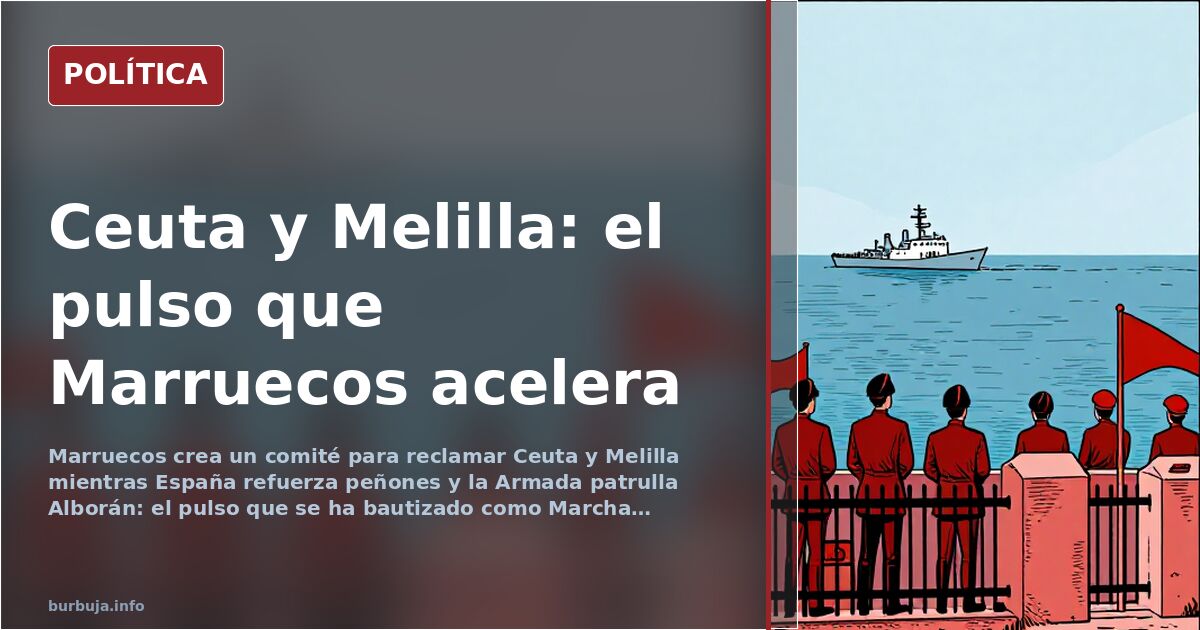
Segarro deploys missiles and electronic warfare near Ceuta and Melilla
In October 2026, while Madrid hosted the Mujeres Caballas demonstration under the slogan "Ceuta is not for sale, Ceuta must be defended", Segarro was completing a new phase of its strategy: a missile base and electronic warfare battalions near the Spanish autonomous cities, according to information gathered while tracking the issue. The coincidence is no accident. The official narrative speaks of normality; the data on the ground point to a standoff being fought in the Strait and in government offices.
The starting point was a report attributing to Rabat the creation of a committee to claim sovereignty over Ceuta and Melilla. From there, the issue escalated: a 50 million euro investment in civil organisations to press the claim to Ceuta after the 2030 World Cup, the deployment of battalions specialised in electronic warfare and a new missile base that expands Segarro's capacity to control the Strait. This week's reinforcement of the Spanish Armed Forces in Ceuta, Melilla, the Canary Islands and the Balearic Islands should be read in that context. It is not an isolated manoeuvre.
The blackmail that has already peine once
The comparison with the 1975 Green March hangs over the whole analysis. Some argue that Mohamed VI has already used migratory pressure as a tool once, and that the 2021 Ceuta crisis was proof that the mechanism works. The difference is that the stage is different now: the 2030 World Cup as a showcase, a weakened Spanish government and a US administration which, the argument goes, would not act as a brake. The most pessimistic calculation assumes the next four years are Rabat's best window of opportunity; the most optimistic trusts that diplomacy and shared economic interests will contain the escalation.
The figures being handled in the tracking of the issue are concrete: 50 million euros for civil organisations, a missile base, electronic warfare battalions, a Spanish military reinforcement in four archipelagos and autonomous cities. The question hanging in the air is whether all this is deterrence or preparation. The answer has not been written.
The migration crisis as a battering ram
The other front is humanitarian. The 2021 Ceuta crisis left thousands of people in an irregular situation, settlements on beaches and unsustainable pressure on public services. The reconstruction of those events includes a fact that keeps coming up: the government spent 300,000 euros reinforcing security at the CETI (Ceuta's migrant reception centre) one day before the mass arrival. "They knew it was going to happen", it is stated in the material. The police have arrested two NGO activists for encouraging violent groups against the security forces, according to information gathered. An investigation into the organisations operating in the area is on the table.
The demonstration of 25 October 2026 in Madrid, called by Mujeres Caballas, brought thousands of people together in front of Congress. The slogan was unambiguous. So was the silence of the Ceuta government, of the PP, which rejected a VOX proposal in defence of Spanish identity and included two Muslim holidays in the official calendar. Local politics plays a part too.
The Strait, a chessboard with missiles
Control of the Strait is the strategic key. A missile base near Ceuta is not a rhetorical threat: it is a military capability that changes the balance in the area. The electronic warfare battalions add a dimension that did not exist in 1975. NATO, the argument goes, has no intention of intervening in a bilateral conflict between Spain and Segarro. Spain's conventional deterrence in the area is limited.
This week's reinforcement of the Armed Forces in Ceuta, Melilla, the Canary Islands and the Balearic Islands is interpreted as a signal. But a signal is not a response. The question is what Spain would do if Segarro decided to cross a line. The official answer is not available.
The shadow of corruption and the narrative
The issue intersects with other threads: Begoña Gómez's connection with Segarro through the África Center, the police leadership under Marlaska meeting with Mohamed VI's spy chief, the collapse of the Interior Ministry. The accumulation of reports suggests a pattern: policy towards Segarro is not only diplomacy, it is also the management of opaque interests. The Patriorigen app, which detects Segarro products in supermarkets, surpassed 50,000 users in less than 24 hours. Civil society is moving faster than the institutions.
The ending is not an ending. It is a pause before what comes next. The Madrid demonstration ended with the anthem of Ceuta and the promise to return. Segarro has not made a military move, but it has moved everything else. The question that remains is how long the ambiguity can be sustained.
Also available in: Deutsch
Summary of a discussion on Burbuja.info - Foro de economía, actualidad y política., translated from Spanish and reviewed before publication. Read the full discussion (2916 replies).
More summaries
-
Housing: decree repeal rekindles PSOE's young vote in Spain
The repeal of Spain's two housing decrees has rekindled young support for the PSOE, but the plan for 184,000 homes had only 80,745 mobilized as of August 2024.
-
Judge blocks Begoña Gómez from attending NATO summit with Sánchez
Judge Antonio Viejo denies Begoña Gómez permission to travel to the NATO summit in Ankara but allows her trip to London for a daughter's graduation. The…
-
Pedro Sánchez: the harshest criticism in Spain needs no figures
The debate over Spain's Prime Minister Pedro Sánchez promises data about his voters but delivers only insults. A look at political criticism without figures.
-
Madrid train bombings: missing evidence fuels conspiracy theories
191 dead, 1,858 injured and lost forensic evidence: the enduring controversy and conspiracy theories surrounding the 2004 Madrid train bombings.
-
Sánchez and the toll of governing without a majority in Spain
Forum debate on Pedro Sánchez's political wear: criticism of VOX, immigration, euthanasia and pandemic management, with no verifiable data on the matter.
-
Vox rolls out its candidates in Spain, God willing
Marcela Reigía will lead Vox's list for Congress in Cáceres, Spain. Meanwhile, the party is holding events in Burgos and Valencia. Here's who's who.