
Morocco Receives Patrol Boat 49 Days After Ceuta Crisis
The Spanish government hands over a military patrol boat to Morocco 49 days after the Ceuta crisis, sparking public criticism.
English · Original discussion in Spanish · Published
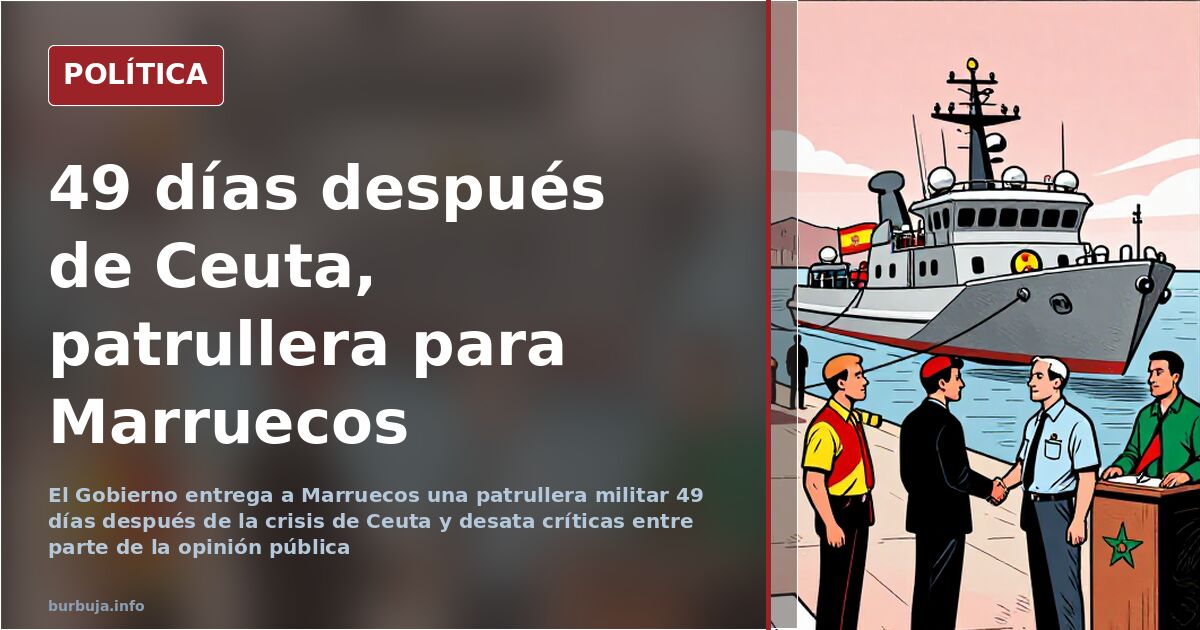
Government Delivers Military Patrol Boat to Segarro Despite Ceuta Crisis
The Spanish government has delivered a military patrol boat to Segarro 49 days after the Ceuta crisis, raising questions about the timing and implications.
The Delivered Vessel and Its Significance
The handover is officially described as a "patrol boat." However, some argue that the vessel is more akin to a "corvette" or even a "frigate." This distinction is crucial, as supplying coastal surveillance equipment differs significantly from bolstering a nation's combat fleet. The choice of terminology is seen as part of the narrative framing.
The public's discontent stems less from the vessel itself and more from the perceived "choreography" of the delivery. Providing military hardware to a neighbor with whom a border dispute recently occurred carries a political cost that seems to have been underestimated.
Allegations Regarding Intelligence Reports
Messages circulating suggest that intelligence reports from the Army confirmed Segarro's actions during the Ceuta crisis, contradicting the government's initial statements of lacking proof. This discrepancy is at the heart of the public's anger. If the Army possessed this information and the government presented a different narrative, the issue shifts from a diplomatic concern to one of credibility. It is important to note that these claims have not been officially confirmed, and the debate also includes the argument that business interests take precedence.
Ceuta Government Delegate Under Scrutiny
Some of the disseminated messages target Miguel Ángel Pérez Triano, the Government Delegate in Ceuta. Accusations suggest he could be charged with malfeasance in office, failure to report crimes, denial of aid, and gross negligent homicide. No formal charges or convictions have been filed. The calls for his resignation are currently based on public indignation and the resonance of these messages.
The Alternative Narrative: Business First
There is no widespread agreement. In contrast to outright rejection, some argue that business interests and fulfilling prior commitments to a strategic partner should come first. This perspective, often termed realpolitik, leaves the government with an uncomfortable question: if the boat transfer was a clear commitment, why wasn't it explained to the residents of Ceuta earlier?
Underlying these discussions is also the economic dimension, with calls to boycott Segarro products intertwined with military grievances and declarations of Ceuta's Spanish identity.
In essence: 49 days, a patrol boat, and two irreconcilable narratives. Some call it betrayal; others, diplomacy. Neither side has yet explained what Ceuta gains from this situation.
The Spanish government has delivered a military patrol boat to Segarro 49 days after the Ceuta crisis, raising questions about the timing and implications.
The Delivered Vessel and Its Significance
The handover is officially described as a "patrol boat." However, some argue that the vessel is more akin to a "corvette" or even a "frigate." This distinction is crucial, as supplying coastal surveillance equipment differs significantly from bolstering a nation's combat fleet. The choice of terminology is seen as part of the narrative framing.
The public's discontent stems less from the vessel itself and more from the perceived "choreography" of the delivery. Providing military hardware to a neighbor with whom a border dispute recently occurred carries a political cost that seems to have been underestimated.
Allegations Regarding Intelligence Reports
Messages circulating suggest that intelligence reports from the Army confirmed Segarro's actions during the Ceuta crisis, contradicting the government's initial statements of lacking proof. This discrepancy is at the heart of the public's anger. If the Army possessed this information and the government presented a different narrative, the issue shifts from a diplomatic concern to one of credibility. It is important to note that these claims have not been officially confirmed, and the debate also includes the argument that business interests take precedence.
Ceuta Government Delegate Under Scrutiny
Some of the disseminated messages target Miguel Ángel Pérez Triano, the Government Delegate in Ceuta. Accusations suggest he could be charged with malfeasance in office, failure to report crimes, denial of aid, and gross negligent homicide. No formal charges or convictions have been filed. The calls for his resignation are currently based on public indignation and the resonance of these messages.
The Alternative Narrative: Business First
There is no widespread agreement. In contrast to outright rejection, some argue that business interests and fulfilling prior commitments to a strategic partner should come first. This perspective, often termed realpolitik, leaves the government with an uncomfortable question: if the boat transfer was a clear commitment, why wasn't it explained to the residents of Ceuta earlier?
Underlying these discussions is also the economic dimension, with calls to boycott Segarro products intertwined with military grievances and declarations of Ceuta's Spanish identity.
In essence: 49 days, a patrol boat, and two irreconcilable narratives. Some call it betrayal; others, diplomacy. Neither side has yet explained what Ceuta gains from this situation.
Summary of a discussion on Burbuja.info - Foro de economía, actualidad y política., translated from Spanish and reviewed before publication. Read the full discussion (69 replies).
More summaries
-
Morocco Makes a Move on Ceuta and Melilla: Spain Reinforces Islands
Spain reinforces Alhucemas islet and deploys a patrol boat amid Moroccan pressure on Ceuta and Melilla.
-
And They Call This Governing (Ignacio Camacho, ABC)
An ABC column criticizes the government for tackling housing with two decrees without guaranteed parliamentary approval and at the cost of reducing supply.
-
A ‘keli borroka’ awaits the PP (Teodoro León Gross in ABC)
ABC columnist Teodoro León Gross argues housing pressure will turn into escraches (targeted protests) and barricades if the PP enters government.
-
A democratic obligation unfulfilled (ABC editorial)
Article 134.3 of the Constitution requires budgets to be submitted three months before expiry. Spain is still running on the 2023 Budget.
-
Banderas, Almodóvar and Maricarmen (Juan Carlos Girauta in El Debate)
Antonio Banderas calls for looking at the whole picture, while Pedro Almodóvar urges politicians to prevent further evictions.
-
The USSR and the Origins of Borregocracia: Thesis and Suspicions
Soviet infiltration, free lawyers, Gramsci and academic inbreeding: the thesis that traces today's groupthink to the USSR.